
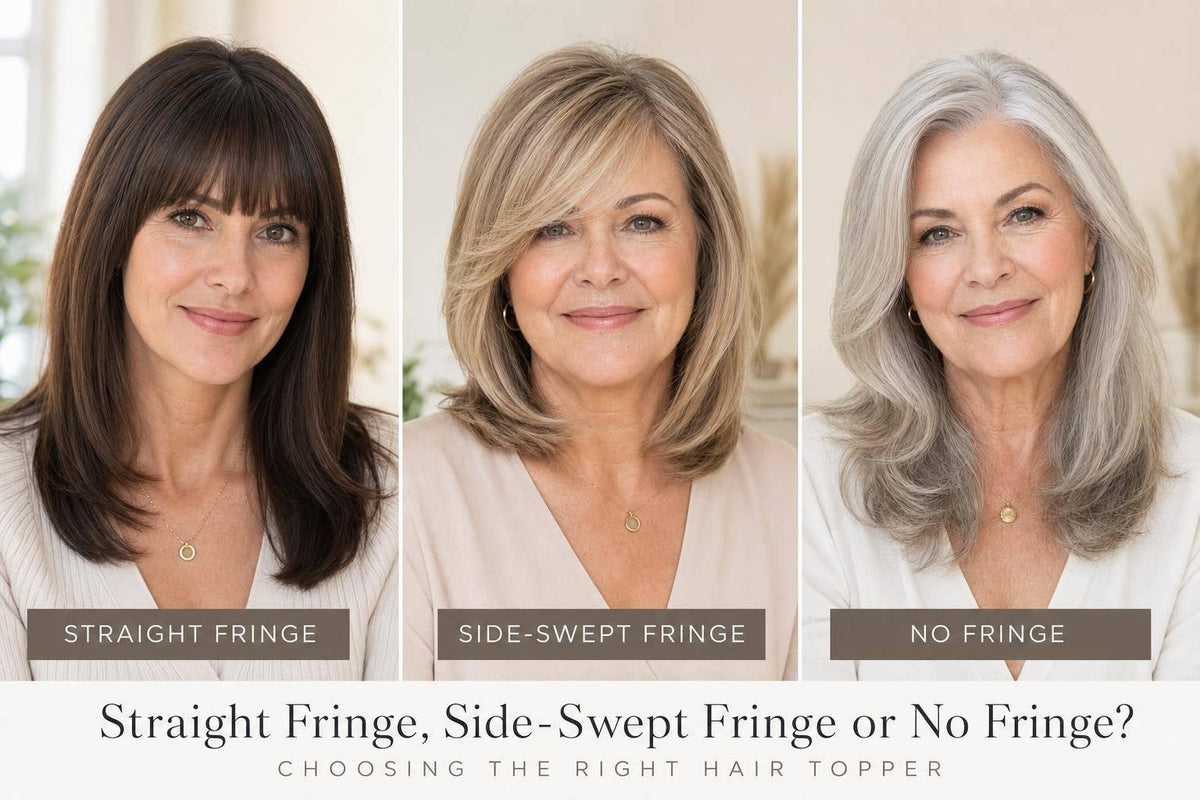
If you want a side fringe, don’t buy a short straight fringe and hope it will sit sideways. That’s the main point.
I’d break it down like this:
- Straight fringe: best if I want strong front coverage and a fringe that sits straight down
- Side-swept fringe: best if I want the hair to fall across my forehead on an angle
- No fringe: best if I want to show my own front hairline and change my part more easily
This choice affects coverage, parting, blending, and how much styling time I’ll need each day. A short blunt fringe often stops around brow level, while a side fringe usually needs more length around eye, cheekbone, or nose level so it can lie across the face without leaving gaps.
The short version: if front thinning is my main issue, a straight fringe may help most. If I want a softer side look, I need a topper cut for that from the start. If my front hairline still looks good and I mostly need help at the crown or part line, no fringe often makes more sense.
Quick Comparison
| Style | Front coverage | Parting | Side styling | Best match |
|---|---|---|---|---|
| Straight fringe | High | None | Hard | High hairline, front thinning |
| Side-swept fringe | Medium | Limited | Easy | Temple or frontal thinning |
| No fringe | Low at the front | High | Good | Crown thinning, part-line thinning |
So before I order, I’d match the topper to the look I want to wear most days - not the look I hope I can force it into later.
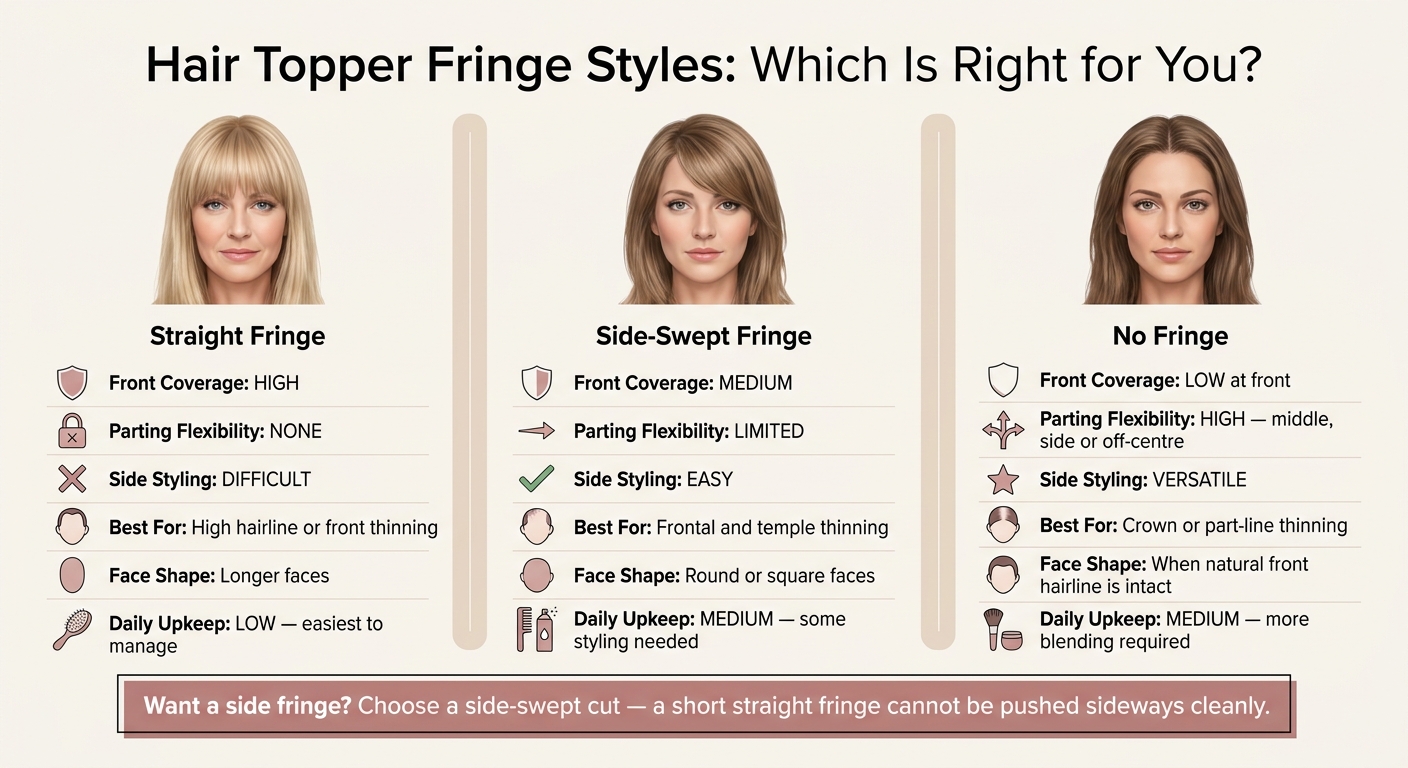
Hair Topper Fringe Styles Compared: Straight vs Side-Swept vs No Fringe
2. Straight Fringe, Side-Swept Fringe or No Fringe: How Each Style Looks and Behaves
2.1 Straight fringe toppers: full front coverage with limited side movement
A straight fringe topper sits in a blunt line across the forehead. It gives the strongest coverage at the front, which makes it a good pick for a receding hairline or thinning through the front.
Because the front pieces are cut to fall forward, they usually don't stay swept to the side for long. That's the key difference here: a true side fringe is cut to move on an angle, while a forward fringe is simply being pushed across.
2.2 Side-swept and no-fringe toppers: more freedom for angled styling
Change the cut, and the styling options change with it.
A side-swept fringe topper has longer, angled front sections that fall diagonally across the forehead. The look is softer and frames the face, while sitting more naturally to one side.
No-fringe toppers don't have a fixed fringe line, so the front can be worn with a middle part, an off-centre part or a deep side part. A silk or 3D base helps the parting look scalp-like [1].
Here's a simple side-by-side comparison of the three styles:
| Feature | Straight Fringe | Side-Swept Fringe | No Fringe |
|---|---|---|---|
| Hairline coverage | Full - hides the front hairline | Partial - angled concealment | Minimal - relies on blending |
| Parting flexibility | None - hair falls forward | Limited - fixed to one side | High - middle, side or off-centre |
| Ease of side styling | Difficult - pieces are too short | Easy - pre-cut for diagonal flow | Versatile - can be pinned or tucked |
| Usually suits | Receding or high front hairline | Frontal and temple thinning | Crown thinning or general volume |
That cut length is exactly why a side fringe needs more than a simple side part.
3. Why a Side Fringe Needs Length, Not a Short Straight Fringe
3.1 What happens when a short blunt fringe is pushed sideways
A short blunt fringe is cut to fall forward, not to the side. That sounds like a small detail, but it changes everything if you want to sweep the front across your forehead.
Because it’s cut in a blunt, straight line, it’s made to sit flat and drop straight down. Push that same fringe sideways and you run into a simple problem: there isn’t enough length for it to drape on an angle. So instead of lying neatly across the forehead, it may slip back to the centre, sit unevenly around brow level, or leave a gap near the temple. And that gap can show the topper base or your natural hairline [3].
3.2 What to look for if you want a true side fringe
A true side fringe needs side movement built into the cut from the start.
That usually means front layers with more length - around eye, cheekbone, or nose level instead of stopping at the brow. With that extra drop, the hair has enough room to sweep across the forehead without coming up short on one side [3].
The shape of the cut matters as well. Side-swept styles tend to use soft texture through the ends, which takes out bulk and helps the hair fall on a diagonal instead of sitting in a stiff line [3]. So if you’re comparing toppers, pay attention to the front design. A topper with face-framing layers, a graduated cut, or a front that can be parted is far more likely to give you a natural side-fringe look than one with a full blunt fringe [3].
| Feature | Short Straight Fringe Topper | Side-Swept / No-Fringe Topper |
|---|---|---|
| Front length | Brow level or shorter [3] | Eye, cheekbone or nose level, or longer [3] |
| Cutting style | Blunt, horizontal lines; heavier density [3] | Point-cut, tapered or graduated ends [3] |
| Movement | Limited; designed to sit flat at the front [3] | Fluid; designed for diagonal drape and flow [3] |
| Styling options | Best worn straight down [3] | Can be swept, tucked or side-parted [3] |
| Side-fringe result | Low - tends to look uneven if pushed aside [3] | High - drapes naturally and blends better [3] |
If you’re unsure, use a colour and style match before ordering.
Once the front length is right, the next step is matching the shape to your hairline and the way you normally part your hair.
sbb-itb-08feb2f
4. How to Choose the Right Topper for Your Face Shape, Hairline and Daily Routine
4.1 Which front style suits your face shape and hairline
Once you’ve settled on the front cut, the next step is matching it to your face shape and hairline.
A straight fringe can make a longer face look a bit shorter, and it tends to suit a high hairline or thinning at the front [1].
A side-swept fringe is a good match if your features are rounder or more square, as it helps soften the overall look.
No-fringe toppers tend to work best when your natural front hairline is still in good shape. If thinning is mostly around the part line or crown, this option lets your own hair stay visible at the front while the topper adds volume and coverage where you need it most [2].
4.2 Which front style suits your parting habits and daily upkeep
Your morning styling routine matters just as much as your face shape.
A straight-fringe topper is usually the easiest to manage day to day. The fringe already sits at the front, so you don’t need to blend the hairline or think about where to part it [1]. If you like wearing the front swept to the side, this style may not suit you. A short straight fringe often won’t stay pushed aside, so a longer side-swept or no-fringe option is usually a better fit [1].
A side-swept or no-fringe topper gives you more room to move with styling. You can wear a centre part or an off-centre part, and the front tends to fall in a more natural diagonal shape [1]. The trade-off is simple: more styling freedom often means a bit more time getting the hair to sit the way you want.
Use your styling habits and parting preference to narrow things down:
| Front Style | When it works best | Hairline Suitability |
|---|---|---|
| Straight fringe | Longer faces | High hairline or front thinning |
| Side-swept fringe | Round or square faces | Frontal and temple thinning |
| No fringe | When you want to keep your natural hairline visible | Strong natural front hairline; part line or crown thinning |
If you’re ordering online, fitting tools can help you narrow your options before you buy.
4.3 How Silkara Hair helps you choose before ordering
Silkara Hair offers a free photo-based colour match and an AI virtual try-on for selected products, which helps cut down the guesswork before ordering [1]. You can also get pre-purchase help with colour, density, length and front style, so the choice feels a lot less hit-and-miss [1]. And if the colour isn’t quite right when it arrives, there’s a 14-day colour exchange guarantee for extra peace of mind [1].
5. Key Takeaway: Match the Front Style to the Look You Actually Want
Once you compare coverage, movement, and parting, the choice usually comes down to the front cut. That detail shapes how much coverage you get and how the topper sits at the front.
A straight fringe topper works best if you want a fringe that sits straight across the forehead. It gives full front coverage and sits forward. It is not cut to sweep to the side. If you want that side-swept look, you need the right cut from the start. You can’t take a short straight fringe and expect it to fall neatly across on an angle.
Here’s the simple breakdown:
- Straight fringe - full front coverage, sits forward, with no side movement.
- Side-swept fringe - needs extra length so the fringe can fall diagonally.
- No fringe - gives you an open front and more flexible parting, while keeping your natural hairline visible and adding volume behind it.
If you want a side fringe, go for a longer side-swept cut. Don’t order a short straight fringe and hope it will sweep cleanly across. That’s the simplest way to match the topper to the look you actually want.
FAQs
Can a straight fringe topper be trimmed into a side fringe?
Yes. A straight fringe topper can be trimmed and reshaped into a side-swept style.
For the best result, have a stylist trim it while you’re wearing the secured topper so it blends in smoothly. If you’re trimming it at home, take off only 2 to 3 millimetres at a time and use vertical point-cutting snips to get a soft, natural edge.
How do I know if a no-fringe topper will blend with my hairline?
Check whether your front hairline has enough density to cover the attachment seam. A no-fringe topper is meant to blend with your own hair, not take its place.
For the most natural look, place the base 1 to 5 cm behind your natural hairline. Then brush a thin layer of your own hair over the front edge. A light-density topper can help stop the front from looking harsh or obvious.
Which topper style needs the least daily styling?
Side-swept or curtain bangs are usually easier to manage day to day than straight-across blunt bangs.
Blunt bangs give you a bold, modern look. But they often need more frequent trims to keep their shape.
A high-quality human hair topper also gives you flexible styling. You can customise it or heat-style it with minimal day-to-day effort.