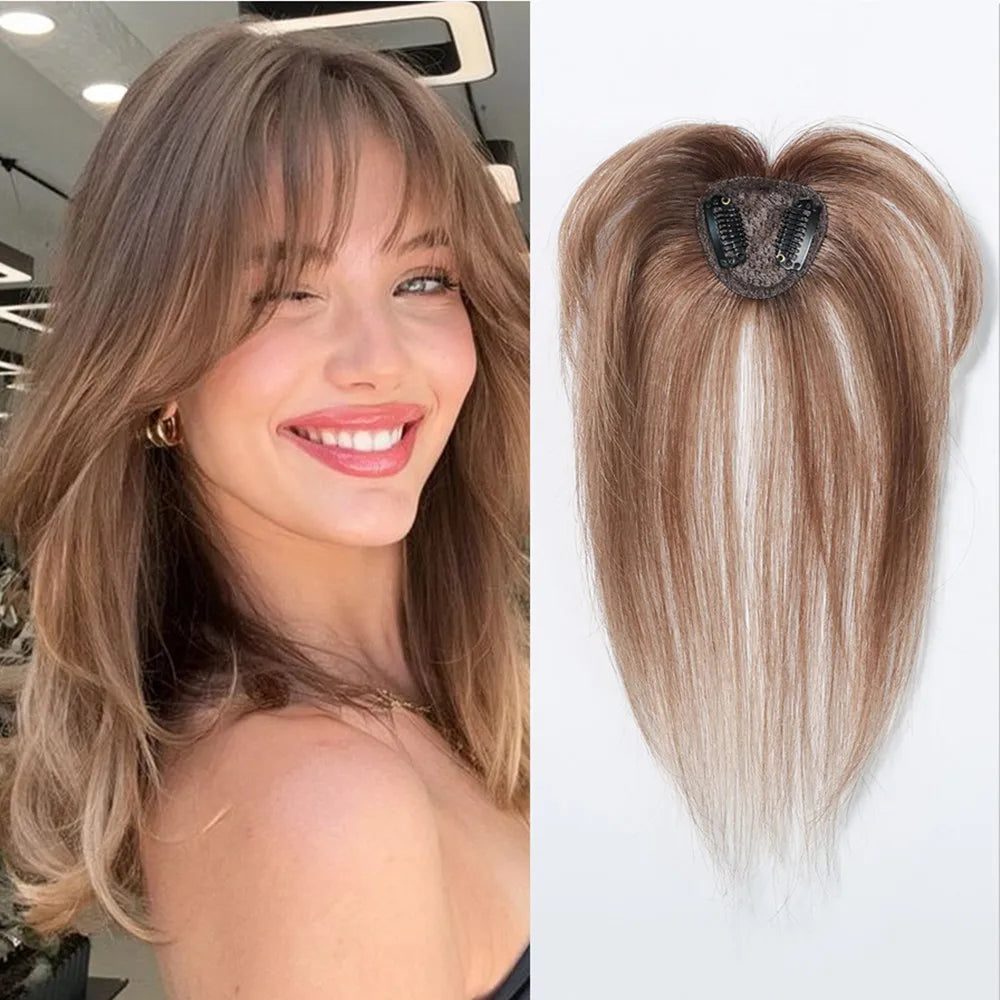

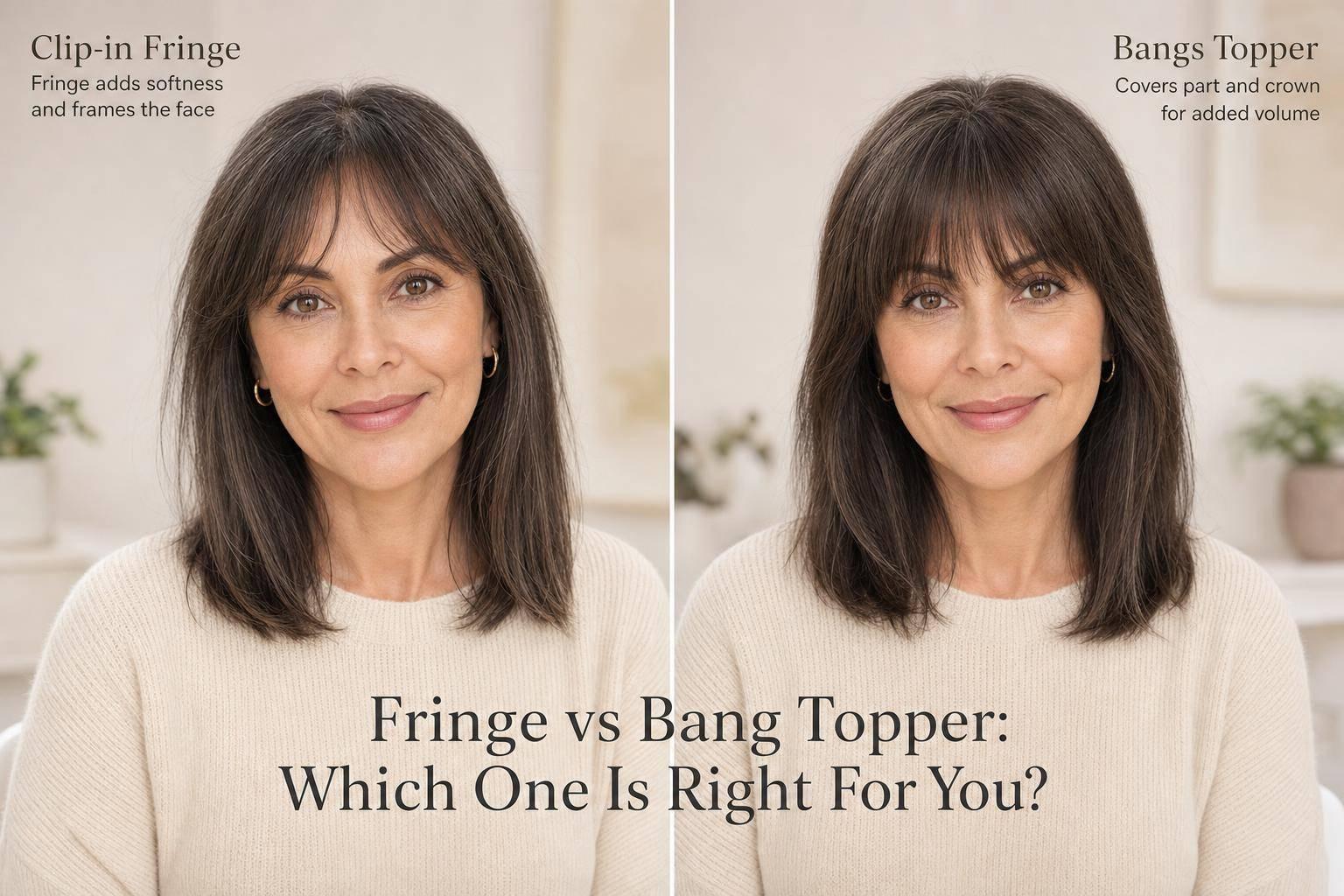
If your thinning is only at the front, I’d go with a clip-in fringe. If you can see scalp at the part or crown, I’d pick a bangs topper. That’s the short answer.
Here’s the simple split:
- Clip-in fringe: covers the front hairline only
- Bangs topper: covers the front, part, and crown
- Fringe: lighter, faster to put on, but needs enough hair at the front to hide clips
- Topper: gives more coverage and top volume, but can feel a bit heavier
- Human hair often lasts about 12 to 18 months
- Synthetic often lasts about 3 to 6 months
- Synthetic pieces may handle only low heat, around 85°C
If I were choosing, I’d base it on where the thinning shows now, not what might happen later. That one check usually makes the choice much easier.
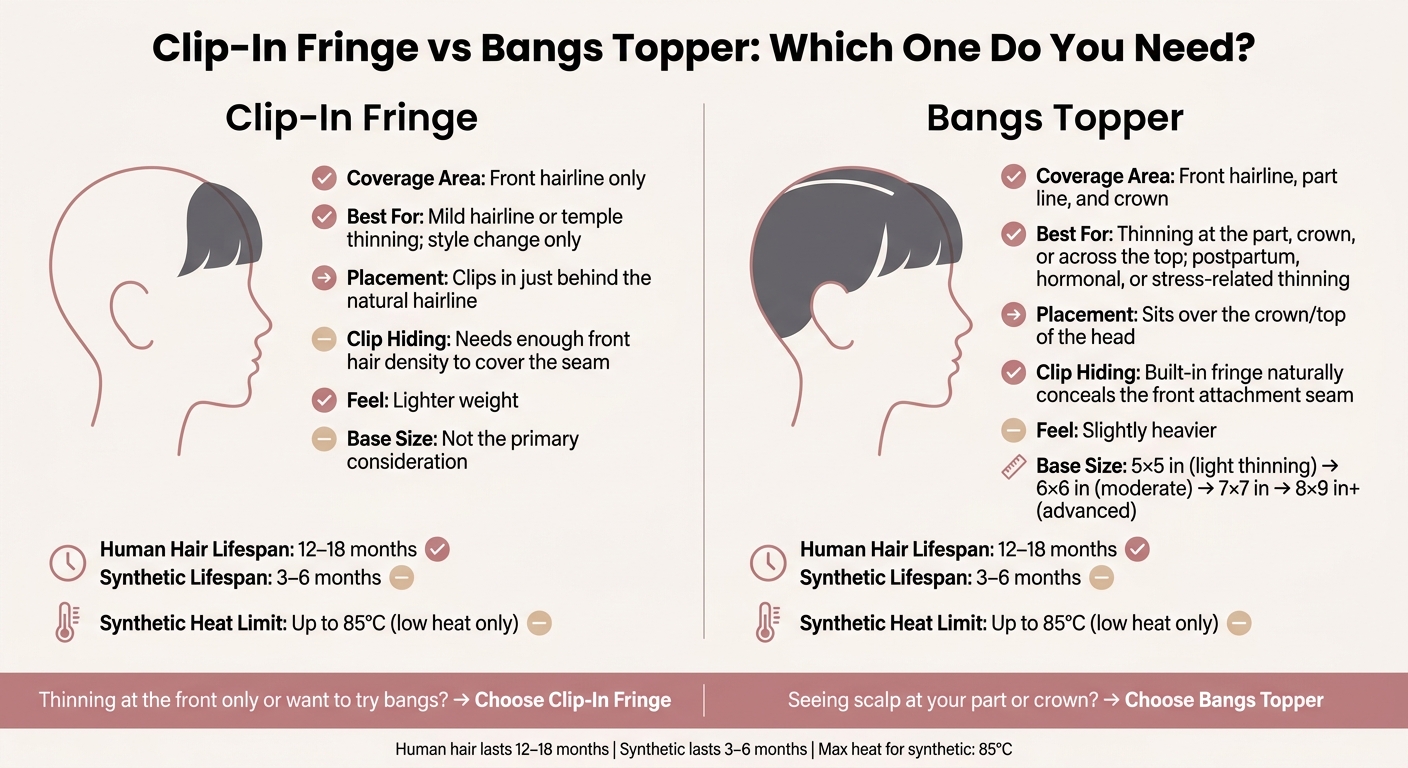
Clip-In Fringe vs Bangs Topper: Which One Do You Need?
Fringe Bang Hair Topper Tutorial! #hairtransformation #thinninghair #hairpiece #hairtopper #tutorial
sbb-itb-08feb2f
Quick Comparison
| Point | Clip-in Fringe | Bangs Topper |
|---|---|---|
| Coverage | Front only | Front, part, and crown |
| Best for | Mild hairline or temple thinning, or trying bangs | Thinning across the top of the head |
| Placement | Behind the front hairline | Over the crown/top |
| Clip hiding | Needs front density to cover the seam | Built-in fringe helps hide the front edge |
| Feel | Lighter | Slightly heavier |
| Base sizing | Not the main issue | Often starts at 5 x 5 in for light thinning |
I see this as a coverage-first choice. Style matters, but placement matters more. If you match the piece to the thinning pattern, it tends to look better and feel easier to wear day to day.
Clip-in fringe vs bangs topper: key differences
The main gap between these two comes down to where the piece sits and how much it covers. If coverage matters most to you, placement is the next thing to check.
Coverage area and where each piece sits on the head
A clip-in fringe clips in just behind your hairline and covers only the front. It frames the face and tends to work best if you still have enough density at the front to clip it in and blend your own hair over the clips.
A bangs topper sits farther back on the crown. It covers the front, the part, and the crown area. Topper bases often start at around 5 x 5 inches for light thinning, and they can go larger if you need more coverage [4].
| Feature | Clip-in Fringe | Bangs Topper |
|---|---|---|
| Primary coverage | Front hairline only | Top, crown, and front hairline |
| Best for | Mild hairline thinning or a style change | Thinning at the part, crown, or front |
| Clip-in point | Just behind the natural hairline | Crown/top of the head |
| Blending needs | Needs enough front density to hide the clips | The fringe helps hide the clips |
| Styling flexibility | Face-framing only | Adds volume and density across the top |
Daily wear, feel and comfort
A clip-in fringe usually feels lighter and takes less time to put on. A bangs topper can feel a bit heavier, but it gives you more coverage in return. In warm Australian weather, mono or lace bases can feel cooler and more breathable [3][4].
Both are non-permanent clip-in pieces. If you choose a human hair version, you can usually heat-style it with straighteners or curling irons.
Once you know how each one sits and feels, the next step is to match the piece to your thinning pattern.
When a clip-in fringe is the right choice
A clip-in fringe works best for front-only thinning and for anyone who wants a simple bangs change. If the issue is just at the front, this is usually the easiest fix.
Good for mild hairline thinning and trying out bangs
When thinning is limited to the front hairline - like a higher forehead, mild temple recession, or slight thinning at the front - a clip-in fringe can cover it fast and in a way that looks natural. It’s also the lowest-commitment way to try bangs. There’s no haircut, and no awkward grow-out stage to deal with.
Once thinning starts reaching the part or crown, a topper tends to make more sense.
Benefits and limits for fine hair
Clip-in fringes are lightweight and fast to put on - often in seconds. That makes them handy before work, dinner, or an event, especially when you don’t want extra bulk.
The catch for fine hair is simple: the clips need enough hair to hold onto. If your hair is very fine at the front, lightly backcomb the roots where the clips will attach before clipping it in [3]. You’ll also need enough of your own hair to brush over the seam so the join stays hidden. If that front density isn’t there, the clips can be harder to disguise.
If your thinning goes past the hairline, the next section looks at when a bangs topper is the better fit.
When a bangs topper is the right choice
A bangs topper does more than change your front hairline. Unlike a clip-in fringe, it gives you built-in coverage across the front hairline, part line, and crown in one piece [3][4].
That matters if scalp show-through is starting to stand out under overhead lighting, or if your part has shifted from a fine line to a visible gap. In those cases, a topper is often the better match [3].
Good for thinning at the part, crown and front
A bangs topper makes more sense when thinning goes past the front hairline. It's a strong option for female pattern hair loss (androgenetic alopecia), postpartum shedding, hormonal thinning, and stress-induced thinning [3][4].
Another plus: the built-in fringe helps hide the front attachment point or seam. That's often harder to do with a standard topper [4].
Here’s a quick side-by-side look:
| Concern | Bangs Topper | Clip-In Fringe |
|---|---|---|
| Thinning at the crown or part | ✓ Best fit | Not enough coverage |
| Visible scalp under overhead light | ✓ Best fit | Won't reach the area |
| Postpartum, hormonal or stress-related thinning | ✓ Best fit | May be insufficient |
| Healthy crown, style change only | Often more coverage than needed | ✓ Best fit |
| Front hairline only, mild thinning | Works, but may be excess | ✓ Best fit |
Choosing base size, density and human hair options
Base size is the main thing to get right. Measure the thinning area by length and width, then add 1 to 2 inches to each side so the clips can grip strong, healthy hair [3].
As a rough guide:
- A 5x5 to 6x6 inch base suits early or light thinning
- A 7x7 inch base suits moderate thinning
- An 8x9 inch base or larger is better for advanced or more spread-out thinning [4]
For the most natural look, human hair is usually the better pick than synthetic. You can heat-style it, match it to your regrowth more closely, and it tends to last longer with proper care - about 12 to 18 months, compared with 3 to 6 months for synthetic pieces [3][4].
Base construction also changes how the topper looks and feels. A silk base gives the most realistic scalp look at the part, while a mono top gives you more breathability and longer wear for day-to-day use [3][4].
For the best finish, have a professional stylist trim the built-in bangs only after the topper has been placed and secured on your head [4].
When you're colour matching, look at your mid-lengths instead of your roots. Most toppers come in one continuous shade, and your mid-lengths tend to be the steadiest point of reference [3].
"This hair topper is magic! I'm in love! It matches perfectly to my own hair colour. You can't even tell I'm wearing it." - Teresa Green, Verified Customer, Silkara Hair [2]
How to decide and wear your choice with confidence
Once you’ve matched the coverage you need and the base that suits your hair, the last step is simple: think about how it’ll work in day-to-day wear.
A simple decision guide based on your hair concern
Start with where the thinning shows.
If it’s mostly at the front hairline or temples, or you just want a style change, a clip-in fringe is usually the better pick. If you can see more scalp at the part or crown, a bangs topper makes more sense.
The key is to choose for the hair loss you have now, not what you might need later.
If you’re unsure about shade, use photo-based colour matching to help narrow it down.
Application, blending and key takeaways
Once you’ve picked the right level of coverage, placement matters. A good match can still look off if it’s not sitting in the right spot.
For a clip-in fringe, clip it in behind your natural hairline so the seam stays hidden. Lightly backcomb the roots, then brush a thin layer of your own hair over the seam to keep the join out of sight [1].
For a bangs topper, place it over the crown and clip it flat from front to back so the part looks natural [4]. If the hair underneath is fine, use a light volumising spray at the roots before placing it. That helps the clips grip better [4].
Synthetic pieces can be styled with low heat, up to about 85°C [1][5].
So the rule of thumb is pretty clear:
- Front-only thinning usually points to a clip-in fringe
- Part or crown thinning usually points to a bangs topper
FAQs
How do I know if my thinning is front-only?
Style your natural hair first so the sparse spots are easy to see. That gives you a clear view of where the thinning sits. If it’s mostly around the hairline and temples, you’re probably dealing with front-only thinning.
You might see a receding hairline or thinner hair just behind it, while the crown and back still look fairly dense. In that case, a topper with bangs or a clip-in fringe can help cover those front areas and blend in with your natural hair.
Will a bangs topper look bulky on fine hair?
No. A well-fitted bangs topper shouldn't look bulky on fine hair. Silkara Hair makes these pieces to feel light, breathable, and easy to blend with your own hair.
For the most natural look, pick a base that lies flat against your scalp. A softer fringe style, like wispy bangs, also helps keep the finish light and airy.
How do I choose the right topper base size?
Measure the exact area of your crown or thinning hair first. Topper bases usually range from 10 cm x 13 cm for focused crown or part-line coverage up to 20 cm x 25 cm for more broad coverage.
Pick a base that's slightly larger than the thinning area. That extra room gives the clips enough space to grip healthy, dense hair and stay secure.
As a general guide:
- Circular bases tend to work best for crown coverage
- Rectangular or teardrop shapes often suit a widening part line