
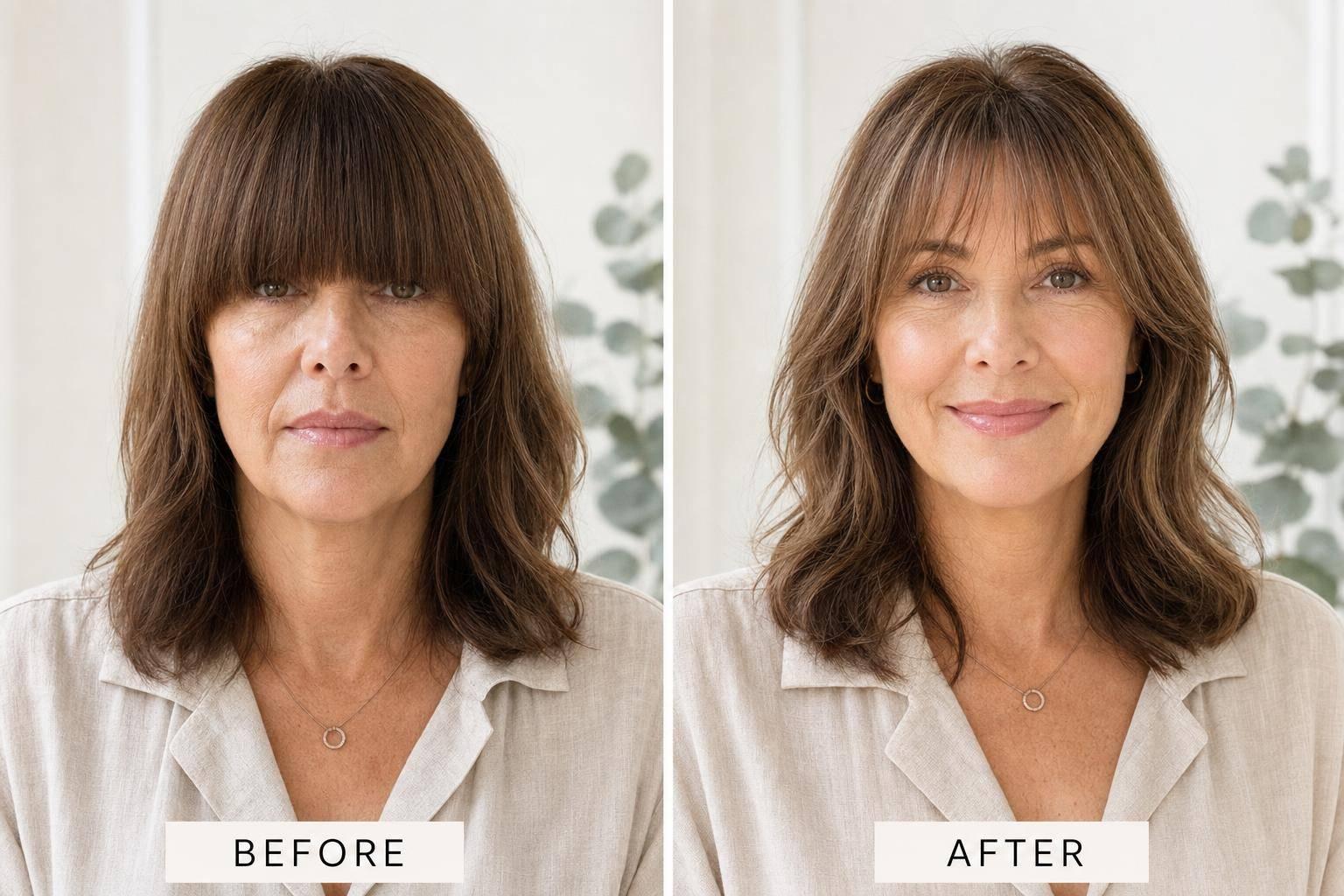
If my fringe looks too thick, I usually need to fix one of three things: the cut, the styling, or the hairpiece density. Most heavy fringes come from a blunt line, too much hair taken from the front, oil or product making strands stick together, or a clip-in piece that looks denser than the rest of the hair.
Here’s the short version:
- If it looks blocky: the cut is likely too blunt or too wide.
- If it looks stringy by the end of the day: oil or product is likely the issue.
- If it looks heavy next to fine hair: the fringe piece may be too dense.
- If I want to fix it at home: I make small changes first, like light point-cutting on dry hair, side-to-side blow-drying, and using less product.
- If it goes patchy or too short: I stop and book a hairdresser.
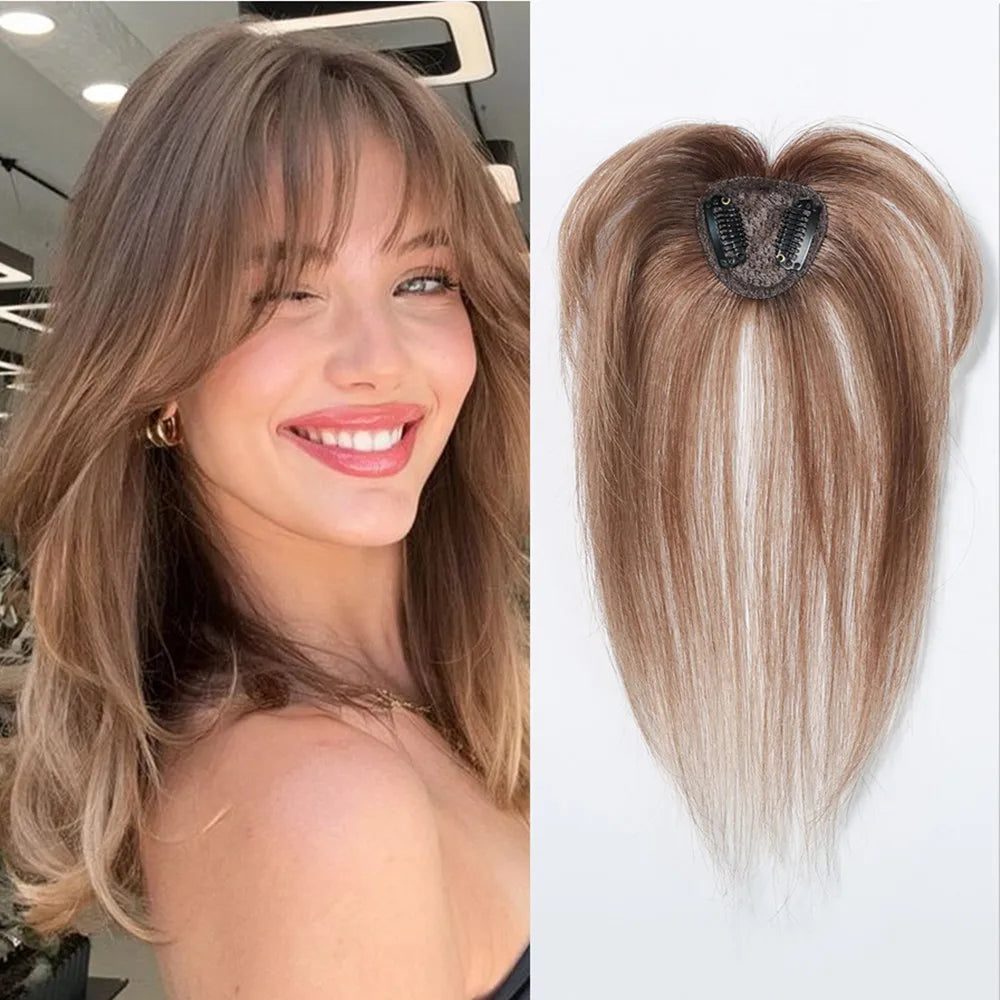
- If I want a non-permanent fix: I choose a low-density wispy fringe or a hair topper with bangs.
A few facts stand out. The article suggests trimming a fringe every 3–4 weeks to keep it light, and keeping scissors 2.5–5 cm away from the scalp when softening the ends at home. It also notes that fine hair shows oil and density mismatch faster, which is why a heavy fringe often stands out more on finer strands.
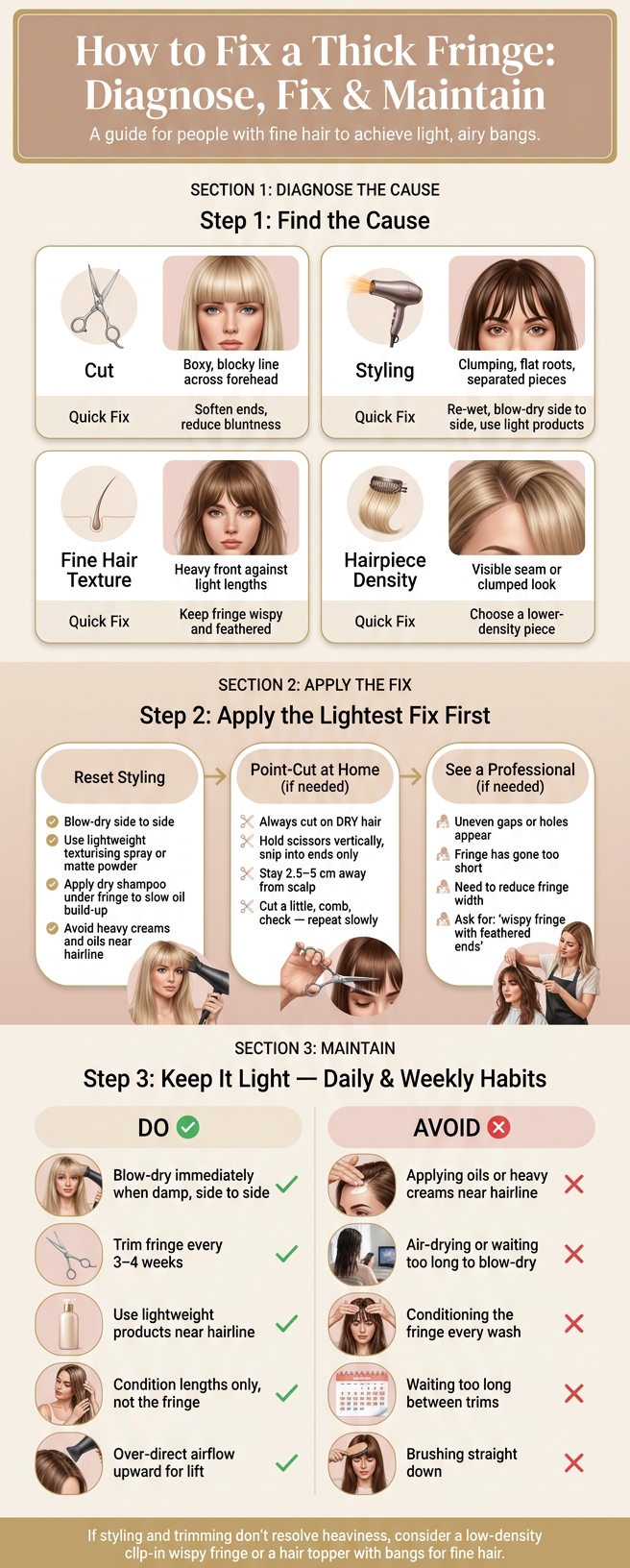
How to Fix a Thick Fringe: Diagnose, Fix & Maintain
Removing weight from a heavy fringe
sbb-itb-08feb2f
Quick comparison
| Cause | What I notice | What usually helps |
|---|---|---|
| Cut | Thick, boxy line across the forehead | Soften the ends, reduce bluntness |
| Styling | Clumping, flat roots, separated pieces | Re-wet, blow-dry side to side, use light products |
| Fine hair | Heavy front against light lengths | Keep the fringe wispy and feathered |
| Hairpiece | Visible join or too much hair at the front | Pick a lower-density piece |
The main point: I start with the cause, use the lightest fix first, and avoid taking off too much hair too fast.
Find out why your fringe looks heavy
Start by working out where the weight is coming from: the cut, the styling, or the hairpiece.
A blunt or wide cut can create a blocky look
A blunt cut, or a fringe section taken too far back, can make the fringe sit like one solid block [1][7].
If the fringe starts too far back, it can also flatten the crown and make the whole style look heavier [7].
Fine hair makes a dense fringe stand out more
With fine hair, weight, clumping, and density mismatch tend to show up faster than they do on thicker hair. If your fringe looks good right after styling but starts to clump later, oils or product are usually behind it [2][3].
A simple test helps here: mist the fringe with water, then blow-dry it from side to side. If it looks lighter after that, the issue is styling rather than the cut [3].
Hairpieces can look too dense if not matched to your hair type
A hairpiece that's denser than your own hair can create a visible line instead of blending in [5][10]. On fine hair, a wispy or tapered fringe usually sits better, especially with lighter ends and feathered temples [6][3].
| Problem Source | Visual Sign at Home | Why It Happens |
|---|---|---|
| Cut | Boxy or heavy block look | Too much hair taken in a blunt, horizontal line [1][7] |
| Styling | Stringy or separated ends | Forehead oils or product buildup causing separation [2][3] |
| Fine hair texture | See-through gaps | Fine strands don't stack densely; lack of internal layering [3][10] |
| Hairpiece match | Visible seam or clumped look | Density mismatch or incorrect placement [5][4] |
Once you know the cause, the fix is often pretty simple: a softer cut, lighter styling, or a lower-density piece. Then you can move on to softening, resetting, or rebalancing the fringe.
Safe ways to soften and blend a thick fringe
If your fringe still feels too heavy, make small changes. With fine hair, the aim is to soften the front without taking too much from the crown or sides.
Use point-cutting to soften the ends
Point-cutting is a simple way to break up a blunt fringe at home. The idea is to take weight out of the ends without leaving gaps or making the fringe shorter. Instead of cutting straight across, hold your scissors vertically or on a slight angle and make tiny snips into the ends. This takes bulk from the tips and leaves a softer, textured finish instead of one solid line [1].
Two rules matter most:
- Always cut on dry hair. Wet hair stretches, so dry-cutting shows the true length [12].
- Keep your scissors about 2.5–5 cm away from the scalp. If you cut too close, you can end up with short, spiky hairs that push the fringe up [1][9].
Take off a little, comb through, then check it before you keep going. That slow approach is much safer than taking too much and dealing with thin patches later [1].
If the fringe still feels heavy after that, change the styling before you take off more length.
Try changing your styling before changing the cut
Before you pick up the scissors again, reset the fringe with your blow-dryer. Blow-dry it from side to side to stop it splitting and help it sit more evenly [1]. If you want a softer look, dry the fringe against its natural fall. That can lift the root a bit and give it a gentle bounce [1].
Products matter a lot with fine hair. Heavy creams and oils can drag everything down, so switch to a lightweight texturising spray or matte styling powder [11][9]. After styling, dust a small amount of translucent dry shampoo under the fringe to slow oil build-up on the forehead [8].
Know when to stop and see a professional
There’s a clear point where DIY stops being a good idea. If you spot uneven gaps, holes, or the fringe has gone too short, stop and book a trim with a hairdresser [1][2]. The same goes for reducing the width of the fringe by taking hair from the sides. That needs clean sectioning, and if it goes wrong, you can lose density from the rest of the haircut [7][8].
When you do book in, ask for a wispy fringe with feathered ends. A stylist can soften the front while keeping the sides full [1][8].
If softness still doesn’t get you where you want to go, the next step is a lighter front section made for fine hair.
Choose the right Silkara Hair product for fine hair

If trimming and styling haven't fixed it, a lighter hairpiece can soften the front without any permanent change. The best pick comes down to where the weight sits: just at the front, or across the crown and fringe as well.
Clip-in bangs and wispy fringes for a lighter front section
If the crown still has enough density and the main issue is a heavy fringe, a low-density clip-in fringe is often the easiest fix. Silkara Hair's clip-in bangs are made from 100% Remy human hair, so you can heat-style them and trim them to suit your brow length and face shape[6].
For fine hair, a wispy fringe is usually the better place to start than a fuller style. It sits lighter, and the feathered ends help avoid that blunt, blocky look you can get when a dense piece meets a delicate hairline. If you already have a denser bang, styling it slightly off-centre can soften the finish.
If the heaviness runs back into the crown or parting, it makes sense to move up to full-top coverage.
Hair toppers with bangs for crown coverage and softer framing
If the crown or parting shows scalp, choose a hair topper with bangs. It covers the crown, parting, and front in one go, which helps the whole shape look more balanced. For fine hair, a light-to-medium density topper is usually the safer option. Anything too full can look out of proportion next to a delicate hairline[14].
A stylist can lightly point-cut the fringe after clipping it in to refine the shape.
Fringe and volume options for fine hair: comparison table
Use this table to match the product to the area that's causing the problem.
| Product | Density | Best hair type | Coverage area | Styling flexibility |
|---|---|---|---|---|
| Clip-in bangs | Light to medium | Fine to normal | Forehead/front only | Heat-style, trim, sweep to the side |
| Wispy fringe | Extra light, feathered ends | Fine hair, small foreheads | Narrow front section | Soft, airy styling |
| Hair topper with bangs | Light to medium | Fine or thinning at the crown | Crown, parting, and front | Restyle the parting, add root lift, trim the fringe |
Keep your fringe light with better styling and upkeep
Once the cut and density are sorted, day-to-day upkeep is what stops a fringe from feeling heavy all over again.
Wash and style the fringe separately between full hair washes
Wash the fringe on its own between full washes. Fine hair tends to show oil and lose shape faster, so the little habits make a bigger difference.
A simple reset works well: rinse the fringe in the sink, then blow-dry it straight away. Fine hair sets fast, so start blow-drying within three minutes of getting it wet [8]. Dry it side to side first, then work in small diagonal sections to help stop gaps and harsh partings [13].
Keep richer products away from the hairline. If oil is the main issue, use dry shampoo under the fringe to slow build-up [8].
Keep movement with small trims and gentle heat styling
A wispy fringe stays softer with regular trims. Trim the fringe every 3–4 weeks to keep the edge light [7][9]. If you're doing a trim at home, always cut it dry so you can see how the hair is actually falling [1].
For Silkara Hair clip-in fringes, gentle heat styling can help add a natural bend and a bit of movement. Use heat protectant and keep the temperature moderate to help prevent brittleness [7].
If the fringe still feels too thick after fixing the daily upkeep, the lightest Silkara Hair option is the next step.
Conclusion: Start with the cause, then choose the lightest fix
Start with the cause, then choose the lightest fix for a fringe that feels too thick on fine hair. In many cases, small changes do the job: soften the ends with point-cutting, wash the fringe separately, and trim it every few weeks. If upkeep doesn't solve the heaviness, move to a lighter Silkara Hair fringe or topper with bangs.
The same habits apply whether you're looking after a natural fringe, clip-in bangs, or a hair topper with bangs.
| What weighs it down | What keeps it light |
|---|---|
| Applying oils or heavy creams near the hairline | Using lightweight products |
| Air-drying or waiting too long to blow-dry | Blow-drying straight away while damp, side to side |
| Conditioning the fringe every wash | Conditioning the lengths, not the fringe |
| Waiting too long between trims | Micro-trims every 3–4 weeks [7][9] |
| Brushing straight down | Over-directing airflow upward for lift and movement |
FAQs
How do I tell if my fringe is too thick or just styled badly?
It usually comes down to weight, sectioning, and maintenance. When a fringe feels too thick, the cut is often the issue. In many cases, the section taken is too wide or pulled too deep from the crown, which can make the fringe look heavy, blunt, or stiff.
If it splits, turns stringy, or drops flat by midday, that’s more likely a styling problem. Fine hair often does best with damp blow-drying, a small flat brush, and light styling products that give some lift and movement.
Can I thin my fringe at home without making it patchy?
Yes, but you need a careful hand or the finish can look patchy. Dry cutting works best because you can see how the hair sits as you go. Use a fine-tooth comb to keep the hair flat and even.
Rather than cutting straight across, use point-cutting and snip lightly into the ends. Go slowly and take off only a small amount each time.
Which fringe piece suits fine hair best?
For fine hair, a wispy fringe is often the best pick because it gives you a lighter, more natural look without too much weight or bulk.
At Silkara Hair, our 3D wispy bangs and hair toppers with integrated bangs are made to blend in smoothly, add volume and coverage, and feel comfortable right through the day.