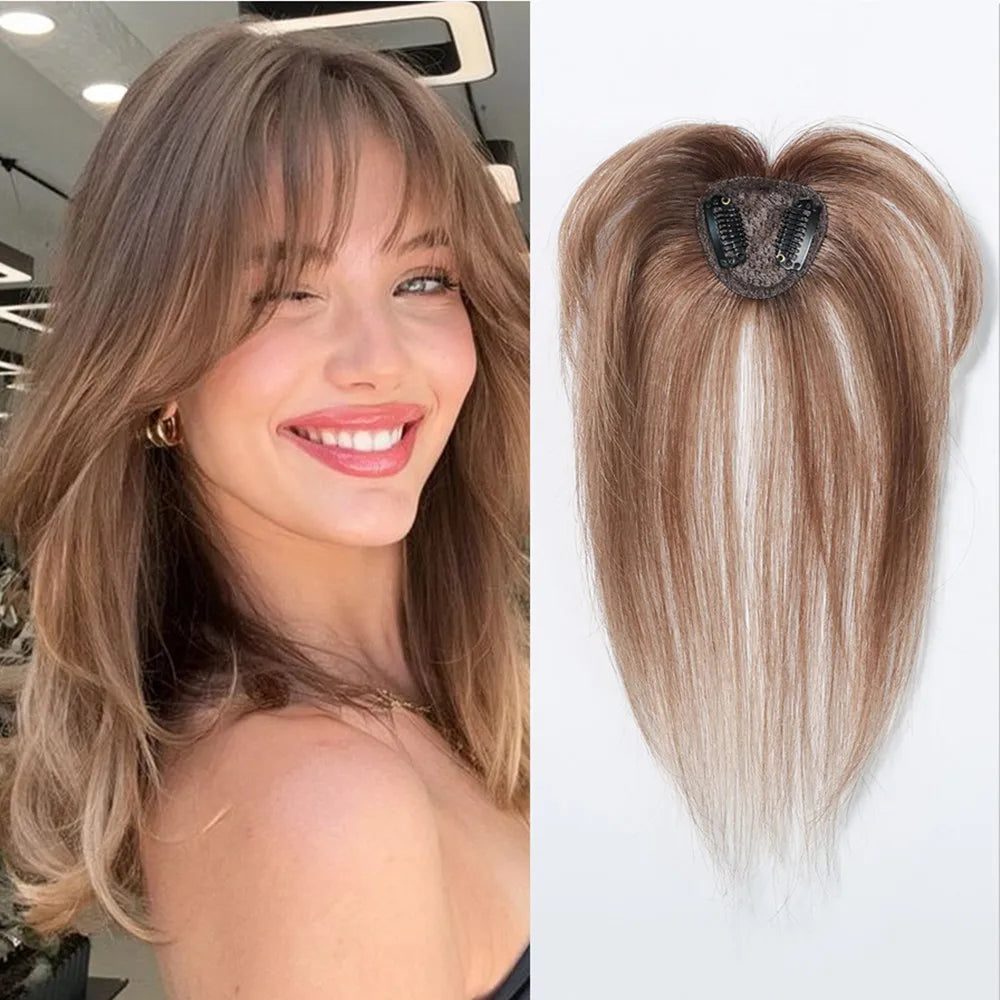

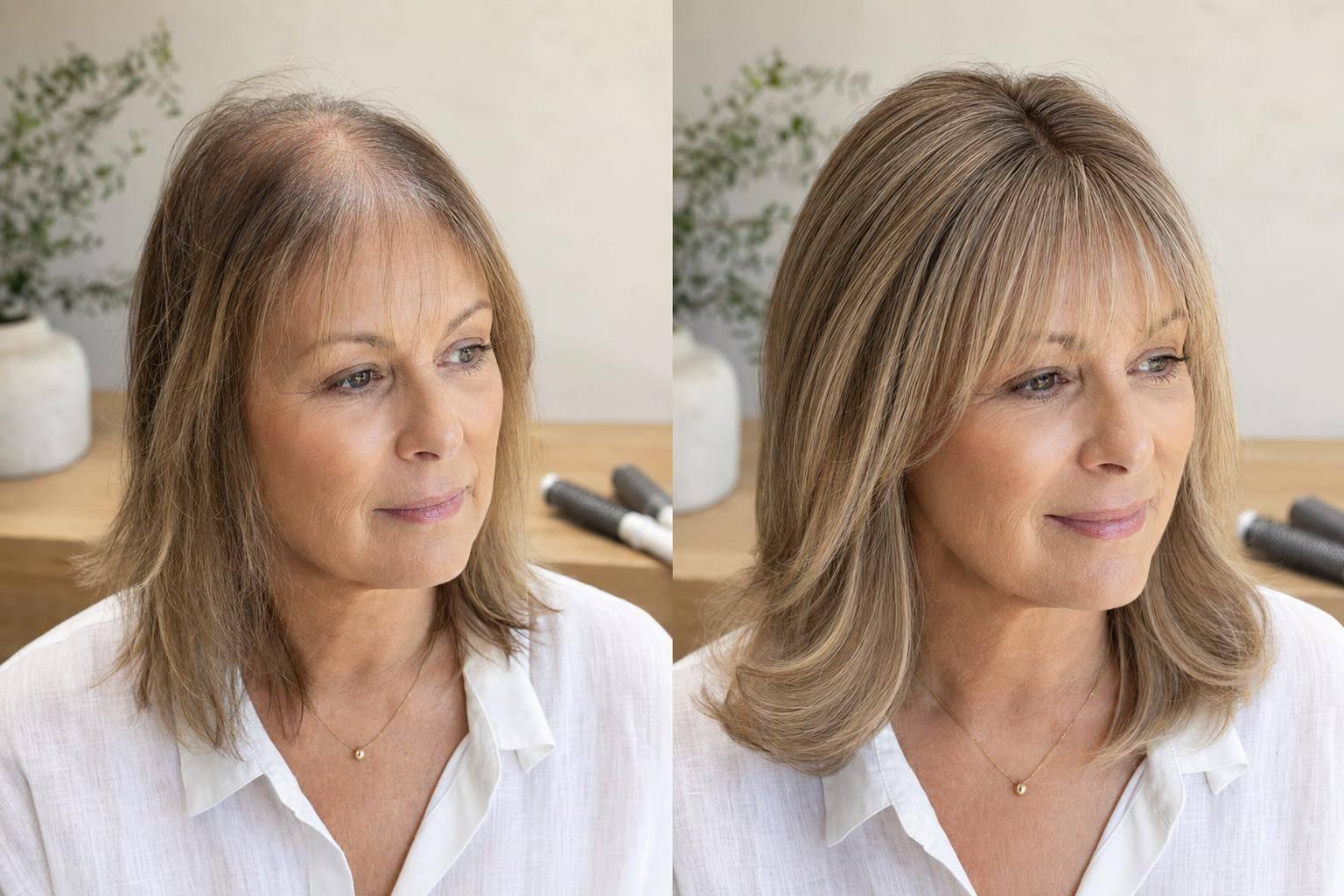
If my hair is fine, I’d start with the smallest and lightest piece that covers the thin spot. That’s the short answer.
Here’s what matters most:
- Fine hair means each strand is thin.
- Low-density hair means there’s less hair overall.
- If a topper or fringe is too dense, it can sit high on the scalp and look obvious.
- For most people, the best pick depends on where the scalp shows: crown, part line, front hairline, or fringe area.
- Human hair pieces can usually handle low heat of about 150–170°C.
- If I’m layering pieces, I’d keep wear time to about 8–10 hours and move clip placement by 1–2 cm each time.
If you want the fast version, this is how I’d break it down:
- Crown thinning: light-density crown topper
- Part getting more visible: part-line topper
- Front hairline looking sparse: front hairline topper
- Front + top coverage: topper with built-in bangs
- Front-only change: ultra-light bangs, wispy fringe, or curtain bangs
Hair Toppers for Thinning Hair: Coverage, Comfort & Natural Blending
sbb-itb-08feb2f
Quick Comparison
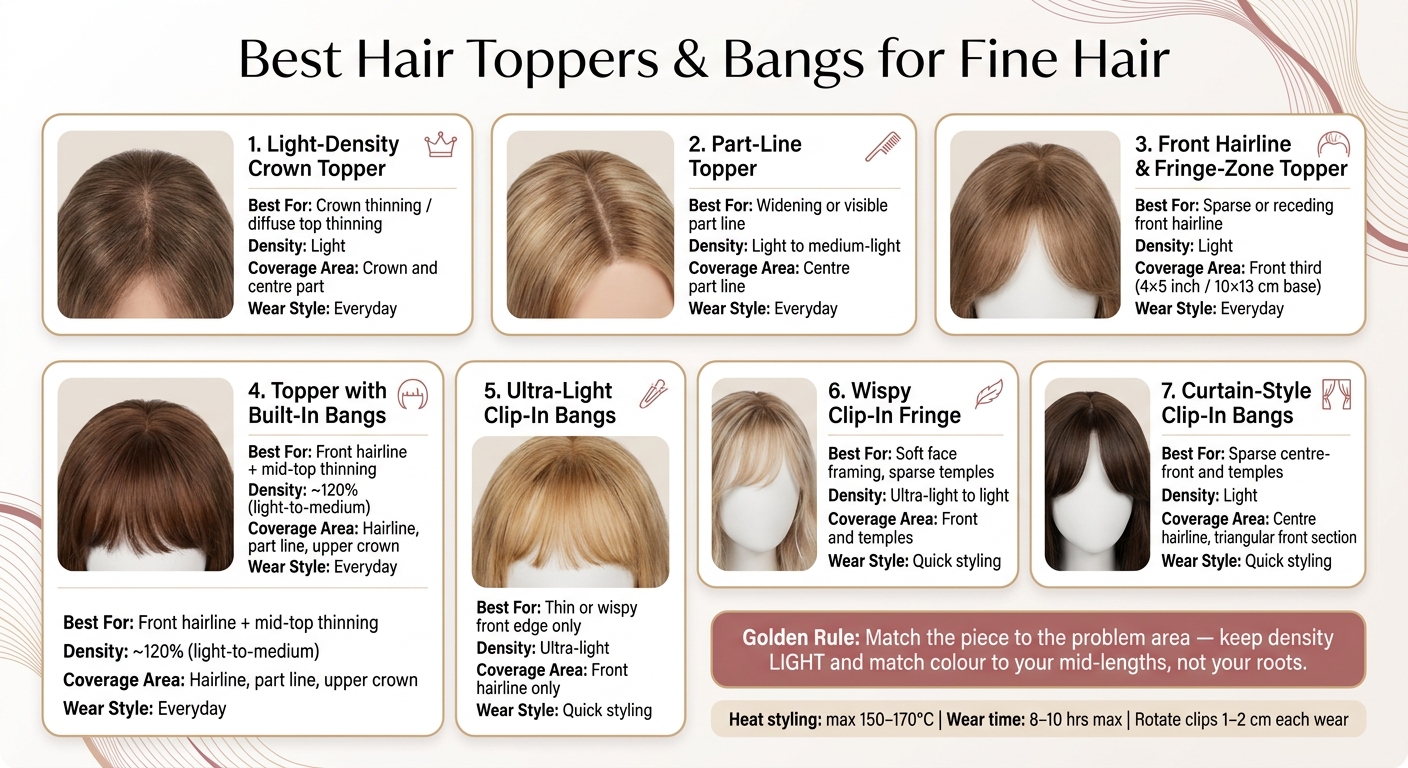
Best Hair Toppers & Bangs for Fine Hair: Quick Comparison Guide
| Piece | Best for | Density feel | Main coverage | Best if I want |
|---|---|---|---|---|
| Light-Density Crown Topper | Crown thinning | Light | Crown and top | Daily top coverage |
| Part-Line Topper | Visible scalp through the part | Light to medium-light | Centre part | A flatter part-line fix |
| Front Hairline & Fringe-Zone Topper | Sparse front hairline | Light | Front third | Front coverage without a full topper |
| Topper with Built-In Bangs | Front + mid-top thinning | About 120% | Hairline, part, upper crown | Coverage plus fringe shape |
| Ultra-Light Clip-In Bangs | Thin front edge | Ultra-light | Front hairline only | The lightest bang option |
| Wispy Clip-In Fringe | Soft face frame | Ultra-light to light | Front and temples | A soft, airy fringe |
| Curtain-Style Clip-In Bangs | Sparse centre-front and temples | Light | Centre hairline | A middle-part look |
The main idea is simple: match the piece to the problem area, keep density light, and match colour to your mid-lengths more than your roots. That’s what helps fine hair look smooth instead of overdone.
How to Choose a Topper or Fringe for Fine Hair
Start with the smallest piece that covers the area you want to fix. If your hair is fine or low-density, go for the lightest option that blends in without sitting too high on the scalp. If the piece is too full, it can leave a clear edge, and that’s usually what gives it away.
Start by identifying your problem area. A crown topper is a good fit for thinning across the top of the head. A part-line topper works well if your part is getting wider or you’re seeing early thinning through the centre. A front hairline or fringe-zone piece makes more sense when the front looks sparse or the hairline has pulled back. In most cases, targeted coverage looks lighter and blends in better with your own hair.
Measure before you buy. Measure the thinning area in centimetres, then pick a base that goes a little beyond it. That way, the clips can hold onto stronger hair around the area. It helps the piece stay in place and lets the edge sit flatter against your own hair.
When it comes to density, stick with light-density or low-density pieces. Thick, full-volume options can swamp fine strands and look out of place. If you’re choosing clip-in bangs, a wispy style tends to blend better. A wispy fringe also sits flatter and looks more natural around the hairline.
Human hair blends well and can handle heat styling, so you can match it to your own hair with a straightener or a soft curl. It’s also worth choosing a lightweight attachment that feels secure without pulling on delicate strands. That gives you the best starting point for the product options below.
1. Silkara Hair Light-Density Human Hair Crown Topper
If your thinning is mostly at the crown, this topper gives you coverage right where you need it without making your hair look heavy. It works well for mild to moderate crown thinning, especially when your scalp shows under bright light or your part has started to look wider. The light-to-moderate density is made to blend with fine hair rather than sit on top of it like extra volume.
The compact base sits on the upper back of the head and covers the crown plus the centre part-line area. That makes it a good pick if you still have solid density at the front or you want to keep your fringe visible.
For the best finish, blend the topper into your own part once it’s in place. You can line it up with your natural part or move it slightly into a soft side part. Clip the front first, then secure the sides and back so the base lies flat against your head.
Because it’s made from 100% human hair, you can style it to match your own texture. Use low heat, around 150–170°C, and keep hot tools away from the base. It also helps to apply a thermal protectant first.
Silkara Hair also offers a free colour match service, so you can send photos before you buy. One small tip: match the topper to your mid-lengths, not just your roots, for a softer, more natural blend.
2. Silkara Hair Part-Line Human Hair Topper
If your main concern is a widening part, this topper is built for exactly that. Its narrow, elongated base follows the part line from the front hairline towards the crown, so it covers the visible part without adding extra bulk. And because the part line is such an exposed area, the base and density need to stay light.
A light to medium density helps soften the look of visible scalp while still keeping everything airy. The scalp-like base also helps the part look natural instead of obvious or heavy.
Blending it is pretty simple. Line up the topper's part with your own, then use a tail comb to gently lift a small amount of your natural hair over the edges of the base. If you need a bit more help with scalp-tone matching, a touch of pressed powder or root-colour spray can soften the edge. Once the part is blended, the aim is to keep the finish flat and hard to spot.
When styling, use low heat with a heat protectant, and keep hot tools away from the base.
The part line is one of the most visible areas of the head, so even small colour differences can show up fast here. Use Silkara Hair's free colour match service, then check the shade in natural daylight.
3. Silkara Hair Front Hairline & Fringe-Zone Topper
If thinning has spread from the part line to the front hairline, it makes sense to switch to a smaller topper that focuses on the front. This one is made for thinning around the front hairline and fringe zone, so you get light coverage without adding extra fullness across the entire top.
The compact 4 × 5 inch base, or about 10 × 13 cm, helps keep the weight down while still leaving enough hair for the clips to grip.
Here’s the part that matters most: density. A light- or low-density topper tends to sit flatter against the scalp and blend better with thinner front sections. If there’s too much volume at the hairline, it can create a harsh edge. And that makes the join much easier to see.
To get a better blend, smooth your own hair down first. Then place the topper at, or just behind, your natural hairline. After clipping it in, comb your hair and the topper hair together so they blend as one, instead of sitting in two separate layers. A tail comb helps here. Use it to guide the front pieces in the same direction as your natural growth pattern, then smooth the edges flat.
If you want front coverage with a built-in fringe shape, the next step is a topper with bangs.
4. Silkara Hair Human Hair Topper with Built-In Bangs
This topper is a good fit for thinning around the front hairline and part-line. With 120% density, it gives light-to-medium coverage without looking bulky, which matters if your hair is fine. It’s best when you want extra coverage at the front but still want your own fringe to look like your fringe.
The small-to-medium base sits at the top front of the head and reaches across the part-line, front hairline, and upper crown. A simple way to size it: measure the thinning area, then add about 1 cm around each edge so the clips can grip stronger hair.
What stands out here is the built-in fringe. The graduated layers and feathered ends help the bangs sit softly against the forehead instead of looking heavy or blunt. You can wear them straight across, sweep them to one side, or part them a little through the middle. If needed, a stylist can trim the fringe to match your hairline or the length of your current bangs.
For styling, keep heat to 150–170°C max if you want to smooth, bend, or add a soft wave. Use a heat protectant first, pay extra attention to the lengths and ends, and let the hair cool before you touch it.
If you want something lighter and more focused on the fringe, the next clip-in options give you a bit more freedom.
5. Silkara Hair Ultra-Light Clip-In Bangs
If the topper options above feel like more coverage than you want, Silkara Hair Ultra-Light Clip-In Bangs keep things simple. They cover the front hairline only, which is often where fine hair starts to thin first, without adding extra bulk through the rest of the hair.
Regular clip-in bangs can look a bit too dense on fine hair. This ultra-light version takes a lighter approach. It uses small, low-profile clips on a slim base, so it sits more like fine hair naturally sits. It also leaves baby hairs visible around the edges, which helps the bangs blend in better with your own hair.
Once they’re fitted, less is more with styling. Use low heat only if you need to, and keep hot tools away from the clip base.
For day-to-day wear, it’s better to skip heat altogether. A cool blow-dry with a round brush can add a soft curve, which helps in warm or humid weather. If you want an even lighter finish, a stylist can trim and soften the ends after fitting so the bangs stay wispy and easy to wear.
6. Silkara Hair Wispy Clip-In Fringe
If you want a softer frame around the front of the face, the Silkara Hair Wispy Clip-In Fringe is a good fit. It gives light front coverage, and the shape stretches a little towards the temples for a more face-framing look.
The feathered, tapered ends and slightly uneven strand pattern help it blend in better. Instead of sitting like a blunt block, it lets a bit of scalp and some of your own shorter hairs show through, which makes the finish look more natural.
For placement, clip it just behind your natural hairline. That way, your baby hairs or shorter face-framing pieces can sit in front of the base. If your hair is very fine, prep the roots at the clip points with root powder or texturising spray so the clips have better hold.
Because this is a 100% Remy human hair piece, you can style it with ease. If you want a softer result, have it cut while it's clipped in and ask for light texturising only.
Silkara Hair's free colour match service also helps at the hairline, where even a small shade mismatch tends to stand out first.
If you'd like a broader, curtain-like shape, the curtain-style clip-in option is next.
7. Silkara Hair Curtain-Style Clip-In Bangs
If you want a softer, face-framing look than a straight fringe, curtain bangs are a smart pick for fine hair. The Silkara Hair Curtain-Style Clip-In Bangs part at the centre and sweep out to each side, so they frame the face with soft layers. The low-density base sits flat, doesn’t swamp fine hair, and feels light on delicate roots. You get front coverage without that bulky, heavy look.
The coverage sits across the central hairline and the triangular front section from the centre part to the outer brows. That’s often the first area where scalp starts to show. So if your centre part looks sparse but you still want your hair to feel light and airy, this shape makes sense. Because the bangs follow the same centre line your hair already has, they tend to blend in well with a middle part or a soft off-centre part. To make the join less obvious, brush some of your own hair forward over the base. And when choosing a shade, match the root colour of the piece to your natural hair, not just the ends, especially if you have grown-out highlights or balayage.[1][2]
You can style them with low heat and a heat protectant. Use a small round brush while blow-drying to guide each side away from the centre part, or use a low-heat iron to add a soft C-curve.
Silkara Hair’s free colour match service helps with this, because curtain bangs leave the root area in plain view and even a small shade mismatch tends to show first at the hairline. If you’re wearing them with a crown topper, place the topper 0.5–1 cm behind the front hairline and line up the parting with the fringe.
This shape suits readers who want front coverage without a blunt fringe.
Quick Comparison: Which Option Suits Your Fine Hair Concern?
Use this table to line up each Silkara Hair piece with the fine-hair issue you want to fix first.
| Silkara Hair Product | Best For | Density | Works Best With | Wear Style |
|---|---|---|---|---|
| Light-Density Crown Topper | Flat or low-volume crown; diffuse thinning at the top | Light | Shoulder-length to mid-back | Everyday |
| Part-Line Topper | Visible scalp along the part line | Light to medium-light | Long bob to long hair | Everyday |
| Front Hairline & Fringe-Zone Topper | Weak or receding hairline; thinning through the front third | Light at the front edge | Short to long, with trimming to suit shorter cuts | Everyday |
| Human Hair Topper with Built-In Bangs | Weak hairline plus low mid-front density | Light overall | Shoulder-length and longer | Everyday |
| Ultra-Light Clip-In Bangs | Soft face framing when the fringe area is wispy or uneven | Ultra-light | Brow-grazing bobs to long hair | Quick styling |
| Wispy Clip-In Fringe | Delicate, airy fringe and subtle face softening | Ultra-light to light | Short, medium or long | Quick styling |
| Curtain-Style Clip-In Bangs | Sparse temples and centre-part framing | Light | Medium to long | Quick styling |
Start with coverage, not style. If scalp show is constant at the crown or along the part line, a full topper usually makes more sense than a smaller front piece. That gives you steadier coverage instead of a patch-up job that only works from certain angles.
Clip-in bangs and fringes are better when the issue sits at the front and you want fast shaping around the face. They’re handy for front-only touch-ups, especially when the rest of your hair still has enough fullness.
If you’re stuck between densities, go lighter. A piece with too much density can sit up off the scalp and make the join easier to spot.
Once you’ve picked the right shape, the next section helps you sort out shade and styling so everything blends in cleanly.
Colour Matching and Styling Tips for a Natural Finish
Once you've picked the right topper or bangs, shade and finish are what help the piece melt into your hair.
Match to Your Mid-Lengths and Ends
Match the piece to your mid-lengths and ends, not your roots. Roots are often darker, so a piece matched to the root can look too harsh once it sits over lighter lengths.
Sun exposure often leaves mid-lengths and ends lighter and warmer than the roots. And on fine hair, even a small shade mismatch shows up fast at the part, fringe, or base.
If your hair carries warm tones through the mid-lengths, ends, part line and hairline, lean towards shades like honey, warm beige blonde or golden brown instead of cool ash. Cool tones can look a bit flat against the warmth the sun tends to bring out.
Use Photo Matching to Get the Shade Right
Use Silkara Hair's photo match service with natural-light photos. Take front, side and back shots near a window with artificial lights switched off. Skip filters and heavy editing.
Send front, side and back photos in natural daylight so Silkara Hair can match your mid-lengths and ends with care.
If your hair looks quite different in summer compared with winter, mention that when you submit your photos. A colour that blends well in July may need a slight tweak by December once your ends lighten more.
After colour, the next step is keeping the texture soft and light.
Gentle Styling Keeps Fine Hair Looking Natural
Use low heat only on human hair toppers and bangs, and always apply a lightweight heat protectant first. Use just a small amount of product on the mid-lengths and ends. For most fine hair pieces, a light leave-in conditioner or flexible-hold mist is enough.
Avoid heavy oils, wax sticks or thick pomades near the fringe or base. They can cause clumping and make the attachment area easier to spot.
Brushing and Trimming
Final shaping matters most on fine hair, where every millimetre shows. Always detangle from the ends upward with a wide-tooth comb or soft brush, and support the base with your free hand so you don't pull on the clips. This matters even more after a day outdoors or near the beach, where wind and salt air can lead to knotting.
If you want to trim your fringe or topper bangs, cut only 2–3 mm at a time and point-cut with small vertical snips. That helps keep the edge soft and wispy. Start longer, then trim slowly.
Can You Wear a Topper with Bangs or Extensions?
Yes - and for fine hair, this can often look better than using one heavier piece.
If one light piece doesn't cover every thin area, it's often smarter to layer two light pieces instead of reaching for one dense option. That tends to sit more softly on fine hair and can blend in with less bulk.
The simplest way to think about it is to give each piece one job:
- a topper for the crown or part line
- bangs for the front hairline
- a halo extension for length and fuller ends
A handy day-to-day combo is a light-density crown topper with ultra-light clip-in bangs. The bang piece clips just behind the front hairline, then a thin veil of your own hair is combed over the edge to hide the attachment. If you want extra length and body through the ends as well, add a halo extension that sits at the back of the head under the topper.
There is one small catch: make sure the topper clips don't sit straight on top of the halo wire. That kind of overlap can create pressure points, and on fine hair, that can get uncomfortable fast. This setup works well because each piece covers one area without piling on bulk where you don't need it. In most cases, your own hair should be at least shoulder length so the halo blends cleanly, especially in bright Australian daylight where seams and lines are easier to spot.
With fine hair, clip placement matters more than many people think. Rotate where your clips sit each time you wear them. Even moving them by 1–2 cm can help stop the same delicate strands from being pulled day after day. It's also smart to keep wear time to about 8–10 hours and take toppers and clip-ins out before bed. If you notice redness, soreness, or broken hairs, that's a sign the clips are putting too much tension on your hair.
If your hair is very delicate or actively shedding - after postpartum changes, during medical treatment, or with advanced thinning - stacking multiple clips may put too much stress on fragile roots. In that case, one larger-base ultra-light topper with fewer clips may be a better fit, and Silkara Hair's free colour match service can help you choose the right piece before you commit.
Conclusion
Fine hair needs light density, targeted coverage, and a flat, natural edge. Add too much volume, and you end up with bulk and visible lines. So the best way to choose isn’t by volume. It’s by the concern you want to fix.
Go with ultra-light clip-in bangs for a flat fringe, a part-line topper for a widening part, a light-density crown topper for crown thinning, or a topper with built-in bangs for front-and-top coverage. Match the piece to the problem, and the result stays light and believable.
When the fit is right, it blends into your own hair with far less fuss. And if shade is the last thing holding it back, the colour match service can help finish the blend.
If you’re not sure where to start, use Silkara Hair's free colour match service. Start with the smallest piece that solves the problem, then build from there.
FAQs
How do I measure for the right topper size?
Style your hair as you normally would, then find the thinning area that needs coverage. Use a soft tape measure to check the length and width.
Next, add 1–2 cm to each measurement. That extra room gives the clips enough space to grip onto healthy hair, which helps the topper sit securely and feel comfortable.
Silkara Hair toppers usually range from 10–20 cm in length and width.
Will a topper damage fine hair?
When it’s fitted the right way, a hair topper should feel secure without putting stress on your hair. Silkara Hair toppers use pressure-sensitive clips, so you can wear them comfortably all day without damaging your natural hair.
If your hair is fine, the small details matter. Make sure the clips feel firm, but not too tight. And place the base so it sits flat against your scalp, with no gaps or bulges.
How do I make bangs look natural?
Choose a 100% Remy human hair piece if you want it to catch the light and move more like your own hair. When you’re matching colour, look at your mid-lengths and ends, not your roots.
Place the piece about 1–5 cm behind your natural hairline so your own hair helps soften the front edge. Then blend it in with root sprays, powders, or a bit of gentle teasing, and trim or heat-style the fringe so it suits your face shape.