
Most first-week topper problems are fixable. If I’m new to hair toppers, I can expect three main things in the first 7 days: a bit of scalp awareness, a short styling learning curve, and some self-consciousness that usually settles once fit and placement are right.
Here’s the short version:
- Normal in week one: light clip pressure, mirror-checking, slight puffiness, and spending 15–20 minutes styling at first.
- Not normal: sharp pain, clips digging in, redness, soreness, constant slipping, or a topper that looks far too thick for my own hair.
- What helps fast: start with 1–2 hours at home, place the front edge about 1.25 cm behind the hairline, shift sore clips by 2–3 mm, and use dry shampoo or texturising spray for grip.
- What styling can fix: a puffy crown, a dense-looking part, and minor colour mismatch.
- What styling can’t fix: the wrong base size or density.
- First-week care: most human hair toppers only need washing every 10 to 15 wears, so the first week is more about placement, brushing, heat care, and storage.
If I still feel pain or the topper keeps moving after a few wears, the issue is usually fit, placement, or density rather than “just getting used to it”.
| Issue | Usually normal | Needs a fix |
|---|---|---|
| Comfort | Mild pressure at first | Sharp pain or sore spots |
| Look | Slight puffiness or stiff part line | Base too small or density too heavy |
| Wear | A bit of movement on slick hair | Sliding every time I wear it |
| Feelings | Worry about being noticed | Avoiding going out because it feels wrong |
That’s the core of it: week one is less about perfection and more about getting the topper to sit, blend, and feel right.
Normal first-week problems vs signs that need attention
Most first-week topper discomfort comes down to adjustment, not failure. That’s the big thing to keep in mind during your first topper experience. The goal is to tell the difference between normal wear-and-tear feelings and a fit problem that needs fixing.
Scalp awareness, mild clip pressure and clip sensitivity
It’s normal to feel the clips and base on your scalp at first. A bit of tightness that fades after a few hours is also part of the early settling-in phase.
What’s not normal is sharp pain, clips digging in, redness, or soreness that keeps hanging around at the clip sites. Those are signs that the clips, fit, or placement need adjusting.
Self-consciousness and worrying about being noticed
Feeling self-conscious in week one is common. So are frequent mirror checks and that extra awareness every time the wind picks up.
"The first time I went out in public wearing a topper I was absolutely certain everyone could tell... Nobody could tell. Nobody was looking." - Neveen Wood [6]
If that feeling doesn’t settle after styling, look at placement and density next. In many cases, anxiety that sticks around is tied to something practical, like fit, density, or placement, rather than something that will fade on its own.
Blending, base size and density concerns
If a topper looks a bit puffy or the part line seems very straight, that’s usually a styling issue, not a product flaw. First-time styling often takes around 15–20 minutes, then drops to just 2–5 minutes once you’ve found the right placement and the hair has settled [4].
If the topper looks visibly thicker than your own hair, you likely need a better density match. Styling won’t fix that. The same goes for base size: if the base is too small to cover the thinning area, repositioning won’t solve it [5]. When the shape and density are right, the whole thing tends to feel much easier.
Here’s the quick breakdown.
| Category | Normal | Needs attention |
|---|---|---|
| Comfort | Light pressure; awareness of the piece | Sharp pain or clips digging in |
| Scalp condition | Mild tightness that fades | Redness or soreness at clip sites |
| Blending | Slightly puffy or straight part line | Too much hair for your own density; base size too small |
| Clip placement | Slight sliding on freshly washed hair | Constant sliding; clips on fragile hair |
| Emotional response | Self-conscious; frequent mirror checks | Avoiding daily activities due to distress |
sbb-itb-08feb2f
How to make your topper feel comfortable and look natural faster
Hair Topper First Week: Day-by-Day Wear Plan & Quick Fixes
Knowing what's normal helps. But what helps even more is a simple plan for the first few days, plus a few easy fixes for the little things that can feel off at first.
A simple day-by-day wear plan for your first week
Use these fixes for the normal adjustment issues that don't need a full reset.
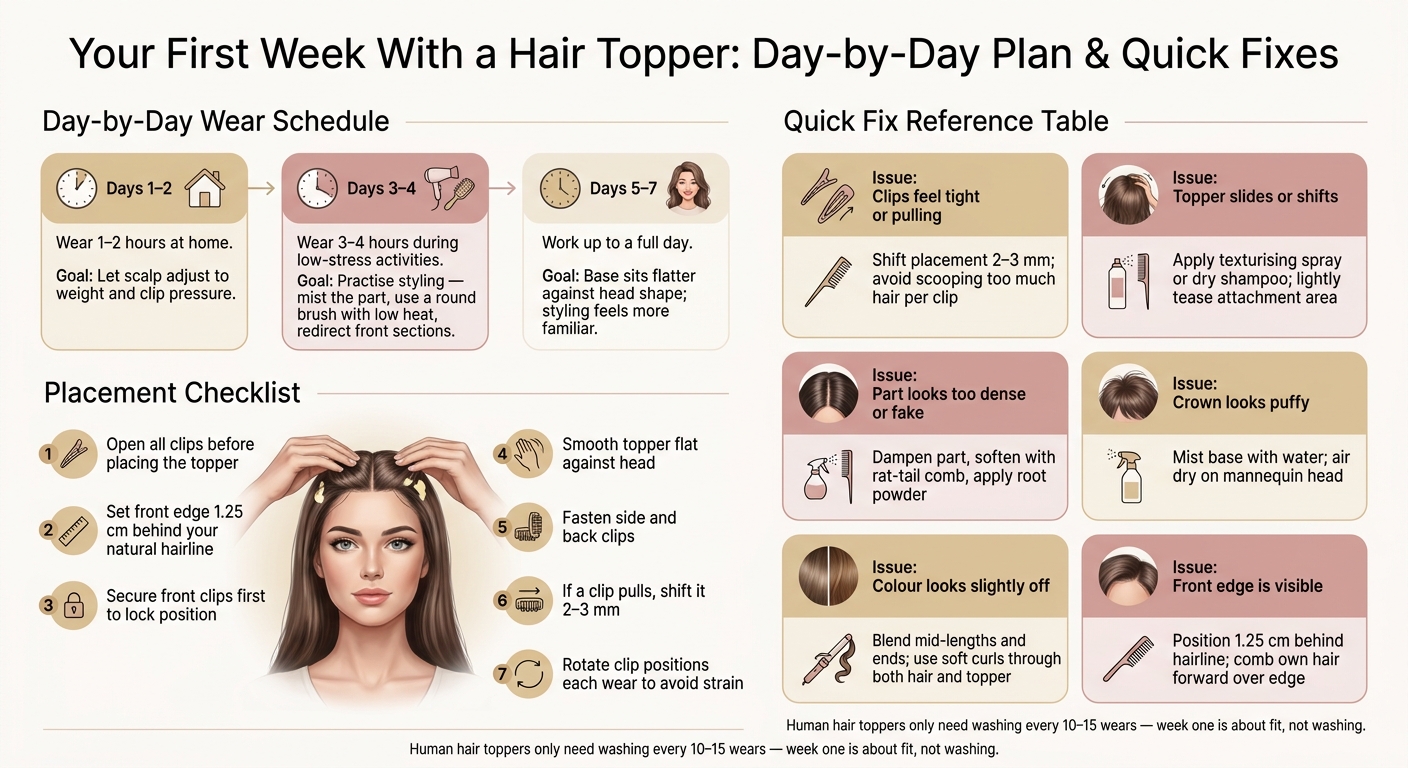
Don't aim for all-day wear on day one. Start with 1–2 hours at home on days one and two so your scalp can get used to the weight and clip pressure. On days three and four, wear it for 3–4 hours during low-stress activities and practise styling. Mist the part, redirect the hair, and use a round brush with low heat to guide the front sections back. By days five to seven, work up to a full day. By then, the base should start sitting flatter against your head shape [7][8].
How to manage clip placement and pressure
Open all clips before you place the topper. Set the front edge about 1.25 cm behind your natural hairline [7][2]. Secure the front clips first to lock in the position, then smooth the topper flat against your head before fastening the sides and back.
If one clip pulls, unclip it and move it 2–3 mm. That tiny shift can make a big difference. It also helps to rotate clip positions a little each time you wear it, so the same hairs aren't under strain every day.
If your hair is fine or slippery, give the roots a bit more grip first. A light spray of dry shampoo or texturising spray, plus a gentle tease at the attachment area, can help the clips hold in place.
How to improve blending through length, density and colour matching
Once the topper feels better to wear, the next step is making it blend in.
If the part looks too dense, lightly mist the area with water and use a rat-tail comb to soften the line. A small amount of root powder in a matching shade can help the scalp look more natural. If the crown of your synthetic hair topper looks puffy from packaging, mist the base and let it air dry on a mannequin head so it can settle into shape.
Colour matching works the same way. A dimensional blend often looks more natural than forcing an exact solid-colour match. Pay close attention to how the topper's mid-lengths and ends sit against your own hair. Soft curls through both can help the tones melt together better.
If you're still deciding on a shade, Silkara Hair's free colour match service and virtual try-on for selected styles, such as a clip in hair topper with bangs, can help you choose the right colour and density before your first wear.
| Common Issue | Practical Fix |
|---|---|
| Clips feel tight or pulling | Shift the placement 2–3 mm; avoid scooping too much hair into each clip |
| Topper slides or shifts | Apply texturising spray or dry shampoo; lightly tease the attachment area |
| Part looks too dense or fake | Dampen the part, soften it with a rat-tail comb, and apply root powder along the line |
| Crown looks puffy | Mist the base with water and let it air dry on a mannequin head |
| Colour looks slightly off | Blend the mid-lengths and ends; use soft curls through both your own hair and the topper |
| Front edge is visible | Position the topper about 1.25 cm behind your hairline and comb your own hair forward over the edge |
The emotional side of week one and how to build confidence
Why you might feel both relieved and unsettled at the same time
Once you’ve sorted the fit and the basic blending, the next hurdle is usually confidence.
It’s completely normal to feel relief and unease at the same time. Hair is closely tied to identity, so a topper can feel emotionally much bigger than it looks. That first wear is best seen as a fit check, not the finished result. As the fit and styling start to feel familiar, the topper often becomes far less noticeable.
Small habits that help you feel more like yourself
One of the easiest ways to settle in is to wear the topper at home first, with clothes you already feel good in. When fewer things feel new at once, the whole experience is usually less overwhelming.
Before heading out, check the blend in natural daylight, not only under indoor lights. Natural light can show colour differences and blending gaps that artificial light may hide [2][5]. It also helps to take a few photos from the front, sides and crown, so you can see how the piece is sitting from angles that are hard to catch in the mirror [2].
"It was a good test to sit across from [my sister] for half an hour and she didn't say a word. I finally asked if she liked my hair colour and she said it definitely made my hair look thicker! When I told her [about the topper] she was really surprised." - Female client, Transitions Hair [1]
If the topper still feels off after a few wears, the cause is often one of three things:
- fit
- density
- placement
When a different Silkara Hair solution may suit you better
If crown coverage isn’t your main goal, it helps to match the solution to the area you want to change. Halo hair extensions and clip-in extensions are a better fit for women who want more volume or length without scalp coverage. Clip-in bangs or a wispy fringe are better for softening the front hairline, rather than covering the crown.
If you’re unsure what suits your situation, Silkara Hair’s free colour match service can help you talk through the right base size, density and style before you commit.
First-week care, next steps and key reminders
Basic care for the first seven days
Once the fit feels okay, shift your attention to care. That helps the topper settle in faster and keep its shape. A human hair topper usually only needs washing every 10 to 15 wears, so in the first week, the main jobs are placement, brushing, and storage, not washing[10].
When you brush it, start at the ends and work your way up. That simple habit cuts down on tugging. A wide-tooth comb is gentler than a standard brush and puts less stress on the base[10].
For storage, a mannequin head or wig stand helps the topper hold its shape between wears[9]. No stand on hand? The original box also works. So does a silk or satin bag kept in a cool, dry spot away from direct sunlight[3].
Go easy on products in week one. Heavy products and silicone-rich shampoos can lead to build-up and make the hair sit flat[3]. If you use heat tools, use a heat protectant first and keep the temperature on the low to medium side[4][10].
Planning for long-term wear and value
These small habits in the first week do more than make day-to-day wear easier. They also help protect the topper's shape and extend how long it lasts. A human hair topper blends in well, can be heat-styled, and tends to last longer when it's cared for properly. Good early care can also help it feel more natural sooner.
A few factors affect long-term value:
- Larger bases give more coverage[10][9].
- Length and density affect price[10][9].
- With proper care, a human hair topper can last one to four years[10][3].
Conclusion: Most first-week issues are fixable
Most first-week issues come back to fit, placement, or styling, and they often get better fast. Ongoing pain, constant pulling, or clips that dig in and don't ease up are signs that fit or placement needs to change. They are not something to just put up with.
Blending, comfort, and confidence tend to improve as placement starts to feel more familiar. If something still feels off after a few wears, the cause is usually fit, placement, or density.
FAQs
How do I know if my topper is the wrong size?
A topper is probably the wrong size if it doesn’t sit or feel right on your scalp. A good fit should lie flat, without gaps, bulges, or shifting.
If it’s too small, you may notice pulling, discomfort, or tugging where the clips attach. If it feels loose, slides around, or is much larger than your thinning area, the coverage may not look seamless.
Will a topper damage my natural hair?
When you use a hair topper the right way, it shouldn’t damage your natural hair. The main thing is fit. Pick a lightweight topper that matches your scalp shape, and make sure the clips feel secure without digging in or pinching.
It also helps to be gentle when you put it on. Don’t pull too hard or create extra tension at the roots, because that can stress your hair over time. A small habit that can make a big difference is rotating where the clips sit every few months. Giving your hair regular breaks can also help support scalp and hair health.
How long does it take to feel normal in a topper?
It’s common to need a bit of time to adjust during your first week wearing a hair topper. At first, it can feel unfamiliar. That’s normal. In most cases, it gets much easier once you’ve worn it a few times.
Most people start to feel comfortable by the second week, and some even forget they’re wearing it. As you settle into the routine, it begins to feel natural and fits into your everyday look.