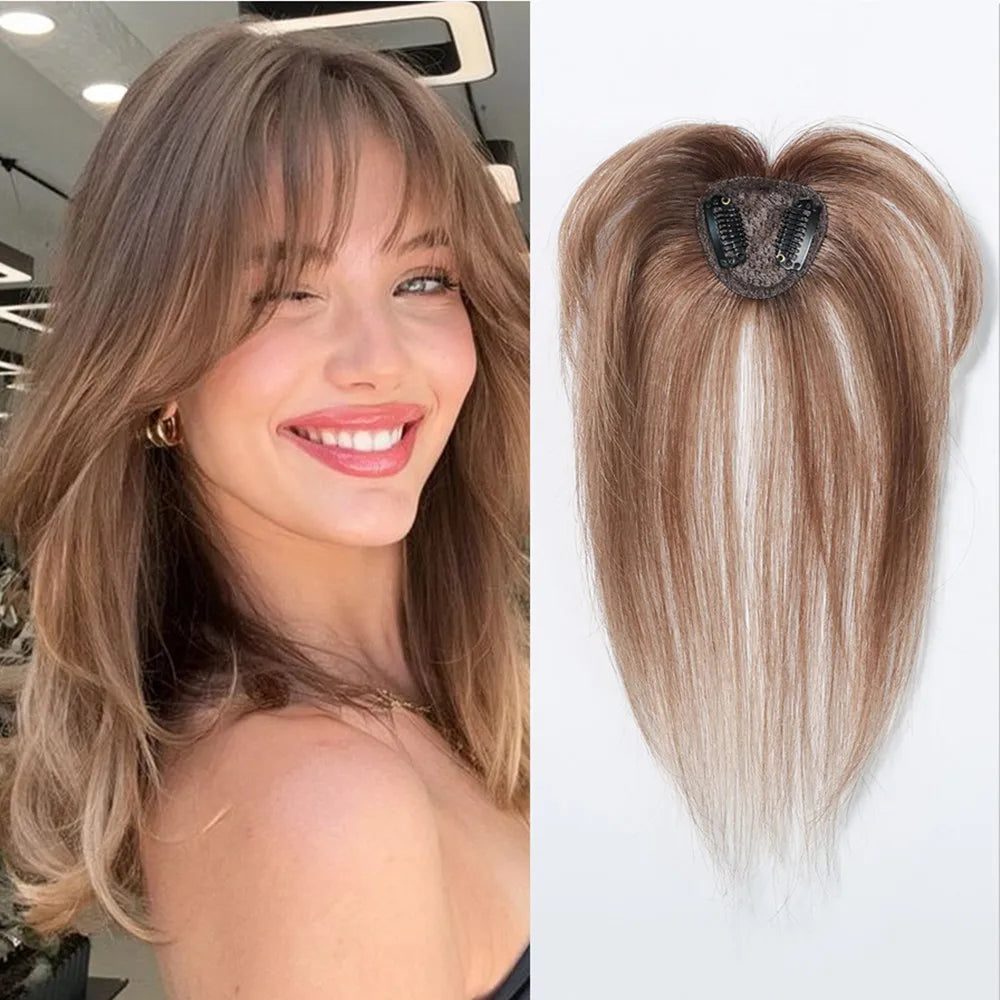

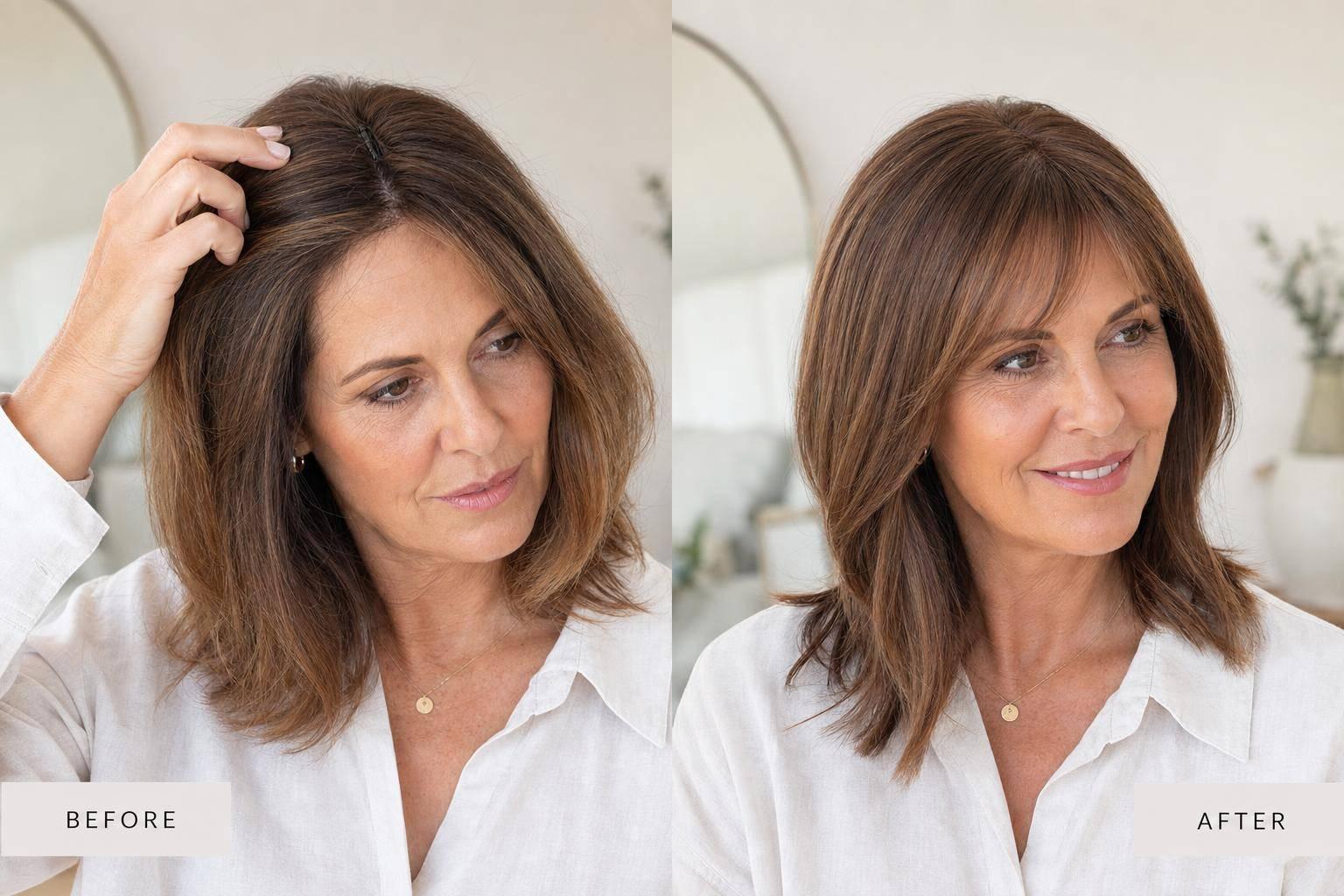
If my topper looks too bulky, the cause is usually simple: the density is too high for my own hair, the base is sitting in the wrong spot, or the hair still has factory shape and lift.
In most cases, I don’t need to panic or start cutting straight away. A few checks can fix it fast: measure the thinning area, place the base just behind the hairline, smooth my own hair flat, and style the topper before trimming. If it still looks too thick after that, I can remove small amounts of weight from the mid-lengths and ends, or choose a lower-density piece next time.
Here’s the short version:
- Most bulky toppers come down to density mismatch
- A base that is too large can bunch and sit high
- Root lift often drops after the first wash and restyle
- Frizz or curl underneath can make the crown puff up
- Trimming should start at the ends, not near the base
- Very fine hair often suits around 100% density
- Around 120%–130% density can suit people who want more coverage without too much extra hair
A few small changes often make the biggest difference. I’d check fit first, then styling, then trimming.
| Check | What I’m looking for | What to do |
|---|---|---|
| Base size | Too much base for the thinning area | Measure the area and add about 2.5 cm for clip hold |
| Placement | Front edge too far forward | Set it slightly behind the natural hairline |
| Hair underneath | Frizz, curl, or lumps under the base | Blow-dry or pin hair flat |
| Density | Topper looks much thicker than my own hair | Thin the mid-lengths and ends, or choose a lighter density |
| Factory shape | New topper looks puffy out of the box | Wash and restyle before judging the fit |
If I work through those points in order, I can usually tell whether the issue is the cut, the placement, or the topper itself.
Why a new topper can look bulkier than expected
Hair toppers are made to add coverage and volume
Hair toppers are designed to cover thinning at the crown and parting, so they often feature a 120% density to provide more hair than the natural strands around them. That extra fullness is there on purpose.
The catch is that it can look a bit too dense next to fine hair, especially when you compare it with the hair at the sides and nape. So even if the topper fits well, the contrast can make it seem bigger than expected.
Density mismatch is the most common reason
The most common reason a topper looks bulky is a density mismatch. That simply means the topper has a lot more hair than your own hair.
When that happens, the change from your natural hair to the topper can look sudden. Instead of blending in, the piece can look heavy and obvious.
How texture, humidity and frizz can add to the problem
A new human hair topper can also arrive with packaged root lift from manufacturing. This usually settles after the first wash and style.
Texture underneath the topper matters more than many people expect. If your own hair is frizzy, curly, or not smoothed down before you clip the topper in, the piece can end up sitting on top of that bulk. That extra lift underneath can make the topper look puffier than it should.
A smooth, flat base helps the topper sit closer to the scalp. Before you trim anything, check the fit and placement first.
sbb-itb-08feb2f
Hair Topper Density Explained: Choose the Right Thickness for You! | UniWigs
Check fit, base size and placement before cutting anything
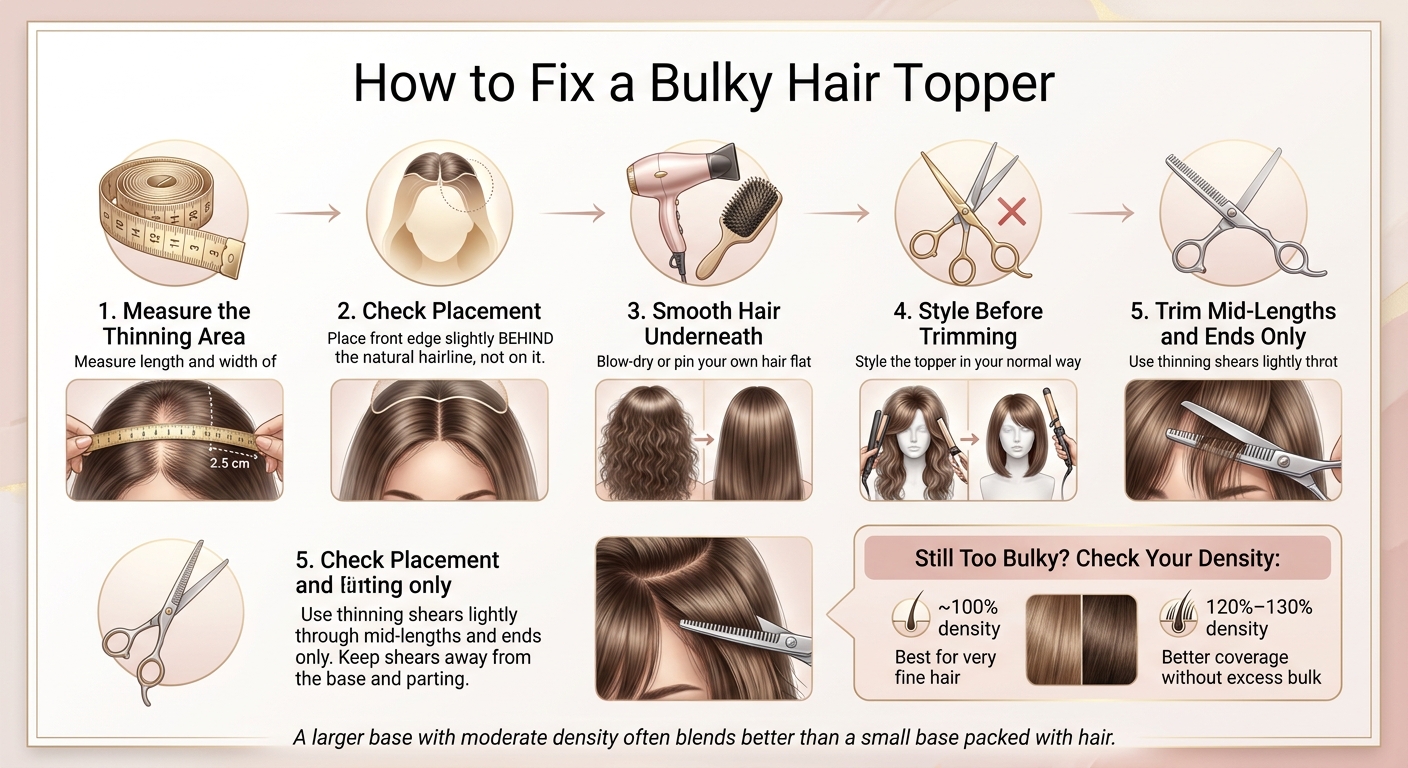
How to Fix a Bulky Hair Topper: Step-by-Step Checklist
Before you cut a single strand, check the fit and placement. Start with size, then look at where the topper sits.
Measure the thinning area in centimetres
Use a soft tape measure to check the length (front to back) and width (side to side) of your thinning area. Then add about 2.5 cm so the clips can grip stronger hair around the edge [1][2].
If the base is too big for the area it’s meant to cover, it can bunch, move through the day, or make the crown sit higher than it should [1]. That extra bulk can be the whole problem.
Place the topper along the natural part and behind the hairline
Line up the topper’s part with your natural part. Then place the front edge slightly behind your natural hairline, not right on it [4][1]. Clip the front first, then the back and sides, while keeping the base taut.
If the base sits loose, it can buckle and give the crown a rounded shape.
Do a quick mirror check in natural daylight
Check the crown and parting in natural daylight. Then run your fingers over the base and look for any lifts or gaps. If you spot one, unclip that section, pull the base taut, and clip it back down [1][4].
A small reposition can often cut down bulk before you trim anything. If it still looks too full after that, move on to thinning and trimming.
Use this quick check to figure out the cause before cutting.
| Issue | Likely Cause | Fix Before Trimming |
|---|---|---|
| Crown sits too high | Underlying hair is frizzy, curly, or not flattened | Blow-dry your own hair flat or pin sections close to the scalp |
| Visible lumps where clips sit | Clips placed on thick or uneven sections | Reposition clips to flatter, more evenly distributed sections |
| Base bunches or shifts | Base is too large for the thinning zone | Remeasure and check base size against the thinning zone |
| Front edge shows | Topper placed at or ahead of the natural hairline | Move the base slightly back, behind the natural hairline |
How to trim and thin a topper to reduce bulk
Once the fit and placement are sorted, trim only the extra bulk the topper adds. Most toppers have more density than natural hair, so a bit of trimming often helps you customise the blend.
Shorten the length and soften blunt ends
Style the topper the way you’d normally wear it first. Then trim the ends in small passes so you can spot where the bulk is sitting. Point-cutting helps soften blunt ends by breaking up that hard line. If the shape still looks heavy, add light layers only in those spots, working in sections with a fine-toothed comb to keep things even [6].
Remove weight with thinning shears carefully
Use thinning shears with a light hand through the mid-lengths and ends only. Keep them away from the base and the parting, where cutting can make the topper harder to blend. Work in small passes and check the shape after each one.
Comparison table: uncut topper vs customised topper
| Feature | Uncut Topper | Customised Topper |
|---|---|---|
| Appearance | Can look overly full at the crown | Balanced density that sits like natural hair |
| Movement | Sits rigidly with heavy, blunt ends | Fluid movement with soft, textured layers |
| Blending | Visible contrast where topper meets natural hair | Blends in with your existing layers |
| Maintenance | Ends prone to tangling if too blunt | Easier to style; needs gentle brushing to protect thinned sections |
Once the extra weight is gone, styling plays a big part in how flat and blended the topper sits.
How to style a topper so it blends with your own hair
Prepare your own hair so the base sits flat
After you’ve trimmed down some of the bulk, styling is what helps the topper sit closer to your scalp. Start by smoothing your own hair so the base has a flatter surface to sit on. Then tease only the areas where the clips will attach, so they have something to hold onto.
When you put the topper on, clip the front in first while keeping the base taut. Then secure the sides and back [8]. If you have longer hair, pin it flat underneath the base [1][4].
Use low-to-moderate heat and lightweight products
If the topper still looks a bit puffy, use low heat to smooth it down. For human hair toppers, keep your flat iron or curling iron at no more than 177°C and apply a heat protectant first [1]. You can also use a round brush on low heat to smooth the first few centimetres at the root and tone down that lifted look around the crown [4].
For products, less is more. Use a small amount of lightweight serum or smoothing cream on the mid-lengths and ends to add shine without dragging down the roots [6]. Skip heavy gels, waxes, and thick oils near the roots. They can make the hair split apart in odd ways and cause the topper to sit higher.
Comparison table: sleek styling vs soft waves for bulk control
| Feature | Sleek & Straight | Soft Waves |
|---|---|---|
| Visible density | Hair sits closer to the scalp and helps cut down crown bulk | Adds movement and visual volume, which can help hide a base that feels too dense |
| Blending | Needs a close colour match and can show the step if it’s not layered | Texture softens the transition and hides where your own hair ends |
| Movement | Polished and even; can look stiff if over-styled | Natural and bouncy; texture helps mask where your own hair ends |
| Use when | Fine or straight natural hair | The base or edges are hard to hide |
If it still looks bulky after styling, the problem is usually the density or the base size.
Choose the right Silkara Hair topper for a natural long-term result
If trimming and styling still leave the topper looking bulky, the issue is usually the starting point: density or base size.
Match density, base size and cut to your natural hair
When fit, placement and styling still don't fix the bulk, the topper's original density or base size is likely off. Very fine hair usually needs around 100% density. 120%–130% tends to suit women who want more coverage without making the topper look too full. Base size matters just as much. In many cases, a larger base with moderate density blends better than a small base packed with hair [3].
The cut also makes a big difference. Layered shapes help the topper blend into your natural hair. Blunt shapes, on the other hand, can sit on top like a shelf [3][7].
Use Silkara Hair colour matching and density guidance
Once the density is right, colour matching is often the next fastest fix for softening the line between the topper and your natural hair. Match the topper to your mid-lengths and ends, not just your roots, so the colour looks like part of your own hair [5].
Silkara Hair's photo-based colour matching guidance can help you get a piece with subtle variation instead of a flat, artificial-looking colour [2].
Silkara Hair's density and base size guidance can also help you choose a topper that suits your thinning area and blends more naturally from the start.
FAQs
How do I know if my topper density is too high for my hair?
A topper’s density may be too high if it creates a clear contrast or a sudden step where it meets your natural hair, especially around the perimeter.
It can also feel heavy or warm, look bulky or lifted at the hairline, or have trouble sitting flat against the scalp. For the most natural blend, the density should match your existing hair at the sides and back.
Will a new topper flatten after washing and styling?
Yes, a new topper will often flatten after washing and styling.
If it still feels bulky or puffy, the cap may have lost its shape in transit. Lightly wet the cap, place it on a mannequin head or wig stand, and let it air dry or blow-dry it.
It also helps to smooth your natural hair as flat as possible underneath. Then blend the topper with a bit of styling so it sits close to the head and looks natural.
Can a bulky topper be fixed without cutting it?
Yes, often.
The main thing is to make sure your natural hair underneath is smooth and lies flat. Pin or braid it down so the topper can sit evenly on your head.
If the cap lost its shape during shipping, lightly wet it and let it air dry on a mannequin head. That usually helps it bounce back. You can also adjust the clip placement so the base sits taut and flush against your scalp.