
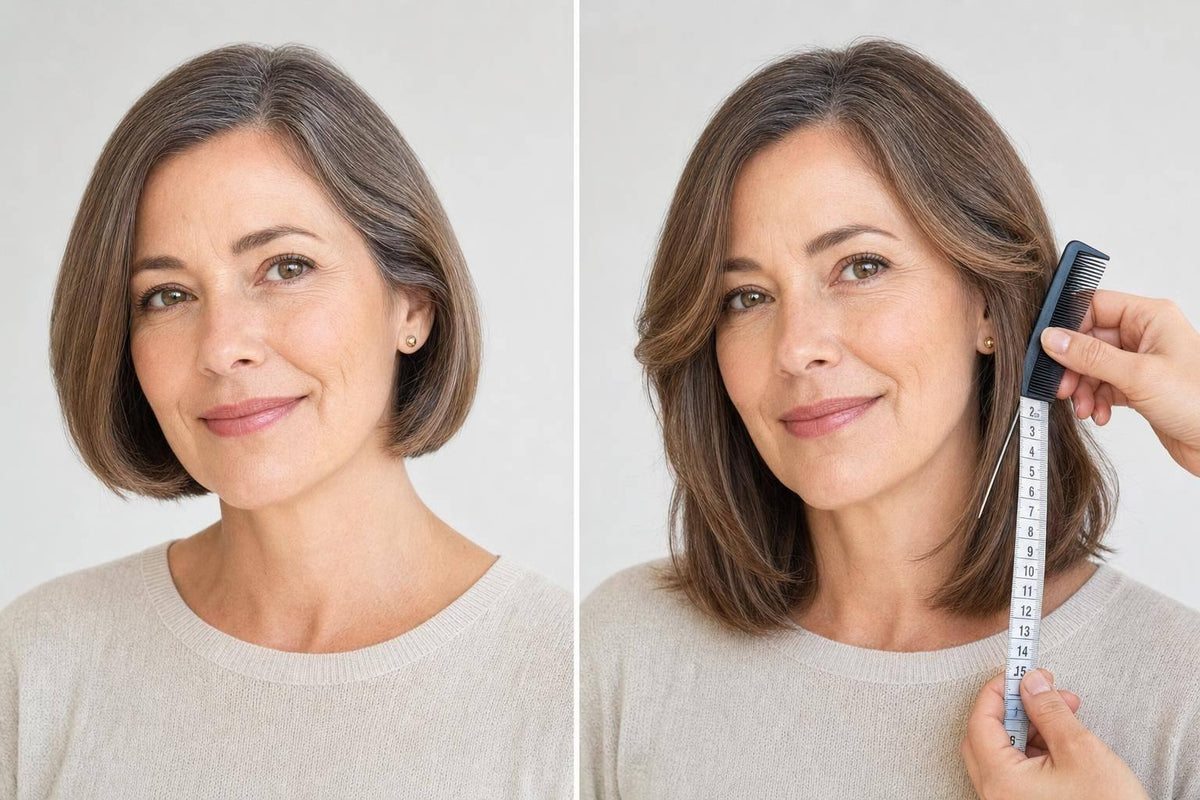
If I have short hair, the safest rule is simple: I keep my extensions within about 5–10 cm of my own length for a smoother blend. That one step does most of the heavy lifting.
Here’s the short version:
- Above chin: I’d look at 30–35 cm
- Chin to jaw bob: I’d look at 35–40 cm
- Jaw to collarbone lob: I’d look at 40–50 cm
- Shoulder length: I’d look at 50–55 cm
A few things matter just as much as the number on the pack:
- Extensions are measured straight, so waves or curls will sit shorter
- Blunt cuts show the join more easily than soft layers
- Colour match matters because even a small shade miss can make the line stand out
- Placement and extension type change how well short hair hides clips, tapes, or wefts
About 4 starting lengths and 5 extension types cover most short-hair cases, but the main aim stays the same: pick the shortest length that gives me the look I want without making the join obvious.
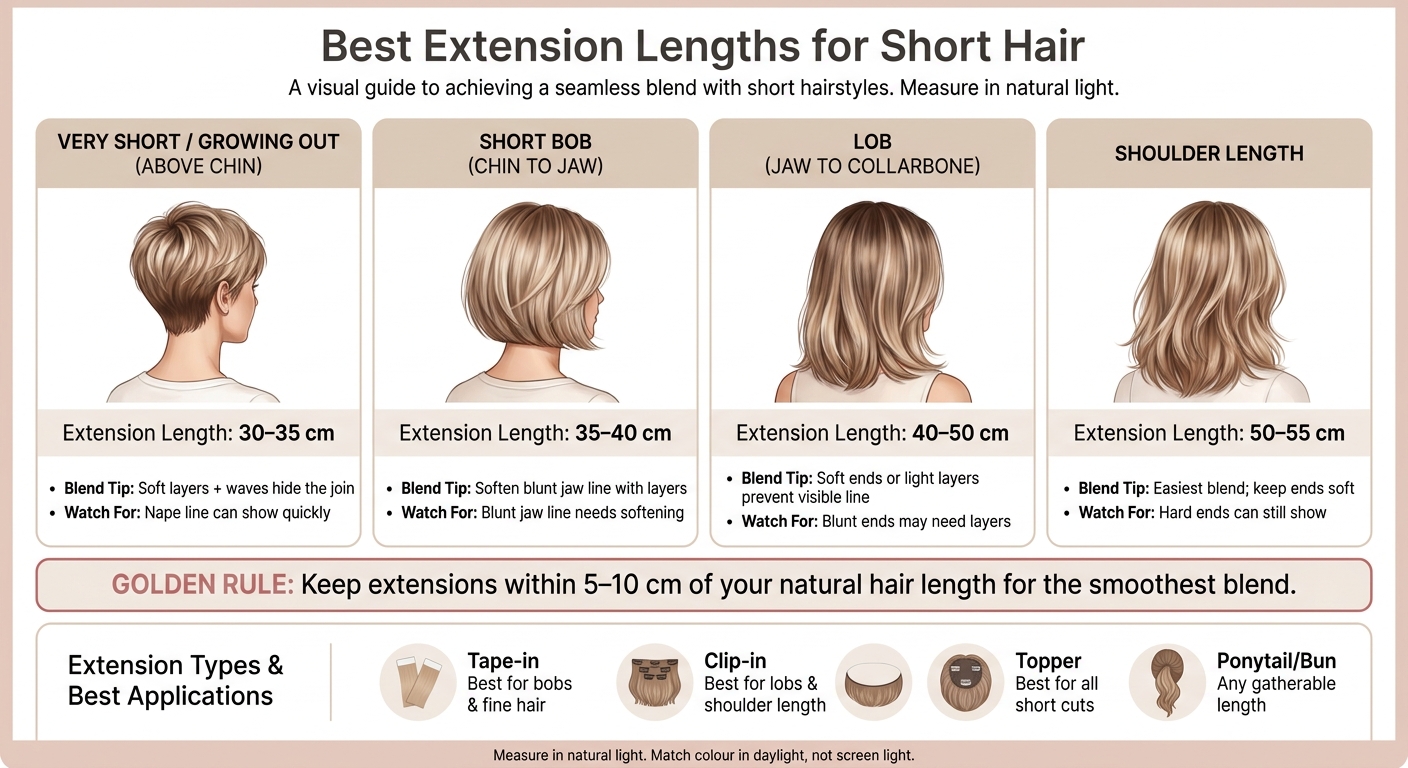
Best Extension Lengths for Short Hair: Quick Match Guide
How to choose the PERFECT length of hair extensions for your hair
sbb-itb-08feb2f
Quick Comparison
| Starting cut | Best length range | Main thing I watch for |
|---|---|---|
| Very short / growing out | 30–35 cm | Nape line can show fast |
| Short bob | 35–40 cm | Blunt jaw line needs softening |
| Lob | 40–50 cm | Blunt ends may need layers |
| Shoulder length | 50–55 cm | Easier blend, but hard ends can still show |
So if I want short hair extensions to look natural, I focus on length, cut shape, colour match, and attachment method instead of just buying the longest set.
How Extension Lengths Work on Short Hair
Extension length won’t land in the exact same spot on every person. Your height and neck length both change where the hair falls, so one length might work nicely on one short cut and sit too high or too low on another. You’ll often notice this most at the back of the neck.
With short hair, it usually helps to keep your extension length within about 5–10 cm of your natural hair length, such as with 14 or 16-inch extensions. That gives you a softer blend and helps the extension sit more naturally. Use that as your starting point when matching the right length to each haircut in the table below.
Quick Comparison Table
Use the guide below to match your extension length to your starting cut. Each range follows the 5–10 cm blend rule from the previous section.
| Starting hair length | Best extension length range | Why it blends well |
|---|---|---|
| Very short or growing out (above chin) | 30–35 cm | Adds length without an extreme jump; layers help disguise the gap |
| Short bob (chin to jaw) | 35–40 cm | Sits past the collarbone; enough difference to change your look without clashing |
| Lob (jaw to collarbone) | 40–50 cm | Reaches mid-back; soft layers at the ends help hide the join |
| Shoulder length | 50–55 cm | Lands at mid-back to waist; closest match in texture, easiest to blend |
Next, we’ll look at each starting length in more detail.
1. Very Short Hair or Hair That's Growing Out
With very short hair, the aim is simple: add some length without making the join obvious.
Hair at this stage usually blends best with 30–35 cm extensions. That smaller jump in length looks more natural and makes the join much easier to hide. If you go too long too soon, the change can look harsh, especially around the nape.
Soft layers make a big difference here. They help break up that line at the back of the neck, so the shift between your natural hair and the extensions looks less blunt.
Styling matters too. Soft waves tend to hide the join far better than pin-straight hair. Straight styles can draw attention to any difference in thickness or texture, while waves help everything melt together a bit more smoothly.
Once your hair reaches chin length, blending usually gets easier, and slightly longer extension lengths can sit more naturally.
2. Short Bob
Once hair hits chin to jaw length, blending gets a lot easier. A short bob works well with 35–40 cm extensions. That gives you enough extra length to shift the shape without creating a harsh line at the jaw.
A soft finish tends to blend better than a blunt edge. Choosing the right hair extensions is key to achieving this seamless transition.
From here, a lob can handle slightly longer lengths more naturally.
3. Lob
A lob gives you a bit more room to play with, which makes blending easier and cuts down the need for a big leap in length.
A layered lob tends to work best with 16–20 inch extensions. That length falls past the collarbone, so you get enough extra hair to shift your look without making the join too hard to hide.
If your lob is blunt, softer ends or light layers usually help stop the extensions from showing as a clear line. And if you style your hair in waves, the join is often much less obvious than it would be with a sleek, straight finish.
When your hair already sits on the shoulders, you can usually go a little longer with fewer blending issues and less chance of ending up with a harsh line.
4. Shoulder-Length Hair
Shoulder-length hair gives you the smoothest blend out of the shorter hair lengths.
Suggested extension range
50–55 cm extensions are usually the sweet spot here. They give you a clear jump in length without pulling the join too high.
Approximate finished position
On most people, that finished length will sit around mid-back to waist, depending on your height and neck length.
Best result
The best result is a longer look with the least visible blend line.
Main blending consideration
Shoulder-length hair does a better job of hiding the join than shorter cuts. That said, blunt ends can still give the game away. If the ends look too sharp or heavy, the join can start to show.
That’s why the focus at this stage shifts a bit. It’s less about getting enough length and more about making the join disappear. Keep the ends soft, and skip a blunt finish if you want the blend to look smooth.
Even at this length, a hard end line can still stand out, so the next step is softening the transition.
How to Avoid a Harsh Line with Short Hair Extensions
Even if you pick the right length, short hair extensions can still look blunt if the colour is even slightly off. Start with colour matching. Screen colours can shift, so check the shade in natural light to help the join blend in instead of standing out.
If your hair has highlights or regrowth, go for a multi-tonal shade instead of a flat colour. That small choice can make a big difference. Hair rarely sits in just one solid tone, so extensions shouldn’t either.
Once the shade is right, the next part comes down to extension type and placement. That’s what shapes how smooth and natural the blend looks.
Extension Types That Work Well on Short Hair
Once you've settled on length and colour, the attachment method plays a big part in how natural extensions look on short hair. Not all extension types blend the same way. On shorter cuts, the method itself, the weft thickness, and how well the piece fits can make or break the final look.
Tape-in extensions tend to work very well for short or fine hair. The adhesive bonds sit flat against the scalp, which helps avoid bulk at the root. That matters on short hair, because extra thickness can push your own hair out and make the join easier to spot. With tape-ins, the transition usually looks smoother.
Clip-in extensions give you more control over where the hair sits. That makes them handy when you're trying to soften a blunt line. Instead of adding one thick section, you can place smaller pieces in layers to break up that harsh step between your own hair and the added length.
Halo extensions create a similar visual effect. They use one wide weft attached to an invisible wire, so they're simple to put on and take off. But there's a catch: they need a bit more natural length to sit under. If the base cut is too short, there may not be enough hair to cover the top of the weft well. On a blunt bob, that can leave a visible line, so halos are usually a better match from lob length and up.
Some pieces skip the blending issue altogether. Ponytail pieces and bun extensions wrap around the hair you've gathered at the base, then cover it. Because of that, there's no visible blend line to deal with. Toppers work a bit differently. They clip into the crown and add volume at the root, which can help soften the shift into longer lengths.
Silkara Hair offers 100% Remy human hair extensions and hair pieces, with free colour matching and AI virtual try-on on selected products to help narrow the right shade, base and length. [1]
Use the table below to match each type to the cut it suits best.
| Extension Type | Best For | Key Advantage on Short Hair |
|---|---|---|
| Tape-in | Bobs, fine hair | Lies flat; no bulk at the join |
| Clip-in | Lobs, shoulder-length | Flexible placement breaks up blunt lines |
| Halo | Lobs, shoulder-length | No clips or glue; easy on and off |
| Topper | All short cuts | Adds root volume for a gradual transition |
| Ponytail / Bun | Any length that can be gathered | No blending required |
Final Selection Checklist
Use these checks to narrow down the right length from the table above.
- Measure from where the extensions will sit, then measure to the ends of your natural hair. This gives you a proper starting point.
- Decide where you want the final length to land. Then work backwards from the result you want, so you can pick the length that fits.
- Choose the shortest length that still reaches your target. Larger gaps are harder to blend, and that can make the finish look less natural.
- Allow for shrinkage and height, which change where the hair falls. Curly or wavy hair often sits shorter than it looks when measured flat.
- Check that your natural hair can cover clips, tapes or wefts. Then match the shade so the blend disappears.
- Match colour in natural daylight, not under screen or indoor light.
Conclusion
For short hair, the best extension length is the shortest one that blends neatly with your cut. Start with your own hair length, then go longer only if it still blends well. That’s the simplest way to avoid a harsh line and keep the finish natural.
If you need help choosing, Silkara Hair offers free colour matching and AI virtual try-on on selected products.
FAQs
Can I wear long extensions with a short bob?
Yes, you can. The key is picking the right length and density so your extensions blend smoothly with your own hair.
Silkara Hair focuses on 100% Remy human hair extensions made to add length and volume with an easy at-home change. Done well, they help you avoid a harsh line and keep the finish looking natural.
Do I need layers to blend extensions into short hair?
It depends on your hair texture and the look you’re after, but layers usually help extensions blend more naturally with short hair.
They create a smoother transition between your own hair and the extensions, so you’re less likely to end up with a harsh, blunt line. Silkara Hair can also offer personalised guidance on the right length and style for a smooth, natural-looking finish.
Which extension type hides best in short hair?
For short hair, a high-quality hair topper or halo extension usually gives the most natural blend.
Why? Because both add volume and length while helping disguise the point where your own hair meets the extension. That makes the finish look smoother and less obvious.
Silkara Hair offers 100% Remy human hair toppers and halo extensions made to blend in naturally, without harsh lines.