
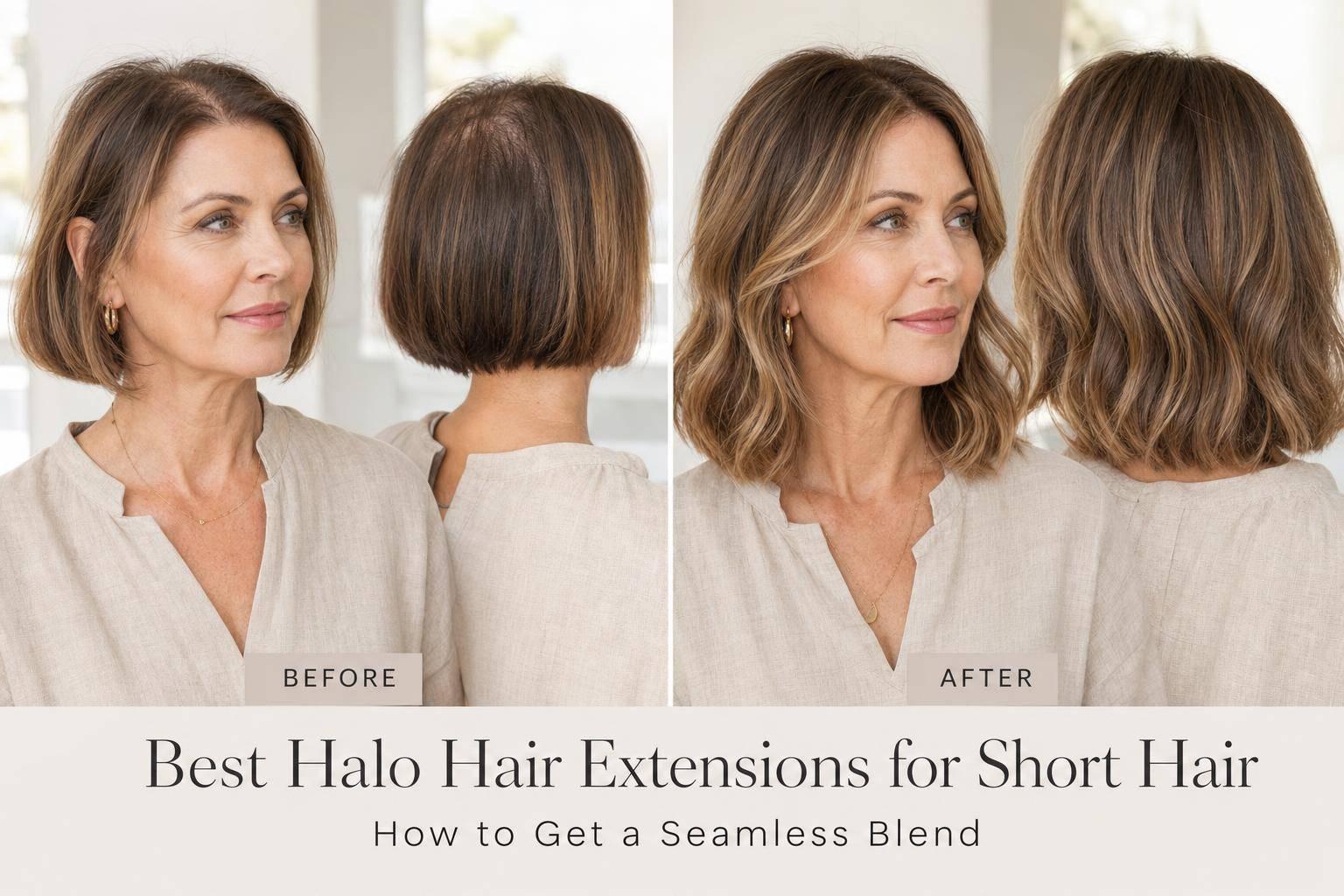
If your hair is shorter than shoulder length, a halo can be hard to hide. In most cases, I’d only expect a smooth result when natural hair is about 15–18 cm (6–7 inches) long or more.
Here’s the short version:
- Shoulder-length hair is the easiest short cut for halo extensions.
- Lobs can work well, but blunt ends often show the join.
- Chin-length bobs are the hardest because there’s less hair to cover the wire.
- I’d keep added length to about 5–10 cm for a more natural finish.
- Waves or curls usually hide the line better than poker-straight styling.
- If your ends are thick and blunt, a lighter halo and a small trim can help stop that shelf-like look.
What matters most isn’t just the halo itself. It’s your starting length, end shape, density match, placement, and styling. Get those right, and short hair can blend well with a halo.
Quick comparison
| Hair length/cut | How hard it is to blend | Best halo approach | Best styling |
|---|---|---|---|
| Chin-length bob | High | Light density, small length change | Waves or curls |
| Lob | Medium | 12–14 in / 30–35 cm, softer ends | Soft waves |
| Shoulder-length | Low | Up to 16 in / 40 cm, match density to hair | Straight or wavy |
I’d treat this as a simple checklist: enough length, not too much added length, the right density, and styling both your hair and the halo together.
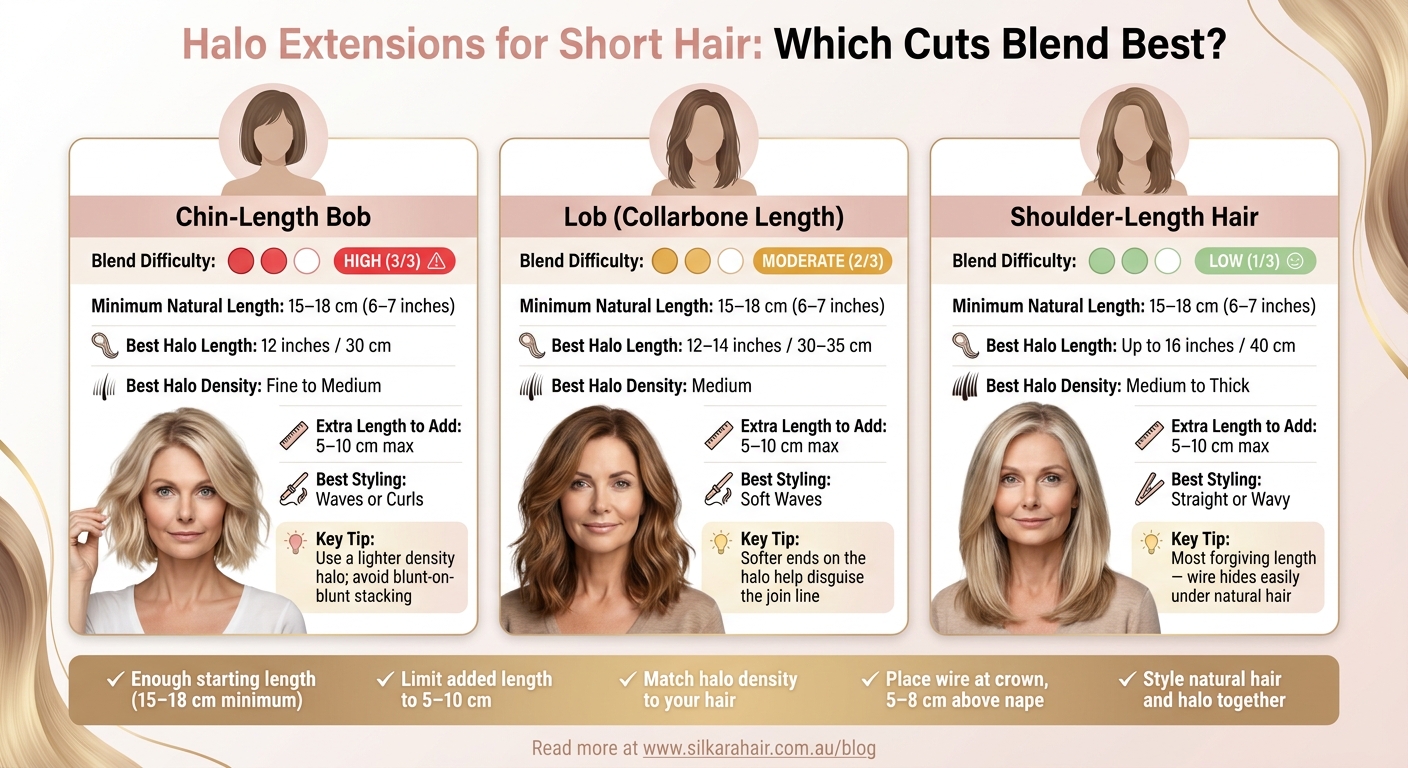
Halo Extensions for Short Hair: Blend Difficulty by Cut Type
Which Short Hair Lengths Work With a Halo Extension
Your starting length matters a lot here. So does the way your ends are cut. Those two things shape how easy it is to hide the join.
Minimum Hair Length Needed for a Convincing Blend
For a halo to blend well, natural hair should be at least shoulder-length, around 15–18 cm (6–7 inches) [4][5]. At that length, your own hair can fall over the wire and soften the step between your ends and the extension [4]. Go shorter than that, and it gets much harder to hide the transition.
Short crown layers can cause the same issue. If those layers don't fall far enough to cover where the wire sits, the extension line can peek through [1][4].
After that, the shape of the cut makes a big difference.
How Bobs, Lobs and Shoulder-Length Hair Blend Differently
Chin-length bobs are the hardest to blend. There just isn't enough length to cover the wire well, and the contrast between your natural ends and the halo hair stands out more [1][4].
Lobs sit somewhere in between. You get more hair to hide the wire, but a blunt finish can still make the join easier to spot [1][4].
Shoulder-length hair is the easiest short length to work with [4][5]. It has enough drop and weight to cover the wire better, and the shift between your own ends and the extension looks much softer. Once you're at shoulder length, the next step is picking the right straight halo length and density.
Next, match the halo's length and density to your natural hair so the blend stays believable.
sbb-itb-08feb2f
How to Choose the Right Halo Length and Density
How Much Length to Add for a Natural Result
Start by matching the halo length to your haircut. If you have a bob, go for 12 inches (30 cm). For a lob, 12–14 inches (30–35 cm) tends to work best. And if your hair sits around shoulder length, 16 inches (40 cm) is usually the right fit [1].
A simple rule helps here: keep the extra length to about 5–10 cm. That gives you the cleanest blend because your own hair can fall over the wire and soften the line where the halo starts [1].
Matching Halo Density to Fine, Medium or Thick Hair
Density matters just as much as length. If your hair is fine, use lighter halo hair extensions. That makes it easier to hide the wire and helps the ends blend without looking too bulky. If your hair is thicker, you can wear more weight.
That said, very thick, blunt-cut hair can be one of the trickiest types to blend. On a blunt bob, a lower-density halo with softer ends usually works better because it helps avoid that obvious shelf effect [1]. In this case, light layers through the ends do more for the blend than piling on extra hair.
Blunt cuts tend to show the join faster, which is why styling can make such a big difference.
Quick Comparison: Short Hair Type, Blend Difficulty, Density and Styling
Use this quick guide to line up the right length, density and styling with your cut.
| Hair Cut | Blend Difficulty | Best Halo Density | How to style |
|---|---|---|---|
| Bob (chin-length) | High | Fine–medium | Waves or curls |
| Lob (collarbone) | Moderate | Medium | Soft waves |
| Shoulder-length | Low | Medium–thick | Straight or wavy |
Why Blunt Cuts Are Harder to Blend With a Halo
How Blunt Ends Make the Join More Visible
On short hair, blunt ends can make a halo harder to hide because the cut has no taper to soften the join. A blunt cut has straight, even ends that don’t taper. With a halo, those ends tend to sit over the extension instead of blending into it, and that can leave a harsh line where the two meet.
That line tends to show more when your natural hair is thick or when the halo is much longer than your own ends. It’s a bit like laying a straight edge over a softer shape - the contrast stands out.
That shape issue is the main reason styling and light texturising matter so much.
When Softening or Layering the Ends Helps
Curl or wave your natural hair and the halo together to soften the join. The texture breaks up the hard line where your ends meet the extension, so the blend looks less obvious. It also helps your own hair fall into the halo instead of sitting on top of it.
For a longer-term fix, ask your stylist to lightly texturise the ends. You can also have the halo trimmed or lightly layered to take out bulk and better match your cut.
After that, placement does the rest of the blending work.
How to Place, Blend and Style a Halo on Short Hair
Short hair needs a bit more care with placement and styling. There’s simply less length to cover the join, so small tweaks make a big difference.
Where to Position the Halo on Short Hair
Once you’ve got the right length and density, placement does most of the heavy lifting.
Start by sectioning your hair about 2.5 cm back from your hairline and 5–8 cm above the ears. Clip the top section up, and leave the front pieces loose so they can cover the wire later [6].
Then place the halo so the wire sits around the crown. The sides should tuck just above the ears, while the back should sit 5–8 cm above the nape. Use a tail comb to pull your natural hair over the wire until it’s fully hidden [1].
If your hair is fine or quite short, set the wire a little lower. That gives you more hair on top to blend with [1]. If you want extra hold, pick wavy halo extensions with clips. They anchor the piece to your hair and help stop it from shifting [1][3].
Once the wire disappears, style your natural hair and the halo together. That’s what helps soften the join.
Style Natural Hair and the Halo Together for a Cleaner Finish
Curling or waving your natural hair and the halo at the same time is the easiest way to hide the join and help everything flow together [1][3].
Match the styling method to your haircut and hair type. A blunt bob usually looks better with wavy halo hair extensions, because they blur the transition line. A softer lob can often work with a straighter finish.
| Styling Method | Best For | Blend |
|---|---|---|
| Curling or waving | All hair types, especially blunt cuts | Masks the transition line |
| Straightening | Fine, naturally straight hair | Works best with a very close colour and density match |
If you’re using heat, apply a heat protectant first and keep your tool between 150°C and 180°C [3][2].
Trim or Layer the Halo to Reduce Bulk and Soften the Shape
Even with good placement and styling, a halo can still look bulky if the length drops too sharply from your natural ends. If that happens, ask for a light end trim so the halo doesn’t sit too heavy at the bottom.
FAQs
Can I wear a halo with a chin-length bob?
Yes - but getting it to blend well usually takes a bit of styling.
If you have a chin-length bob, you can often wear a halo hair extension and make it look natural. The main job is helping your shorter hair mix in with the extension.
A few things can help:
- Curl or wave your natural hair and the halo together so they sit as one
- Place the halo a little lower on your head to help hide shorter ends
- Pick a length that’s closer to your own hair
- Add soft layers so the extension doesn’t look too blunt or obvious
Done well, the result can look smooth and natural instead of looking like two different hair lengths sitting on top of each other.
How do I stop a halo looking obvious on blunt ends?
Blunt cuts tend to create a harsher line, which can make the join more obvious. For a softer blend, ask a stylist to trim your natural hair or add light, soft layers.
You can also have the halo trimmed or lightly layered while you’re wearing it so it matches the way your own hair falls and moves. Another simple fix is to mix two extension lengths, which can help hide the line.
Should I trim or layer the halo to blend it better?
Yes. Trimming or adding light layers to your halo can help it blend better, especially if your natural hair has blunt ends that make the line between your hair and the extension easier to see.
Light layers soften the ends of the extension, which helps the whole look feel more natural. For the best result, ask a professional stylist to trim or layer the halo while you’re wearing it. Curls or waves can also make the blend look smoother and less obvious.