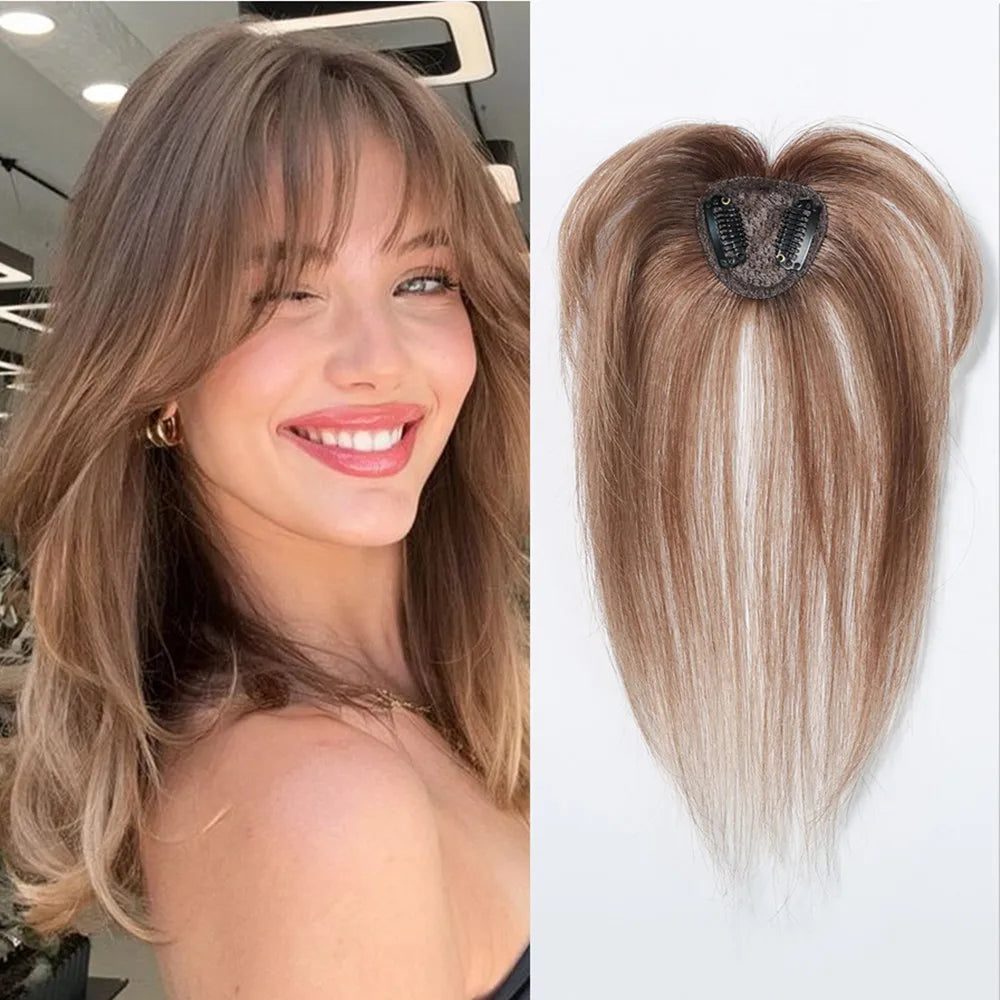


A topper blends into a bob when four things match: flat base, right length, light density, and the same part. If one is off, a bob shows it fast.
Here’s the short version of how I’d do it:
- Start with clean, dry hair so clips hold better.
- Flatten bulk at the crown and sides so the base sits close to the scalp.
- Choose a topper slightly longer than the bob - about 2.5–5 cm longer gives room to trim.
- Keep density light to moderate (around 120% density) so the top doesn’t look too thick next to the sides and back.
- Place the front edge 2.5–5 cm behind the hairline and clip in front, back, then sides.
- Leave a little of your own hair out at the front and sides to cover the base edge.
- Point-cut the join instead of cutting straight across, so the ends look softer.
A bob has less room to hide mistakes than long hair. The crown is more visible, the outline is sharper, and extra bulk on top can show at once. That’s why I’d focus on prep, placement, and light finishing - not heavy styling.
A few numbers matter here: 15–30 cm topper lengths tend to suit most bob lengths, and trimming with the topper just 2.5–5 cm longer than your cut makes blending much easier.
Use this as your quick guide before you start:
| Area | What I’d aim for |
|---|---|
| Base | Small or compact, sitting flat |
| Length | 2.5–5 cm longer than the bob |
| Density | Light to moderate |
| Front placement | 2.5–5 cm behind hairline |
| Clip order | Front → back → sides |
| Finish | Point-cut, light thinning if needed |
If I wanted the blend to last all day, I’d keep the shape light, match the texture to the bob first, and check the part and edges in natural light.
Prepare the bob so the topper sits flat
Start with clean, dry and detangled hair
A bob shows every bump, so the hair underneath needs to be smooth before you clip in the topper. Oil and product build-up can stop the clips from gripping well [1].
"Wash and dry your hair thoroughly to keep it fresh and free from heavy oils." - Noelle Salon [1]
Once your hair is fully dry, brush it through from root to ends. Knots and tangles near the roots can stop the base from sitting flush against the scalp and may leave ridges under the topper. If your hair feels a bit too slippery, mist the roots with dry shampoo or texture spray to give the clips more grip. It also helps to match your natural hair texture to the topper before clipping it in.
With the hair clean and dry, the next job is to deal with any extra bulk around the crown.
Flatten bulky spots at the crown and sides
Bulk at the crown and sides can stop the topper from sitting flat. Thick bobs often hold volume right where the topper base needs to go. When that happens, the topper can lift away from the scalp and take on a helmet-like look.
Before you place the topper, check the crown and sides for any bulky sections. Pin those areas flat against the head with bobby pins. As you secure each clip, press the base flat against your head. That small step can help stop bumps from forming underneath.
After clipping it in, run your fingers along the edges of the base. If you feel bumps, unclip the topper and pin the natural hair underneath a bit tighter before trying again. A smooth base helps the topper sit flush.
Once the base is flat, match the topper's length, density and parting to the bob.
sbb-itb-08feb2f
Match the topper to the bob before you clip it in
Once your bob is prepped and lying flat, check the topper before you clip it in. The length, density, part, and base size need to suit the cut as a whole. If one of those is off, the blend can look awkward fast.
Length, density and parting must work together
Pick a topper that's 2.5–5 cm longer than your bob. That extra length gives you space to trim and feather the ends after it's clipped in, so it melts into your cut instead of leaving a blunt line.
Density is where short styles often go sideways. If there's too much hair in the piece, the shape can turn round and puffy, which makes the topper stand out.
"A common mistake is going too thick. That creates a 'mushroom head' effect and instantly gives the hairpiece away." - Leo, Hairstylist [3]
For bobs, natural or moderate density tends to work best for a soft finish. The part matters too. Match the topper's parting to your own. If you normally wear a side part and place a centre-part topper on top, it will usually show.
Fit table: matching a topper to a bob
Use this table to line up topper length, density, and base size with your bob.
| Bob Style | Recommended Topper Length | Ideal Density | Best Base | Parting Strategy |
|---|---|---|---|---|
| Jaw-length bob | 15–20 cm | Light to moderate | Small silk or monofilament | Align with your natural part; place the front edge 2.5–5 cm behind the hairline |
| Chin-length bob | 20–25 cm | Natural or moderate | Compact silk | Centre or side part; leave a thin section of your own hair at the front to soften the edge |
| Longer bob (lob) | 25–30 cm | Moderate | Medium mono or silk | Multi-directional parting; blend into existing layers |
The base should cover the thinning area, but it shouldn't run into the denser crown and sides. If it reaches thicker hair, the clips can end up sitting on bulk instead of flat against the scalp. When that happens, the topper may lift and look less secure.
Once the fit looks right, clip it in and blend the front, part line, and sides.
Place, secure and blend the topper into the bob
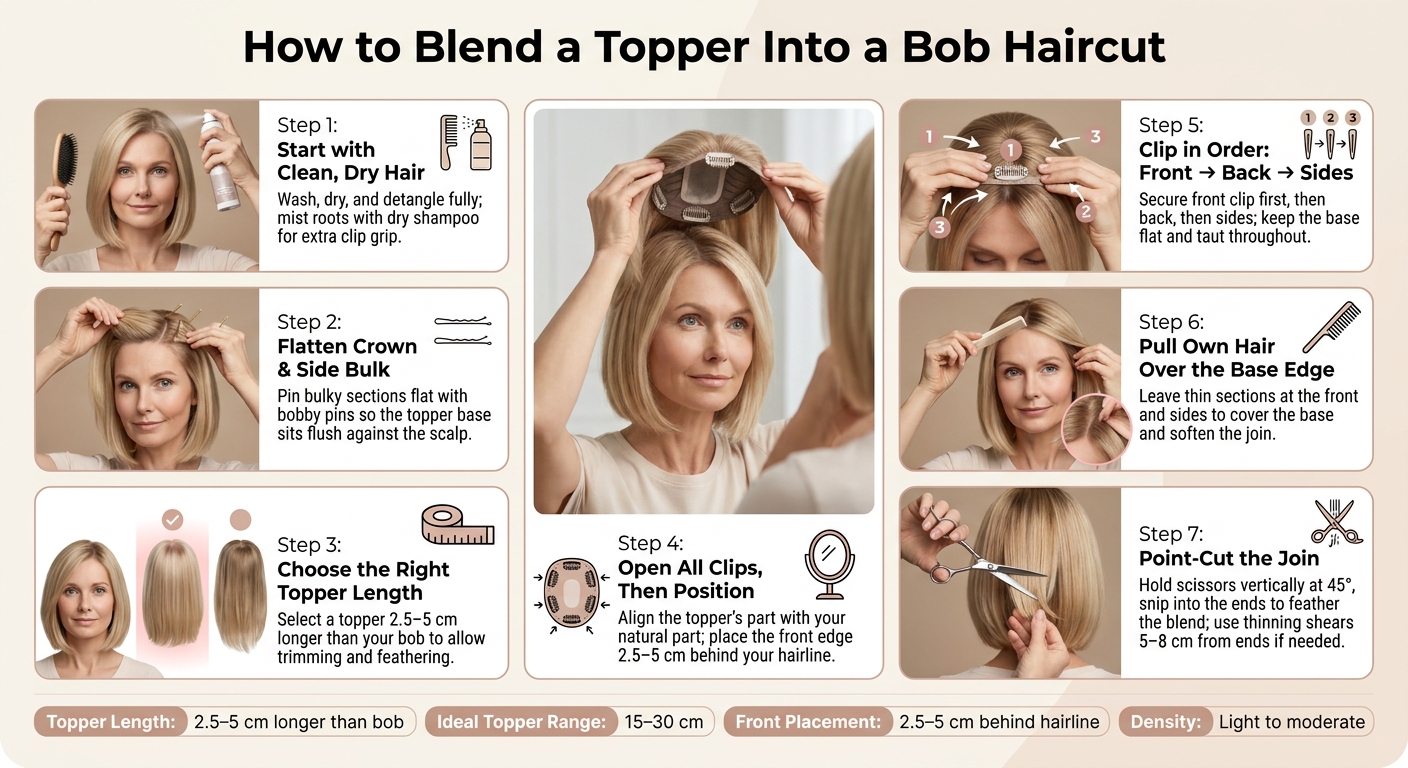
How to Blend a Topper Into a Bob Haircut: Step-by-Step Guide
Position the topper and secure the clips in the right order
Once your topper matches your bob, it’s time to clip it in properly so it sits flat and blends in with your own hair.
Open all the clips before you place the topper. This helps you avoid pulling on your own hair while you’re trying to secure it. [1]
Set the topper over your head and line up its part with your natural part. The front edge should sit about 2.5-5 cm behind your natural hairline. That small gap matters. It gives you room to pull some of your own hair forward and cover the base edge, which helps hide the join. If your hair is fine or silky, lightly roughen each clip point first so the clips have a better grip. [1][2]
"Place the front clip about 1-2 inches behind your natural hairline. Secure the front clip first. Hold the base flat and taut against your head. Clip the back next, then the sides." - Henry Xiang, Founder at Alpha Hair [2]
Clip the topper in this order: front first, then the back, then the sides. As you go, keep the base flat against your head. After that, check around the edge for any bumps, lifting or gaps. If a section isn’t sitting right, unclip it and secure it again. [1][2]
Blend the front, part line and side sections
Once the base is secure, the next step is making the front and sides look soft and natural.
Leave out a few thin sections at the front and sides, then smooth them over the base edge with your fingers. This helps keep the blunt line of the bob from looking too harsh. Use a paddle brush or a wide-tooth comb to blend the topper into your bob, and keep one hand lightly on the base while you do it so nothing shifts out of place. [1][2]
If the part still looks a bit sharp, use a root concealer spray or powder that matches your natural colour to soften the line. Then move your head from side to side and check that the topper stays secure. [1][2]
Finish the shape and keep the blend natural all day
Trim, layer and style the topper with the bob
Once the topper is secure and the front is blended, the last step is making it look like it belongs with the bob. The goal is simple: style the topper and your bob as one shape, not two separate pieces.
Start by styling the bob first. Straighten it, add a wave, or softly bevel the ends based on how you normally wear it. That matters because you want to trim the finished shape, not the unfinished one. When the bob already sits the way you like, the join is much easier to tidy up.
Then use sharp scissors to point-cut where the topper meets your bob. Hold the scissors vertically and snip into the hair at a 45° angle instead of cutting straight across. That gives you a softer, feathered edge rather than a blunt line that can make the join stand out. If the area still feels a bit heavy, use thinning shears about 5–8 cm from the ends to take out some weight. [4]
For very short bobs, the front hairline can be the hardest part to hide. In that case, a topper with a built-in fringe can do a lot of the work for you by helping cover the front join. [1][2]
Key points to remember for a smooth bob blend
"Always cut less than you think you need. You can always trim more, but you can't put hair back!" - Henry Xiang, Founder, Alpha Hair [4]
Finish with small tweaks. Point-cut the join, soften the ends, and check the part in natural light.
FAQs
Can I wear a topper with a very short bob?
Yes, you can absolutely wear a hair topper with a very short bob. It’s a simple way to add volume and coverage without wearing a full wig.
For the most natural look, pick a lightweight topper that matches your hair length, density, and texture. With the right fit and clip placement, it can blend in well and feel secure and comfortable.
How do I stop a topper looking bulky on a bob?
Choose a smaller, lightweight topper so the base sits flat against your scalp and blends with your natural hair density. If there’s too much volume, it can swamp fine hair and make the separation stand out more.
Size matters too. A base that’s too large can add bulk, while one that’s too small may not stay in place well. A professional stylist can trim and layer the topper while you’re wearing it, which helps it sit and look more natural.
Should I trim the topper myself or see a hairdresser?
For the most polished, natural finish, it’s a smart idea to see a professional stylist. They can cut and blend the topper while you’re wearing it, so it melts into your bob and looks like part of your own hair.
You can style a human hair topper at home. But for precise shaping and a flawless, customised result, a stylist makes a big difference.