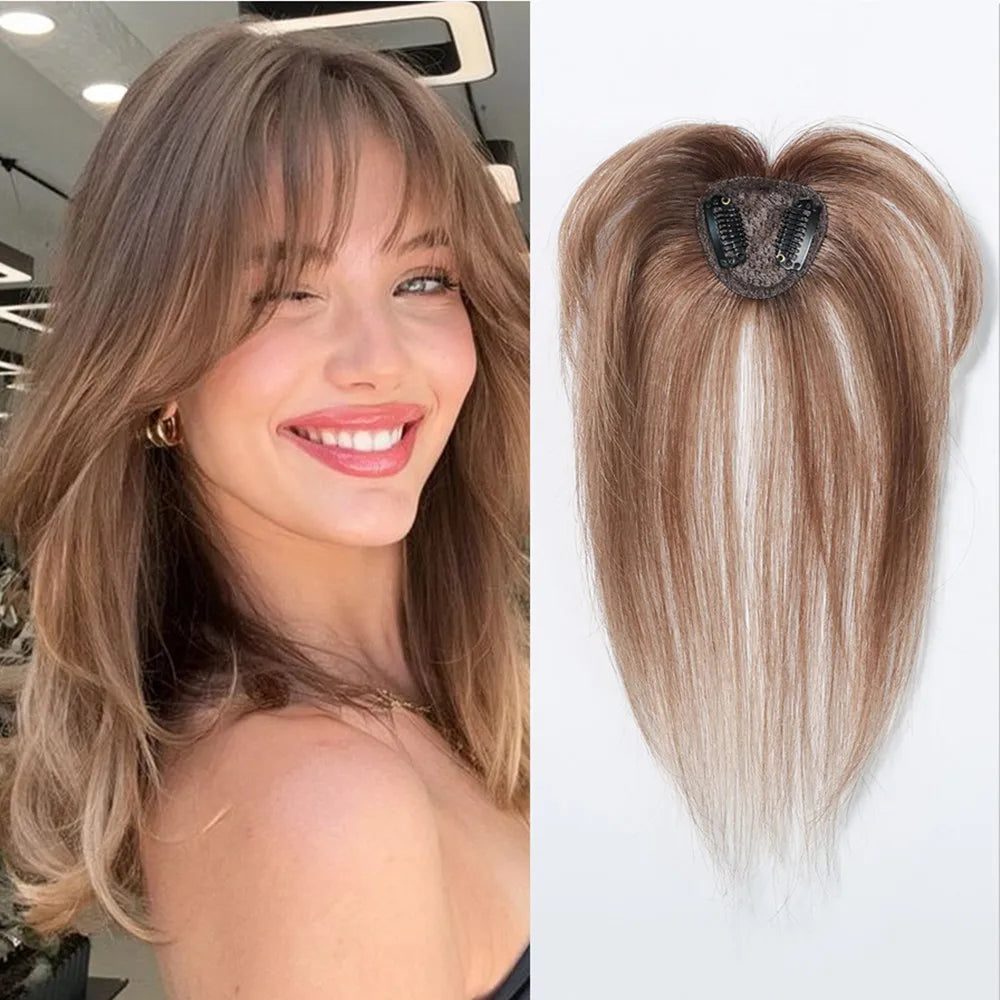

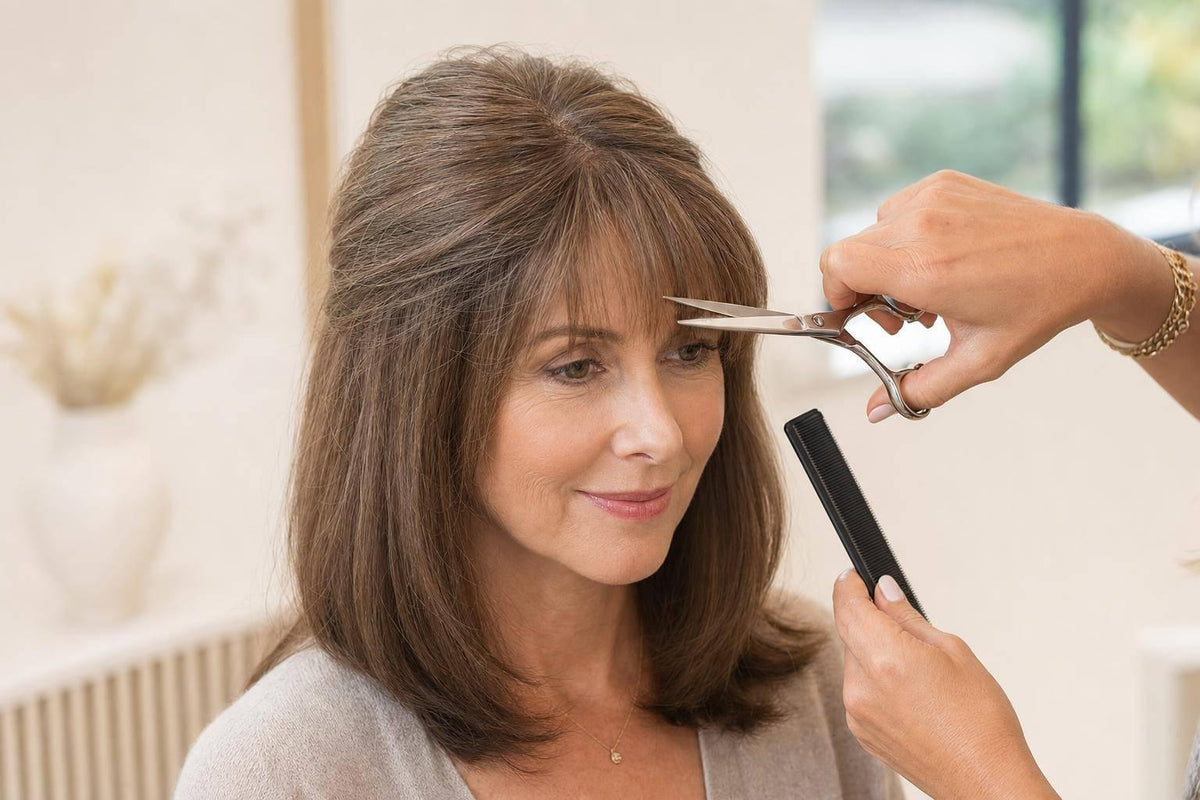
Yes - if your topper is human hair, I can cut, layer, and thin it, but I need to keep it light and careful.
If I cut too much, I can’t put the hair back. That matters because trimming changes coverage, blend, and how long the topper lasts. Most human hair toppers last about 6–12 months, and some can last up to 2 years with gentle styling and small trims.
Before I touch scissors, here’s the short version:
- Human hair toppers can be cut, layered, and lightly thinned
- Synthetic toppers can usually be trimmed for length, but thinning is riskier
- I should trim small amounts only, especially around the crown and front
- If the topper looks puffy, bulky, or too dense, light shaping may help
- If it has a lace or silk base, or needs layers or fringe work, a hairdresser is the safer choice
- For home trims, I should stick to tiny tidy-ups on the ends only
A few simple signs tell me a topper may need shaping: it’s too long for my haircut, it sits high at the crown, the part line looks heavy, or the front pieces don’t sit well around my face.
| Area | What I can do | Main caution |
|---|---|---|
| Length | Trim ends, soften shape | Every cut is permanent |
| Density | Light thinning through mid-lengths or ends | Too much can show the base |
| Fringe/front | Tidy and shape on dry hair | Wet cutting can end up too short |
| Crown/hairline | Minor shaping | Base damage is easy here |
| Synthetic fibre | Small length trim only | Thinning often goes badly |
My rule of thumb: cut less than I think I need. If I’m making a first cut, changing the style, or thinning near the base, it’s better to have a hairdresser do it.
Here’s the plain-English guide to what I can cut, when thinning makes sense, and when I should leave it alone.
What you can safely do to a topper
Cutting length, layers and soft ends
You can trim a topper to match your haircut. If the topper is too long, it can look separate from your own hair even when the colour match is spot on.
For length, point cutting works well. The scissors are held at a 45-degree angle and snipped into the ends, which gives a softer edge [1][2]. Long layers also help. They add movement and stop the topper from looking flat [1][2].
Removing bulk from thick sections
If a topper feels heavy through the mid-lengths or the ends look too dense, thinning shears can take out extra weight. Keep thinning 2–3 inches from the ends and cut diagonally instead of straight across [1]. That takes out bulk bit by bit without going near the base, which is where you need the most density for coverage.
Toppers come in low (110–120%), medium (130%), and high (150–180%) density [2]. On fine hair, a high-density topper can look bulky. Thinning can bring it closer to the way your own hair falls, so both sit together more naturally [2].
Shaping hair toppers with bangs and front pieces
Bangs, a fringe, and front pieces can be refined into wispy or curtain effects with careful trimming [1][2]. At the front and sides, those small sections do a lot of the visual work. Shaping them well can make the blend look more seamless [1][2].
Always shape bangs on dry, styled hair, not wet. Wet hair sits longer than it falls once dry, so trimming it wet can leave you with a fringe much shorter than you meant to cut [1]. Go slowly, trim in tiny increments, and leave the ends a little longer. Hair often settles shorter once styled [1].
Once you know what can be trimmed safely, the next step is working out whether the topper needs a cut at all.
sbb-itb-08feb2f
DIY Hair Topper Fix: Trimming & Blending for Beginners! | UniWigs Airy Elegance
When cutting or thinning a topper makes sense
Not every topper needs cutting. But there are three common cases where a trim or light thinning can help.
Matching a shorter haircut or existing layers
If your topper is longer than your natural hair, it will often need a trim so everything lines up. This comes up a lot after a haircut change, especially if you've moved to a bob, lob or another shorter style[1].
Reducing density for a more natural blend
If a topper feels too full or sits higher than your own hair, the result can look bulky or puffy. When that bulk shows up at the crown, the fix is often shaping rather than a full restyle[2].
Thinning can help if the topper looks too full at the crown or hairline, or if it feels too dense next to your natural hair[1][2].
Blending with other hair pieces
A topper can also be cut or thinned so it blends better with other hair pieces. In most cases, that means matching the length and the front sections[1].
For bigger changes, or if the base is fragile, the next step is working out whether a hairdresser should handle the trim.
Professional customisation versus at-home trims
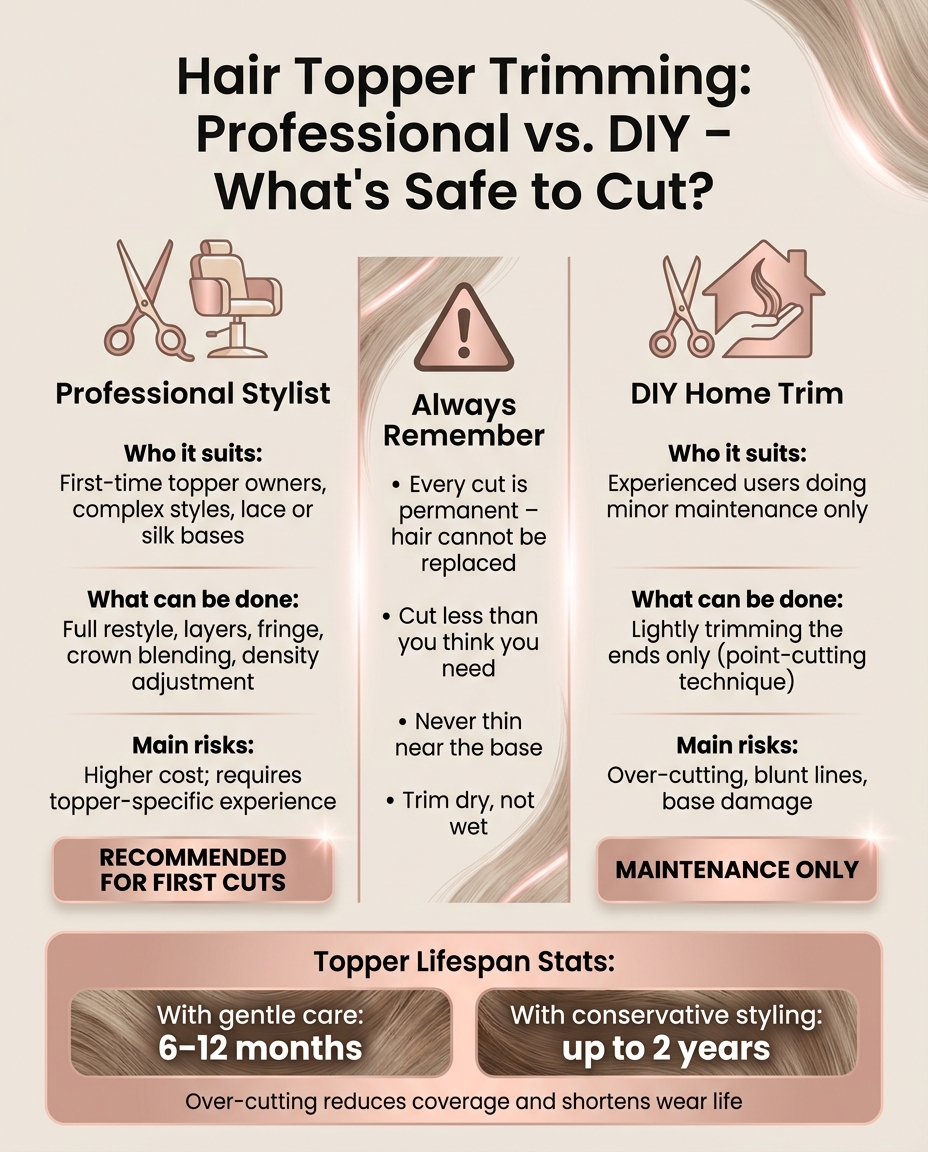
Hair Topper Trimming: Professional vs. DIY – What's Safe to Cut?
Once you know the topper needs shaping, the next step is simple: work out whether it needs a hairdresser or just a very small trim at home.
When to see a hairdresser
A hairdresser is the right choice for first cuts, layers, fringe work, density changes, or any blending that needs to sit neatly with your own hair. If the topper looks bulky at the hairline or creates a hard join, it needs professional blending.
This matters even more with a lace or silk base. A slip of the scissors near the base can weaken that natural scalp look. A stylist can also cut the topper and your own hair together, which helps avoid a harsh line where the piece ends.[2][4]
If all it needs is a slight tidy-up, a careful home trim may be enough.
What you can do carefully at home
For home upkeep, only trim a topper that has already been shaped by a professional. At-home trims should stay small and be for maintenance only. Take off a tiny amount at a time, then stop once the ends look even. Point-cutting helps soften the ends and avoids blunt lines.[1][4]
Even a small cut has an effect. Every snip changes how the topper blends, how much coverage it gives, and how long it lasts.
Comparison table: professional cut versus DIY trim
| Professional stylist | DIY home trim | |
|---|---|---|
| Who it suits | First-time owners, complex styles, lace or silk bases | Experienced users doing minor maintenance |
| What can be safely done | Full restyle, layers, fringe, crown blending, density adjustment | Lightly trimming the ends only |
| Main risks | Higher cost and a need for topper-specific experience | Over-cutting, blunt lines, base damage |
After the cut, the next question is how it changes blend and longevity.
How cutting and thinning affect longevity, blending and results
Protecting coverage and wear life
After the cut, the big issue is coverage and how long the topper will hold up. Every cut is permanent: once hair is removed, it cannot be replaced[1]. If you take out too much density, you can expose the base or reduce coverage[1][5].
That said, a careful cut can help the topper last longer. When a topper is easier to style and blend, you usually need less heat and less day-to-day handling[1][3]. And that can make a big difference over time.
With gentle care, a quality human hair topper can last 6–12 months, and up to 2 years with conservative styling[1][5]. Regular washing and heat styling can roughen the ends, so small maintenance trims may still be needed[1].
Blending starts before the scissors
Blending doesn't start with cutting. It starts earlier, with the right colour, density, base size, length, and whether you need a hair topper with bangs[1][5].
Get those choices right first. That means less correcting later, and less chance of over-cutting[1][5]. In plain terms, the better the topper suits you from the start, the less you need to do with the scissors.
Conclusion: go conservative for the most natural result
The safest move is to stay conservative. Cut less than you think you need[1]. You can always take more off; you can't put hair back.
FAQs
How do I know if my topper needs thinning?
Your topper may need thinning if the ends feel too thick, bulky, or heavy, or if it doesn’t blend in with your own hair.
If it creates a blunt line or doesn’t have much soft movement, thinning can help give it a more feathered finish. A simple way to check is to compare sections of the topper with your natural hair. If the topper looks much denser or sits too heavily, that’s usually a clear sign it needs a bit of work.
Can cutting a topper make it look less natural?
No. Cutting a hair topper usually helps it look more natural by helping it blend with your own hair, sit better, and feel less bulky.
When it’s done well, cutting, layering, and thinning can give the topper a softer, more seamless finish. For the best result, see a professional who has experience with hairpieces.
How often should I trim my hair topper?
There’s no fixed schedule for trimming your hair topper. Just trim it when it needs a tidy-up so it keeps its shape, holds its style, and blends in with your own hair.
A lot of people get their topper cut and blended by a hairdresser when they first buy it. After that, if the ends start to look a bit tired or the shape doesn’t suit your style anymore, a light trim can help it look neat again.
The main thing is to go slowly. Trim very small amounts at a time so you don’t take off too much.