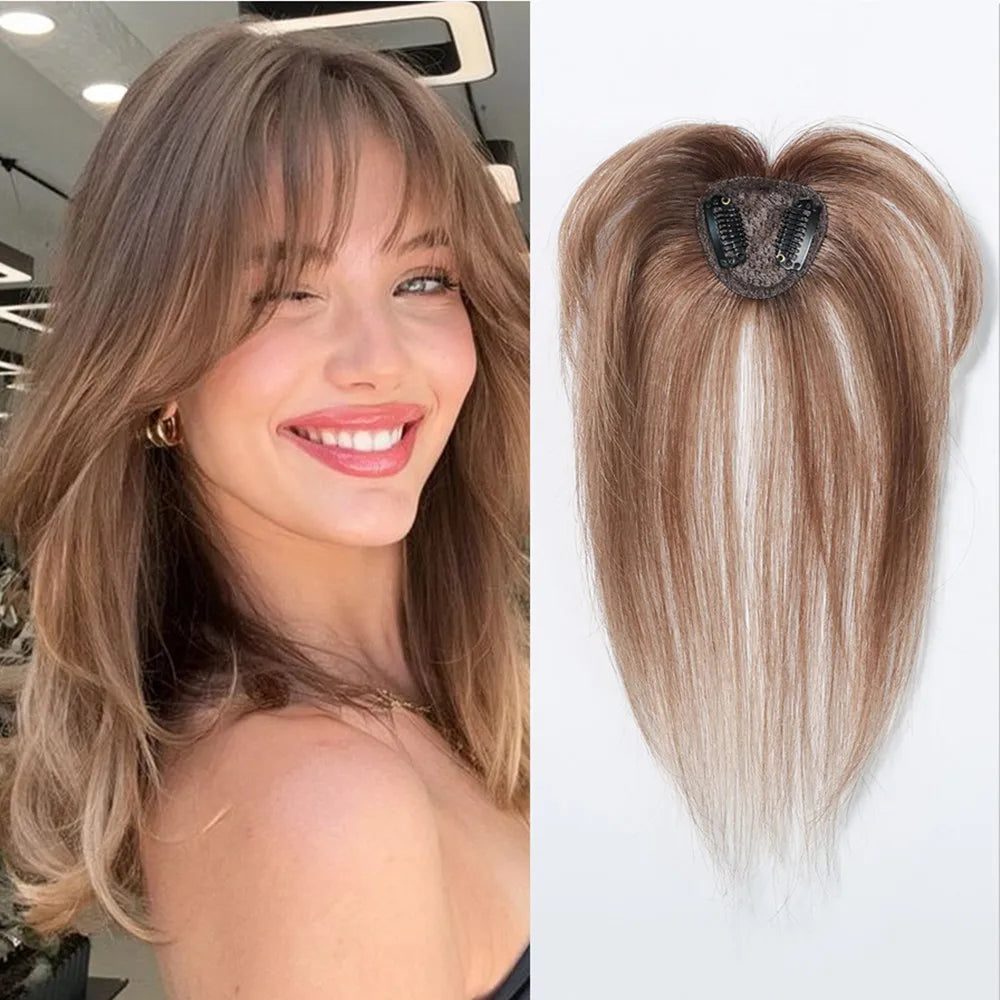

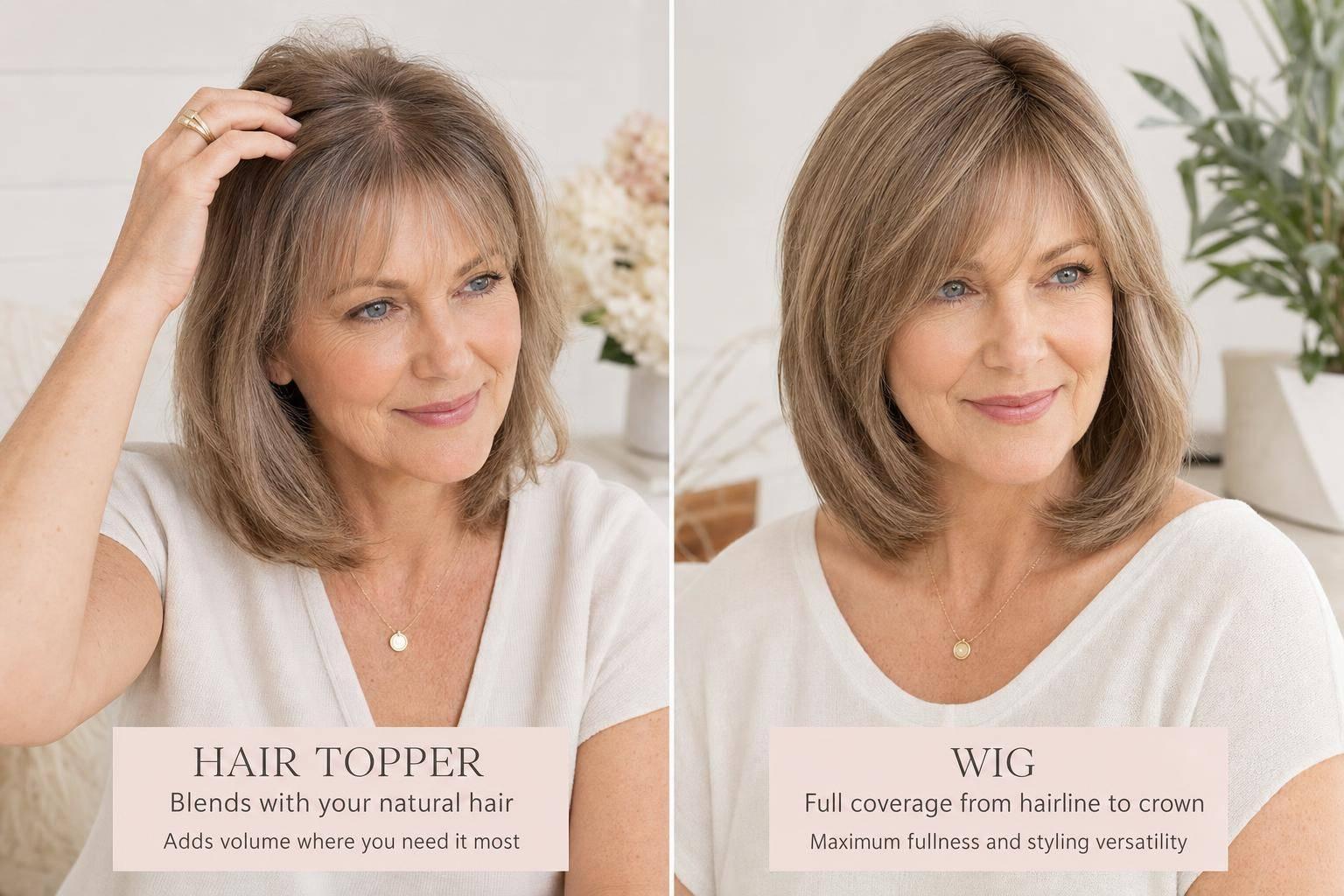
If your thinning is mostly on the crown or part line, I’d look at a hair topper first. If clip-ins won’t hold, or hair loss covers most of the scalp, I’d go with a wig.
That’s the short answer. A topper covers a smaller area, blends with your own hair, feels lighter, and often costs less. A wig covers the full scalp, does not need your own hair for support, and suits more advanced hair loss, including alopecia or treatment-related loss.
Before buying, I’d check 5 things:
- Coverage area: top only, or full scalp
- Clip support: enough hair left for topper clips, or not
- Comfort: lighter and more breathable vs full-cap wear
- Styling: blend with your own hair vs a complete style change
- Cost: toppers from about AU$148, while human hair wigs usually cost more
A few facts from the article stand out:
- For topper sizing, measure the thin area and add 2.5 cm to each measurement
- Silkara’s 360° Human Hair Topper weighs about 30 g
- Around 120% density is noted as a natural level without bulk
- Human hair toppers use less hair than wigs, so the upfront spend is often lower
If I wanted the fastest rule: topper for mild to mid-stage thinning, wig for low density or near full-scalp loss.
Quick Comparison
| Feature | Hair Topper | Wig |
|---|---|---|
| Coverage | Crown, part line, top | Full scalp |
| Needs your own hair to attach | Yes | No |
| Feel on head | Lighter | Heavier |
| Air flow | More | Less |
| Styling result | Blends with your hair | Full style change |
| Best for | Mild to moderate thinning | Advanced hair loss |
| Typical spend | Lower | Higher |
That gives you the main answer up front, so you can judge which option fits your thinning pattern before getting into the finer details.
sbb-itb-08feb2f
Hair Toppers: Targeted Coverage, Lower Weight and Your Own Hair Still Showing
A hair topper gives targeted coverage for the crown, part line or top, while still letting your sides, length and hairline show. That’s the big appeal. You’re not covering everything up. You’re adding hair where you need it most.
Because toppers are smaller than full wigs, they usually feel lighter and let more air through. For daily wear, that can make a big difference.
Who suits a hair topper
A topper works well when thinning is mostly focused at the crown or along the part line. Getting the size right matters. Measure the thinning area from front to back and side to side, then add 2.5 cm to each measurement [2] so the clips can grip onto stable hair.
When the base fits well, wearing it day to day tends to feel much simpler.
Daily wear, styling and cost
Clipping in a topper is often quick and low-fuss once you’ve done it a few times. There’s no adhesive and no full-head cap, so it tends to feel lighter and less bulky than a full wig.
Silkara Hair’s human hair toppers are made from 100% Remy human hair, and selected pieces can be heat-styled at low temperatures [5]. Since a topper uses less hair than a full wig, the price is usually lower too. Silkara’s human hair toppers start from around AU$148 [5].
Silkara Hair topper options
Silkara Hair offers human hair toppers in a range of base sizes, densities and coverage levels. If you want more coverage at the front, hair toppers with bangs, clip-in bangs and wispy fringes can work well alongside a standard topper.
Colour matching can make or break the final look. Silkara offers a free colour match service using your own photos, and selected products also include AI virtual try-on so you can see the style before you buy. Around 120% density gives natural fullness without bulk [6].
If thinning extends beyond the top, full-scalp coverage becomes the next comparison.
Wigs: Full Coverage for Advanced Thinning
Once thinning becomes too spread out for clips to grip well, a wig is often the more practical pick. The same goes for thinning that moves past the crown. At that point, a topper may stop giving secure, even coverage. A wig works better because it covers the whole scalp and doesn't depend on having enough natural hair to hold clips in place [1][2][4].
Who suits a wig
Wigs are a good fit for advanced or widespread thinning, alopecia, or treatment-related hair loss, mainly when you want full coverage [1][3]. If your thinning is patchy, spread across the scalp, or your hairline has receded a lot, a wig can give you a natural-looking hairline [1][3].
Unlike a topper, a wig covers the entire head and doesn't rely on your own hair for attachment [1][4]. That makes it a strong choice when hair loss is extensive.
Application, comfort and styling differences
Putting on a wig usually involves a wig cap, adjustable straps, and sometimes adhesive or tape for extra hold [3].
Wigs are heavier and warmer than toppers, which can matter in hot Australian weather [3]. Human hair wigs can be heat-styled, but they also need regular washing and restyling. Synthetic wigs usually cost less and keep their shape after washing, but most can't be heat-styled [1][3]. Human hair wigs also come with a higher price because of the amount of hair and the construction involved [3]. So if you're planning to wear one every day, material and weight are worth thinking through.
Next, compare coverage, weight, styling and cost side by side.
Topper vs Wig: Side-by-Side Comparison
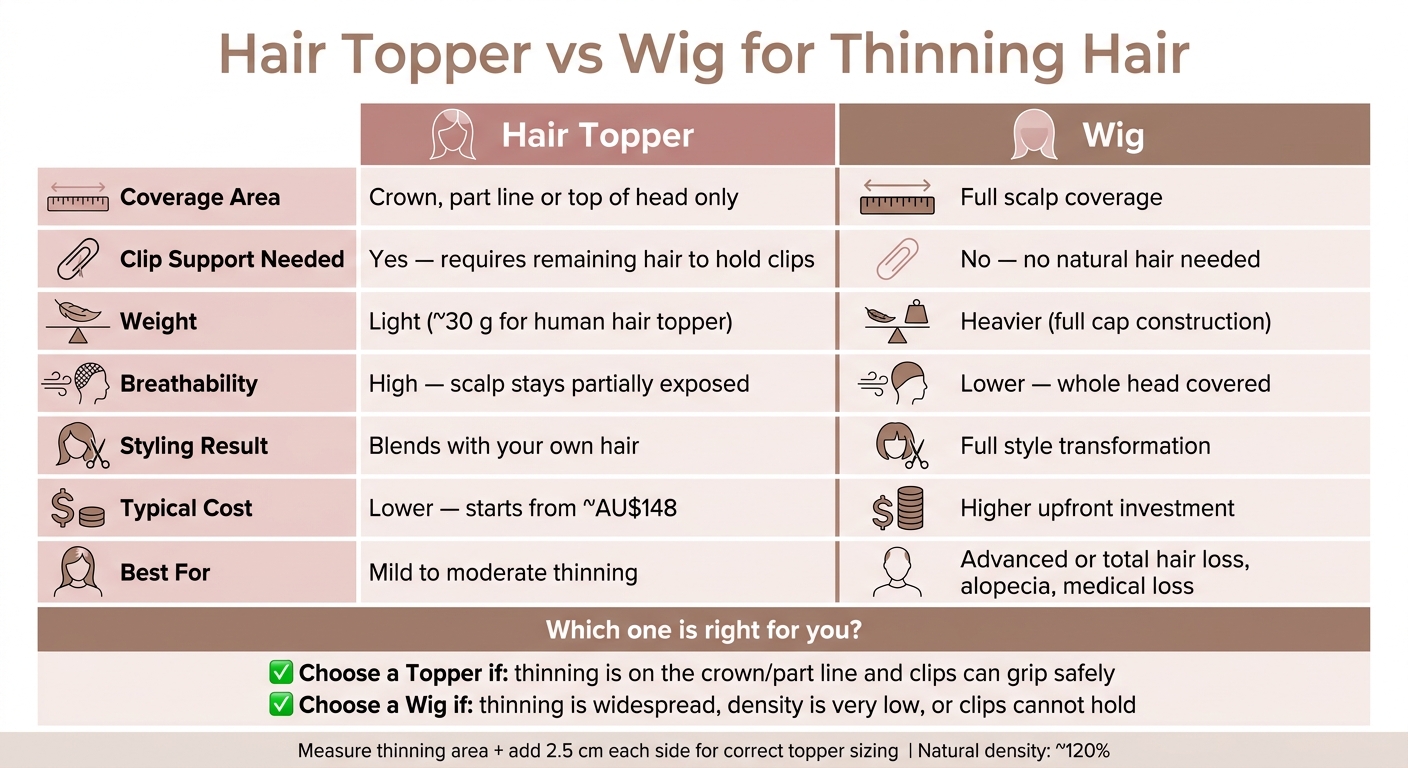
Hair Topper vs Wig for Thinning Hair: Side-by-Side Comparison
Here’s the clearest side-by-side view.
Comparison table: topper vs wig
| Feature | Hair Topper | Wig |
|---|---|---|
| Coverage area | Targeted - crown, part line or top of head | Full scalp |
| Clip support needed | Yes - works best when remaining hair can support clips safely | No - full coverage without relying on natural hair |
| Weight | Light | Heavier due to full cap construction |
| Breathability | High - scalp stays partially exposed | Lower - whole head is covered |
| Styling | Blends with your own hair | Independent - full style transformation |
| Cost | Lower upfront cost | Higher upfront investment; human hair versions cost more |
| Best fit | Mild to moderate thinning | Advanced or total loss |
If you’re still unsure, the easiest way to sort it out is to match your thinning pattern to the right option.
Decision table: which option fits your thinning pattern
Match your thinning pattern to the right option below.
| Thinning scenario | Better fit | Why |
|---|---|---|
| Early crown thinning / widening part | Small base hair topper | Adds volume exactly where it’s needed |
| Frontal recession / receding hairline | Topper with bangs | Bangs conceal the hairline naturally |
| Diffuse thinning across the top and sides | Large base topper (e.g. 9 x 9") | Broader coverage while still blending with your own hair |
| Very low overall density / advanced loss | Wig | Total coverage when clips can’t grip safely |
| Medical hair loss, such as chemotherapy or alopecia | Wig | Immediate, complete coverage without relying on existing hair |
The key question is simple: does your remaining hair support clips safely?
If the answer is yes, a topper may be the better match, especially for mild to moderate thinning on the crown or top of the head. If the answer is no, a wig usually makes more sense because it gives full coverage without depending on your own hair to hold clips in place.
From here, narrow the choice by coverage, clip support and daily wear.
How to Choose the Right Silkara Hair Solution
A simple buying checklist
Use the comparison above to make the final call.
Start with two things: where the thinning is and how much hair you still have left.
If the thinning is mostly around the crown or part line, and you still have enough hair for clips to hold well, a topper usually makes more sense. If that sounds like your situation, match the topper size to the thinning area. Measure the section from front to back and side to side, then add 2.5 cm to each side [2].
If the thinning is more spread out, or the hair you have left is too fine for clips, go with a wig. Alternatively, for those with healthy hair at the crown but thinning elsewhere, U-part clip-in extensions can add volume without full coverage.
Once you've sorted out coverage, the next step is shade matching.
Key takeaways before you buy
Silkara's 360° Human Hair Topper weighs about 30 g [5]. Wigs are better for advanced thinning when you need full coverage. The best pick comes down to coverage needs, clip support, and comfort.
You can also use Silkara's free colour match service to check your shade from a photo. Selected products also include AI virtual try-on.
FAQs
How do I know if I have enough hair for a topper?
You don’t need thick hair, but you do need enough natural hair for the clips to grip well. A simple way to size it is to measure the thinning area, then add 1–2 cm so the clips sit on stronger hair around the edges.
If your hairline is a concern, place the base 2.5–5 cm behind it. That gives your own hair room to fall over the front edge and helps everything blend in better. If your hair is very fine or fragile, go for a lightweight topper so it puts less strain on your natural hair.
What size topper should I buy?
Style your hair as you normally would so the thinning area is easy to spot. Then measure the length and width of the area you want to cover, whether that’s the crown, part line, or front hairline.
Next, add 1 to 2 cm on each side. That extra space gives the clips enough room to grip stronger hair, which helps the piece sit flatter and feel more comfortable while looking more natural.
Can a topper look natural with my own hair?
Yes. A topper is made to blend in with your own hair, so the finish can look natural.
For the best match, choose a colour and texture that lines up with your mid-lengths and ends, not your roots. That usually gives you a smoother blend, because roots can be a bit darker or show regrowth.
Placement also makes a big difference. Set the topper about 2.5 to 5 cm behind your natural hairline so your own hair can soften the join. If thinning shows more at the front, a lace-front topper often gives the most natural-looking finish.