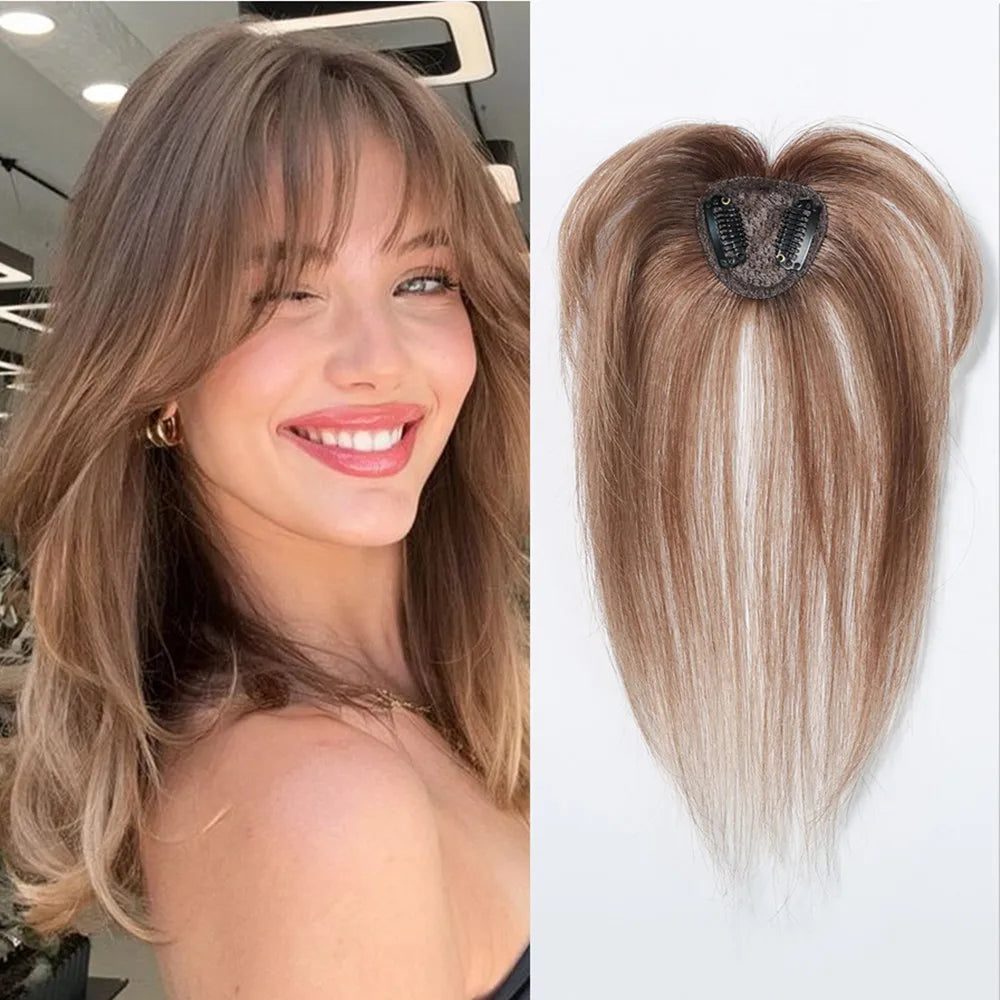

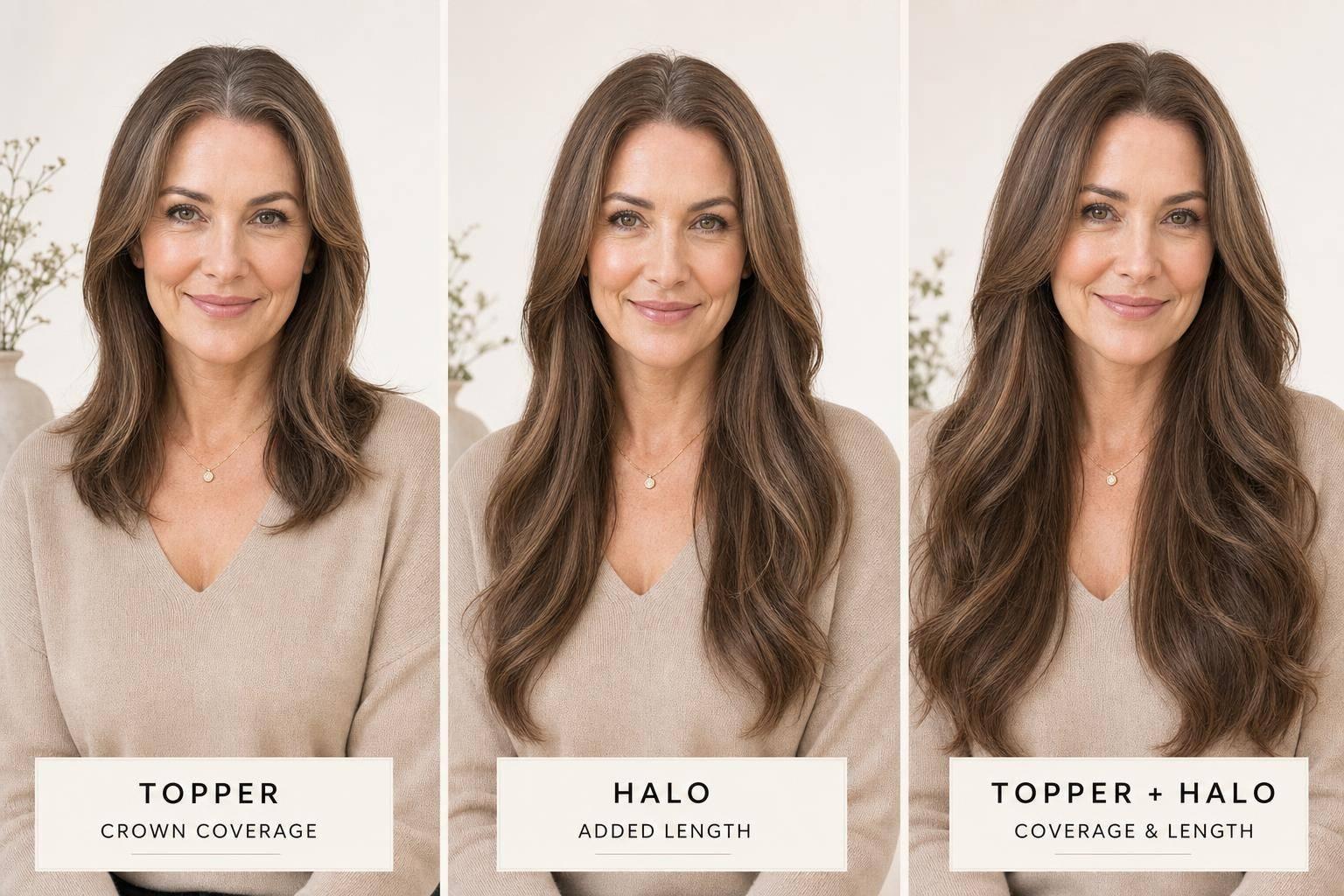
If your scalp shows at the crown, extensions won’t hide it. If you want length through the ends, a topper won’t do much on its own. That’s the main split.
I’d keep it simple:
- Choose a topper for crown or part-line thinning
- Choose a halo for added length if you have enough hair on top to hide the wire
- Choose clip-ins for length and thicker-looking ends if your hair can hide the clips
- Choose both if you want crown coverage and longer hair
About 49% of women deal with hair loss at some point. So this choice is less about style and more about matching the right piece to the thin area.
Quick Comparison
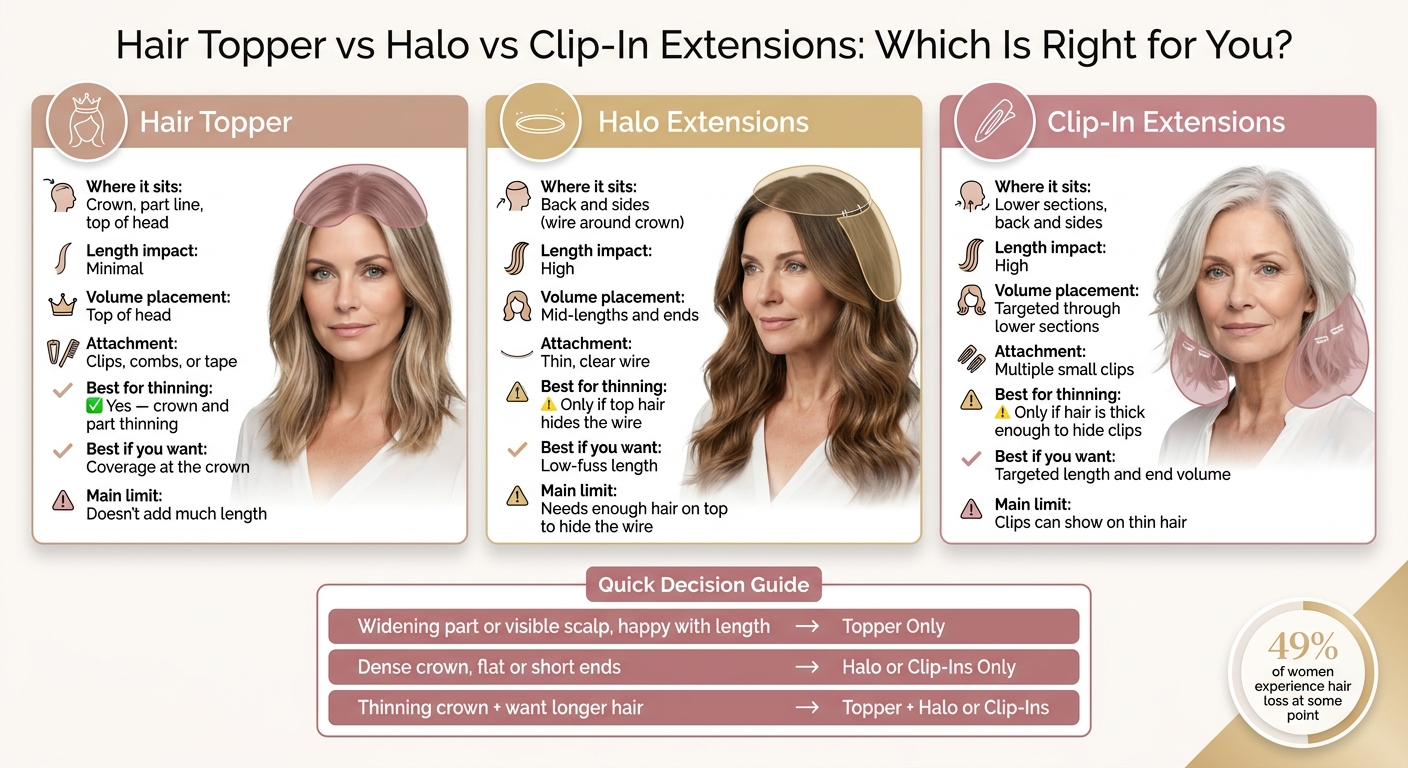
Hair Topper vs Halo vs Clip-In Extensions: Which Is Right for You?
| Option | What it does | Where it sits | Best if you want | Main limit |
|---|---|---|---|---|
| Topper | Covers visible scalp and adds volume on top | Crown, part, top of head | Coverage at the crown | Doesn’t add much length |
| Halo | Adds length and body underneath | Around the head on a wire | Low-fuss length | Needs enough hair on top to hide the wire |
| Clip-ins | Add length and thickness through the lower hair | Back and sides, lower sections | Targeted length and end volume | Clips can show on thin hair |
A few fit points matter too: a topper base should sit past the thin spot, lighter pieces suit finer hair, and longer natural hair tends to blend extensions more easily. Shade match the mid-lengths, not the roots, and remove halo or clip-ins before sleeping or swimming.
That’s the short answer: pick for coverage first, then length.
sbb-itb-08feb2f
Topper vs halo vs clip-in extensions: what each one does
Each product solves a different problem: coverage, length, or a bit of both.
Hair toppers: coverage and volume at the crown
A hair topper clips into your own hair around a thinning area, such as the crown, part line, or top of the head. It sits over the sparse area and adds density and lift where hair looks flat or where the scalp shows through.
Because it sits on top of the thinning area, it’s the only option in this group that covers the crown.
Halo extensions: fast length with low-fuss wear
A halo extension is a single weft attached to a thin, clear wire. You place it around the crown, then let your natural hair fall over it so it blends underneath.
Since there are no clips at the roots, it can feel gentler for women with fine or fragile hair. The catch is simple: you need enough natural hair on top to hide the wire.
Clip-in extensions: targeted length and fuller ends
Clip-in extensions use multiple wefts clipped into the lower sections of your hair to add length and fullness. Since you can place them where you want them, they work well for adding extra body through the mid-lengths and ends.
That said, the clips need enough natural hair to stay hidden. On very thin hair, blending them can be tricky.
The table below shows where each option sits and what it changes.
| Feature | Hair Topper | Halo Extensions | Clip-in Extensions |
|---|---|---|---|
| Where it sits | Crown, part line, top of head | Back and sides | Lower sections |
| Length impact | Minimal | High | High |
| Volume placement | Top of head | Mid-lengths and ends | Targeted through the lower sections |
| Attachment method | Clips, combs, or tape | Thin, clear wire | Multiple small clips |
| Best for thinning hair? | Yes - crown and part thinning | Only if top hair hides the wire | Only if hair is thick enough to hide clips |
How to choose based on your hair goals and thinning pattern
Once you know what each piece is meant to do, the choice gets a lot easier. It comes down to where your hair is thinning and what you want to change.
Here’s the simple version: a topper covers the crown, a halo or clip-ins add length and fullness, and a combination does both.
Choose a topper if the crown or part line is your main concern
Go for a topper if the main issue is thinning at the crown or along the part line. It sits over that area and helps hide visible scalp.
If you already like your current hair length, a topper on its own may be enough.
Choose a halo or clip-ins if the top has enough hair to blend
If your crown still has enough density to blend well, and your main issue is flat ends or lack of length, a halo or clip-in set can work well.
The key is coverage on top. Your top layers need enough hair to hide the attachment. With a halo, those top layers also need to be long enough to cover the wire in a natural way.
Choose a combination if you want both coverage and noticeably longer hair
If you want coverage at the top and more length, use both. A topper handles the crown, while a halo or clip-ins add length and thickness through the back and sides.
This quick guide can help narrow it down.
| Your Situation | Best Option |
|---|---|
| Widening part or visible scalp, happy with length | Topper only |
| Dense crown, flat or short ends | Halo or clip-ins only |
| Thinning crown, want noticeably longer hair | Topper + halo or clip-ins |
Fit, blending and comfort: what makes the result look natural
Once you've chosen the right type, the next part is simple but easy to get wrong: fit, colour and how you wear it day to day. Those three things are what make a hair piece look smooth instead of obvious.
Base size, length matching and extension weight
Start by measuring the thinning area with care. For a topper, the base should sit slightly past the thin section so the clips can grip stronger hair. That extra coverage helps the piece sit better and feel more secure.
Weight matters as well. If your hair is fine, a lighter topper of around 30 g will usually feel more comfortable [2]. Heavier halo sets, usually 140 g to 180 g, work better when there's enough natural density underneath to support the piece [4].
Length plays a big part too. Shoulder-length hair or longer tends to hide the join more easily, while shorter hair can make the transition line stand out [4].
After fit, shade matching does the rest of the blending work.
Colour matching and grey blending
Match the mid-lengths, not the roots. Why? Because roots, ends and sun-lightened sections often sit in slightly different tones [4]. In Australian conditions, that difference can be even more noticeable.
For grey blending, shades such as Salt and Pepper or Grey A01 can help the piece sit more naturally with maturing hair [2].
If you're buying online and not sure which shade to pick, Silkara's free colour match service lets you send in a photo for personalised guidance [2].
Then it's about matching the wear routine to your lifestyle so the piece stays comfortable and lasts longer.
Daily wear, heat and active lifestyles
Halo and clip-in pieces should come out before swimming and sleeping, and they should be kept away from salt water and chlorine [3][4]. To help maintain softness and longevity, use sulfate-free shampoos and conditioners [1][3].
If you're heat styling human hair, keep tools between 71–85°C to help avoid fibre damage [2]. That's one of those small details that can save you a lot of frustration later.
Conclusion: the simplest way to decide
The simplest way to choose is to look at where the thinning is happening. That’s the whole game. Pick based on function, not hair length alone.
If you can see scalp at the part or crown, start with a topper. If your top layers are thick enough to hide the attachment, halo or clip-in extensions are a good fit for extra length and volume through the mid-lengths and ends. If you want both, pair a topper with halo or clip-in extensions so you cover the crown and add length at the same time.
Match the piece to the thinning area first. Then match the shade to your own hair so the result looks natural.
FAQs
Can I wear a topper and extensions together?
Yes - wearing a topper and extensions together can work very well, especially for fine hair.
In many cases, using two lighter pieces feels more comfortable and looks more natural than relying on one thick, heavy option. It’s a bit like splitting the job in two: the topper handles coverage up top, while the extension adds body through the lengths.
For example, a topper can cover the crown, while a halo extension adds length and fullness through the ends. Just make sure the topper clips don’t sit directly on the halo wire, and keep both pieces lightweight so you don’t add extra tension.
Will a halo work if my hair is thin on top?
A halo extension adds length and volume through the back and sides, but it won’t hide thinning on top. It sits around the crown, not over the scalp, so sparse areas at the top stay visible.
If top coverage is the main goal, a hair topper is the better pick. You can also wear a light-density topper with a halo if you want coverage at the crown plus extra length and fullness through the ends.
How do I choose the right topper base size?
Style your hair as you normally would so the thinning areas are easy to see. Then measure the length and width of the area you want to cover, and add 1 to 2 cm to each side.
That extra space gives the clips somewhere better to grip. Instead of pulling on sparse sections, they can attach to stronger, healthier hair, which helps reduce discomfort, breakage, and headaches. A slightly larger base also tends to sit flatter, so the result looks more natural.