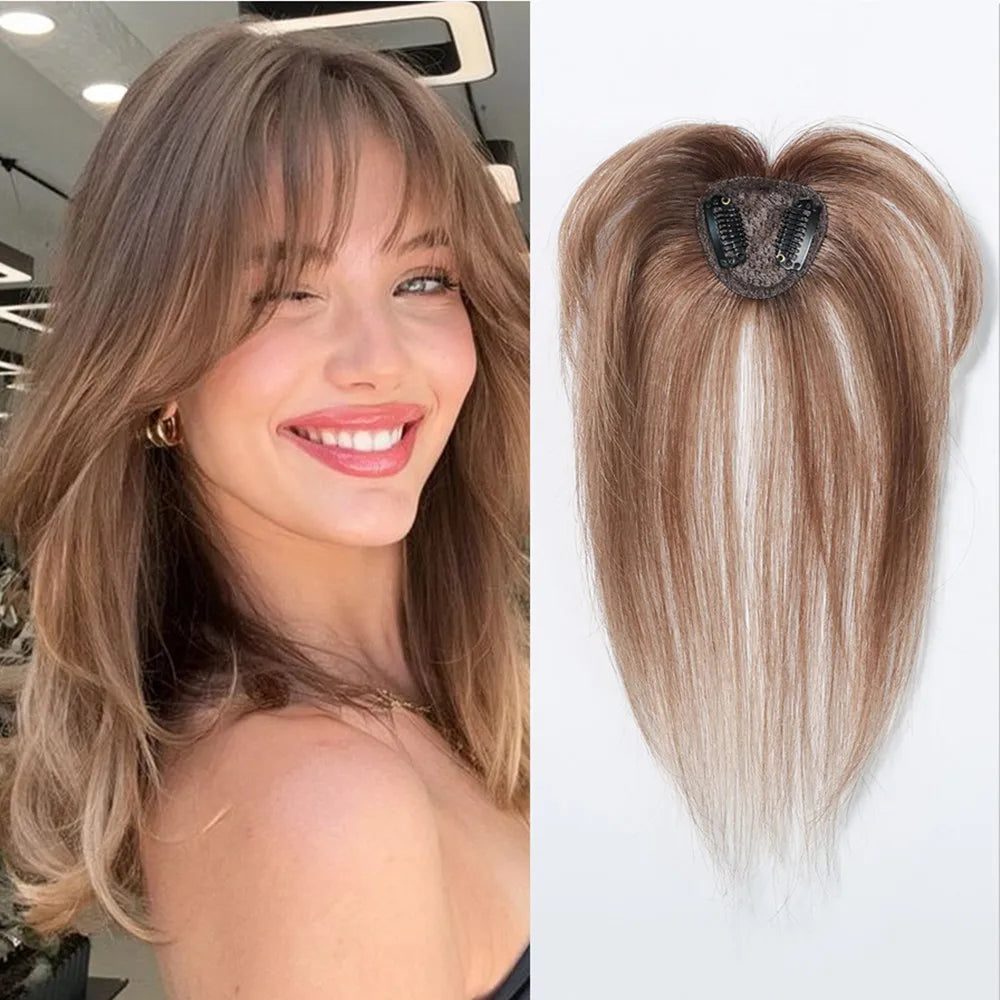

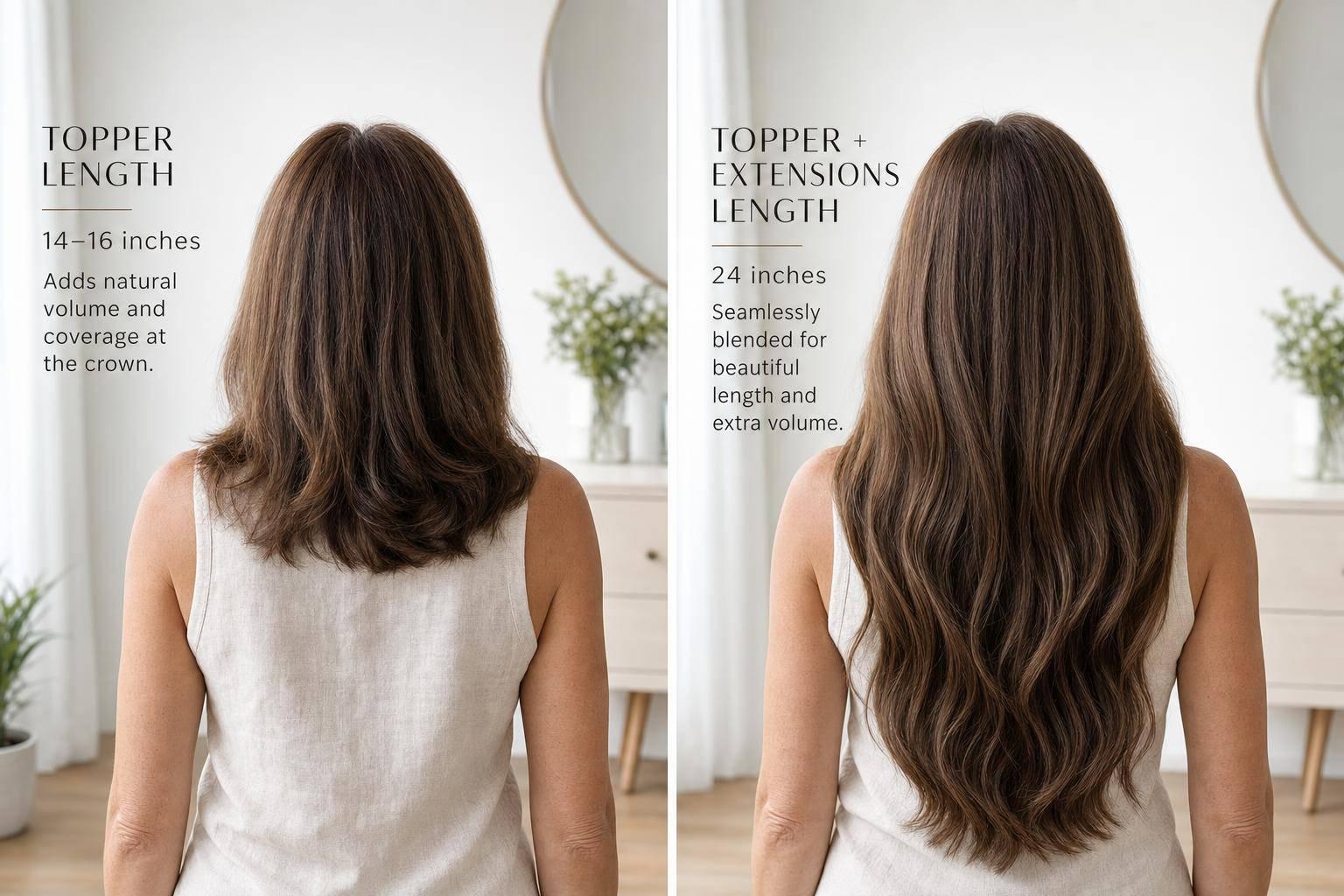
Yes - 24-inch hair toppers are out there, but most people won’t need one. In most cases, if I want to hide thinning at the crown, I’d look at a topper. If I want long, waist-length hair, I’d look at extensions. That’s the main difference.
Here’s the short version:
- Hair toppers are made for crown and part-line coverage
- Most toppers sit in the 10–18 inch range or about 25–46 cm
- 24 inches is about 61 cm, which is much more common in halo or clip-in extensions
- A topper is measured from the crown, so it often looks shorter on the head than an extension with the same listed length
- If I want both top coverage and a 24-inch finish, I’d usually need a topper plus extensions
A few numbers make this easier to judge:
- 10–14 inch toppers: often suit bob to shoulder-length hair
- 16–18 inch toppers: often suit bra-strap to mid-back blends
- 20–24 inch toppers: less common and usually made for long natural hair
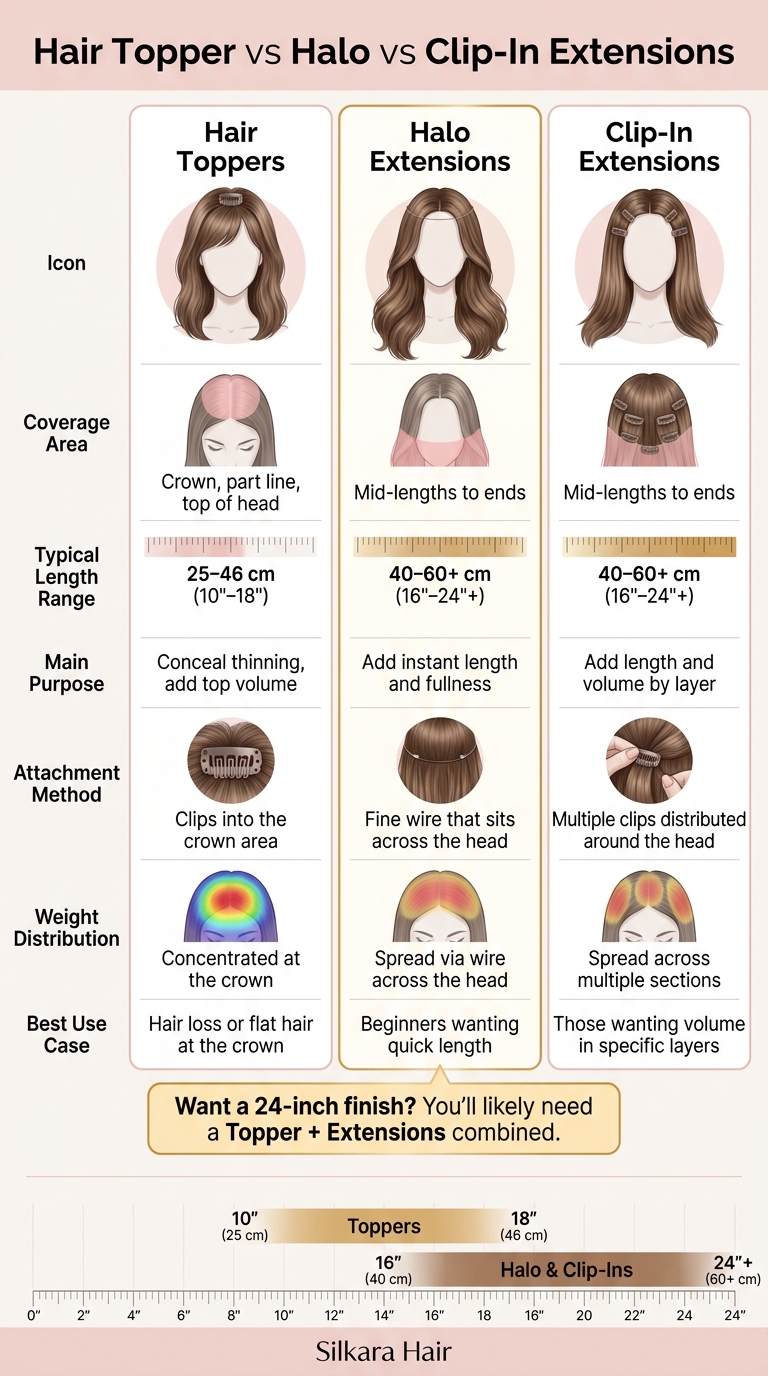
Hair Topper vs Halo vs Clip-In Extensions: Length & Coverage Comparison
Hair Extensions or Hair Toppers? #hairtoppers #thinninghair #toppers #hairextensions #hairtutorial
sbb-itb-08feb2f
Quick Comparison
| Product | Main job | Usual length range | Where it sits | Best if I want… |
|---|---|---|---|---|
| Hair topper | Cover thinning at the crown | 25–46 cm (10–18") | Top of head | Scalp coverage and top volume |
| Halo extension | Add length and thickness | 40–60+ cm (16–24"+) | Mid-lengths to ends | Long hair with low tension |
| Clip-in extensions | Add length and thickness by section | 40–60+ cm (16–24"+) | Mid-lengths to ends | More control over placement |
The simple rule: if the problem starts at the crown, I’d choose a topper. If the goal is length, I’d choose extensions. If I want both, I’d combine them.
Do Hair Toppers Come in 24 Inches
Yes, 24-inch toppers are available, but they’re hard to find [7]. Most toppers fall between 10 and 18 inches because they’re made to cover the crown and blend with your own hair [1][5]. That leads to the next point: topper design usually keeps lengths shorter than extension pieces.
Topper length is measured from the crown base to the ends when the hair is pulled straight [6]. That changes how the length looks once you wear it, because a topper sits higher on the head than a clip-in or halo extension [5][6].
To make that easier to picture, here’s a quick guide to where each length tends to fall [2][3][4][6][7]:
| Topper Length | Approx. Fall | Best For |
|---|---|---|
| 25–35 cm (10"–14") | Chin to shoulder | Short bobs and lobs |
| 40–46 cm (16"–18") | Bra strap to mid-back | Longer blended styles |
| 51–61 cm (20"–24") | Lower back to waist | Specialist lengths for long hair |
Standard Topper Lengths vs Extra-Long Lengths
The gap mostly comes down to coverage, blending, and day-to-day wear. Most topper lines stop at 18 inches because shorter pieces usually blend better at the crown [2][4]. In topper terms, 18–20 inches is already long, while 22–24 inches sits in the specialist category [7].
Why are they harder to source? Simple: long hair is less common, and it’s tougher to work into topper construction. So when you choose a length, the main trade-off is whether you want crown coverage, added length, or a mix of both.
Why Toppers Are Usually Shorter Than Extensions
The length gap comes down to how each piece is built. Toppers are made to cover the crown. Extensions are made to add length.
Because toppers clip into the crown area - often where hair is already fine or thinning - they need to stay light enough for all-day comfort and secure wear [1][2]. If the hair on the piece gets much longer, it can pull more at the crown. And that matters, because many toppers attach to finer hair in that area.
That’s why very long toppers are still more of a niche option. The longer the piece, the tougher it becomes to keep it light and secure at the crown. A 24-inch topper is possible, but it can be harder to wear well because crown coverage gets heavier as length goes up.
How Coverage Area Determines Each Product's Job
Topper bases are sized for targeted coverage, from the part line to a broader crown area [4][2]. Extensions sit lower on the head, where hair is often denser, so it’s easier for them to support extra length and volume [3][4].
Here’s the simplest way to tell the three products apart.
Topper vs Halo vs Clip-In Extensions: Side-by-Side Comparison
| Feature | Hair Toppers | Halo Extensions | Clip-In Extensions |
|---|---|---|---|
| Coverage Area | Crown, part line, top of head | Mid-lengths to ends | Mid-lengths to ends |
| Typical Length Range | 25–46 cm (10"–18") [3][2] | 40–60+ cm (16"–24"+) [3][4] | 40–60+ cm (16"–24"+) [3][4] |
| Main Purpose | Conceal thinning, add top volume | Add instant length and fullness | Add length and volume by layer |
| Attachment Method | Clips into the crown area | A fine wire that sits across the head | Multiple clips distributed around the head |
| Weight Distribution | Concentrated at the crown | Spread via wire across the head | Spread across multiple sections |
| Best Use Case | Hair loss or flat hair at the crown [5] | Beginners wanting quick length | Those wanting volume in specific layers |
Once the product’s job is clear, the next step is matching the length to your own hair so it blends in naturally.
How to Match Topper Length to Your Own Hair
Once you know if you need coverage or added length, the next step is simple: match the topper to where your own hair sits.
Measure your hair from the crown down to the ends of your longest layer. That gives you the minimum topper length you need for it to blend with your cut. From there, choose a topper that’s about 2.5–5 cm (1–2 inches) longer than your natural hair. That extra bit gives your stylist room to trim and layer it so the blend looks cleaner [4][7].
What Short, Medium and Long Topper Lengths Look Like
Very long toppers are out there, but most women fall into a few practical length ranges.
- Short toppers: up to about 25 cm (10 inches). These tend to work well for bobs and pixie grow-outs.
- Medium toppers: around 30–40 cm (12–16 inches). A good match for shoulder-length and collarbone-length hair.
- Long toppers: about 45–50 cm (18–20 inches). Best for longer hair that needs crown coverage and more density [7].
If your hair is curly or wavy, this part matters more than people expect. The same measured length can look shorter than it would on straight hair. So if you’re choosing based on appearance, not just numbers, allow for that.
And if what you want is more length rather than crown coverage, a halo or clip-in extension may suit the result better.
Why the Same Length Looks Different on a Topper vs Extensions
This trips people up all the time. A 16-inch topper and a 16-inch clip-in extension may have the same listed length, but they won’t look the same once they’re on [7][8].
Here’s why: a topper starts at the crown, so the hair has to travel over the curve of your head before it drops. Extensions sit lower, which means the same length hangs longer when worn.
That’s the key difference. If you need a piece that adds obvious length, a topper is usually the wrong fit.
Topper, Halo or Clip-In Extensions: Which One Is Right for You
Once you understand how topper length differs from extension length, the next step is picking the right piece for the look you want. The simplest way to do it? Choose by result.
Use a topper for crown coverage, a halo for easy added length, or clip-ins if you want more control over placement.
This becomes extra important if you're aiming for a 24-inch finish, because crown coverage and added length come from two different types of construction. In most cases, a 24-inch look needs both: a topper to cover the crown and extensions to add length through the lower sections.
Matching Your Hair Goal to the Right Product
If your goal is just more length or volume, halo extensions or clip-in extensions are often the better fit. A halo extension adds length and fullness with minimal root tension. Clip-in extensions work well for a bigger length change, since you can place the wefts exactly where you need them.
Here’s a quick guide to match each product to your hair goal.
Which Piece Suits Each Hair Goal: Quick Reference Table
| Goal | Best Product | Why |
|---|---|---|
| Cover visible scalp at the part or crown | Hair topper | Specifically designed for top-of-head coverage and blending with your own hair [1][8] |
| Add length and volume with low tension | Halo extension | Uses an invisible wire instead of clips, so there is no pulling on fine or fragile hair [7] |
| Adjustable volume and a bigger length change | Clip-in extensions | Multiple wefts let you customise placement and build thickness where needed [7][3] |
| Crown coverage plus a very long 24-inch result | Topper + halo or clip-ins | The topper covers the crown while extensions provide the extra length |
Conclusion
24-inch toppers are uncommon because toppers are made for crown coverage, not extra length. Most sit in the 10–18 inch range [2][3][4]. So yes, a 24-inch topper can exist, but for most women, it isn't the usual pick.
The right piece depends on what you want most. If your main goal is coverage at the crown, go with a clip-in topper. If you want more length through the mid-lengths and ends, a halo or clip-in extension will usually make more sense.
Silkara Hair can help you find the right fit with colour matching and base-size guidance.
FAQs
How do I measure topper length correctly?
First, measure the thinning area. Go side to side across the centre of your crown, and keep the tape lined up with the lower part of your ears.
Then measure front to back, starting at your natural hairline and going over the crown to the point where your head starts to curve downward. Add 1–2 cm so the topper’s clips can hold onto stronger sections of hair more securely.
Will a 24-inch topper feel too heavy?
It depends on the topper’s build and density, but Silkara Hair toppers are usually made to feel light and comfortable enough for all-day wear.
Most weigh 30 to 80 grams and use well-placed clips to spread the weight evenly across the hair. Longer lengths do add more weight, so if you want extra length, a halo or clip-in extension can be a better choice than a very long topper.
Can I wear a topper and extensions together?
Yes - absolutely. You can wear a hair topper and extensions together for a fuller, more voluminous look.
A topper gives you partial coverage at the scalp. Halo or clip-in extensions add length and thickness through the rest of your hair. When the colour and texture match, the two blend in naturally.