

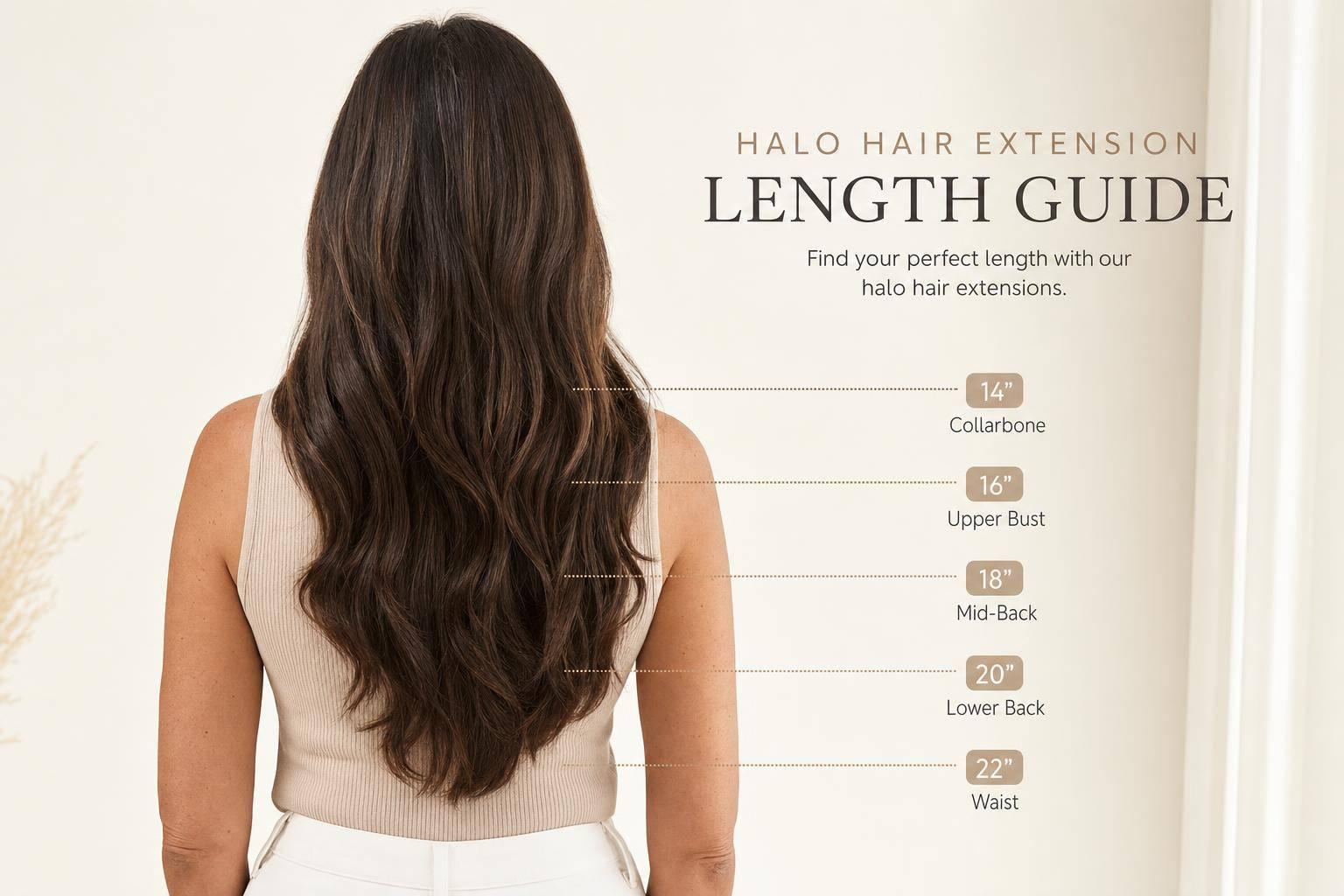
Picking halo length is simpler than it looks: if your hair is shoulder-length, start at 14–16 in (35–40 cm); if it’s around bra length, look at 18–20 in (45–50 cm); if you want hair to sit about halfway down your back, 22 in (56 cm) is usually the first length to check.
I’d use the body-placement chart as a guide only. The final look shifts based on your height, your natural hair length, and your texture. For example, waves and curls can look 2–4 in (5–10 cm) shorter, and keeping the gap between your own hair and the halo to about 10 cm (4 in) often gives a neater blend.
- 14 in / 35 cm: just below shoulders
- 16 in / 40 cm: upper chest
- 18 in / 45 cm: around bra line
- 20 in / 50 cm: mid-back
- 22 in / 56 cm: about halfway down the back
Quick comparison
| Halo length | Approx. length | Usual finish | Best starting point |
|---|---|---|---|
| 14 in | 35 cm | Just below shoulders | Shoulder-length hair |
| 16 in | 40 cm | Upper chest | Shoulder to collarbone hair |
| 18 in | 45 cm | Bra line | Bra-length hair |
| 20 in | 50 cm | Mid-back | Bra to mid-back hair |
| 22 in | 56 cm | Halfway down back | Longer look from bra or mid-back hair |
My quick rule: go for the shortest length that gives you the look you want. That usually makes blending easier and keeps the finish cleaner.
Halo length chart: 14, 16, 18, 20 and 22 inches compared
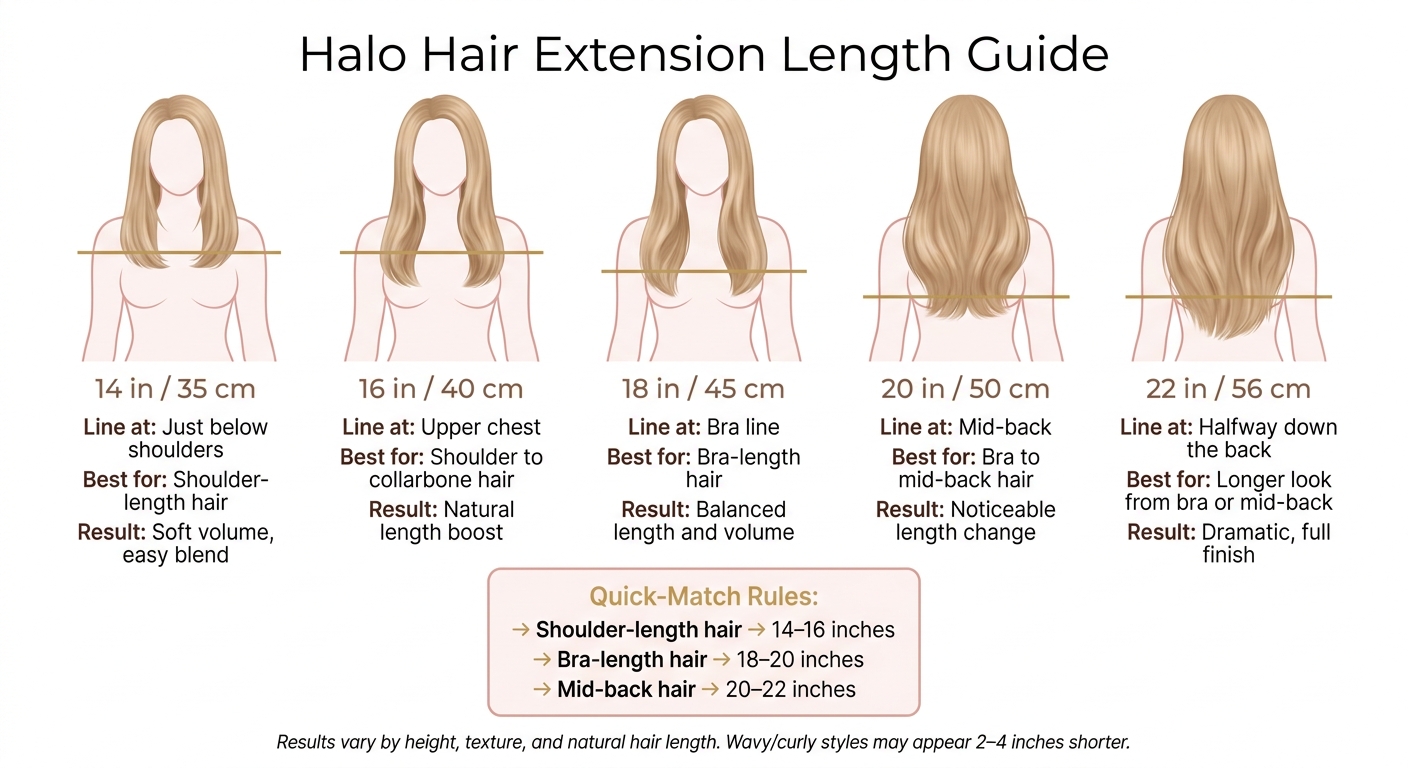
Halo Hair Extension Length Guide: 14 to 22 Inches Compared
The table below shows where each Silkara Hair halo length tends to sit on the body.
| Length | Approx. CM | Body Placement |
|---|---|---|
| 14 in | ~35 cm | Just below shoulders |
| 16 in | ~40 cm | Upper chest |
| 18 in | ~45 cm | Bra line |
| 20 in | ~50 cm | Mid-back |
| 22 in | ~56 cm | Halfway down the back |
Treat this chart as a guide, not a hard rule. Your height, natural hair length, and hair texture can all change how the final result looks.
14 and 16 inch halos: shoulder and collarbone length
A 14 in halo, which is about 35 cm, usually sits just below the shoulders. A 16 in halo, or about 40 cm, tends to fall around the upper chest.
These shorter lengths work best if your own hair sits around shoulder or collarbone length. They’re a good fit when you want a softer finish and a bit more fullness without adding a dramatic jump in length.
18 and 20 inch halos: bra line and mid-back length
An 18 in halo, around 45 cm, usually falls near the bra line. A 20 in halo, around 50 cm, tends to sit at mid-back.
If you want a more noticeable change in length, these are often the sweet spot. They give you more impact than shorter halos while still blending well for many wearers.
22 inch halos: halfway down the back
A 22 in halo, about 56 cm, usually reaches mid-back and can fall halfway down the back. If your goal is hair that sits halfway down your back, this is the length to look at first.
The next section explains why the same halo length can sit a bit differently from one person to another.
sbb-itb-08feb2f
What affects the final result: height, natural hair length and texture
The chart is only a starting point. Where a halo ends up depends on your height, your own hair length, and your texture.
How your height changes where each length falls
Height changes how the same halo length sits on the body. On a petite frame under 160 cm (5'3"), a 20-inch halo can fall lower down the back. On a taller frame over 173 cm (5'8"), that same piece may sit higher [1].
In plain terms, shorter frames often get more visible length from the same halo, while taller frames usually need a longer halo to get that same look [1]. That’s why your own hair length is the next thing to check.
How your natural hair length affects blending
The gap between your natural hair and the halo plays a big part in how well everything blends. The bigger the gap, the harder it is to make the finish look smooth.
For the cleanest blend, keep that gap within about 10 cm (4 in) [1]. Once the length is close, density and layers start to do most of the heavy lifting.
How density, layers and texture change the finish
Density matters as well. Fine hair tends to blend better with lighter, shorter halos, while thicker hair can handle longer, fuller lengths with less fuss [1].
Blunt cuts usually make the join easier to spot. Softening the ends with light layers can help, and having a stylist trim or layer the halo while you’re wearing it can make a significant difference [1].
Texture changes things too. If you plan to wear the hair wavy or curly, choose a halo that’s 2 to 4 inches longer than your target finished length [1].
Next, match those factors to shoulder-length, bra-length and mid-back hair.
Which halo length suits shoulder-length, bra-length and mid-back hair
Once you know where each length sits, the next step is simple: match it to your own hair length so the blend looks clean and natural.
If your natural hair is shoulder-length
If your hair sits around shoulder length, 14-inch and 16-inch halos are usually the best place to start. A 14-inch halo adds volume without changing your length too much. A 16-inch halo usually falls around the collarbone or mid-bust, which makes it a good fit for most people who want a smooth, easy blend.
You can go longer. An 18-inch halo gives you a more noticeable change, but it often takes more blending to make it look smooth. If your hair is fine or thin, 14 or 16 inches tends to work best, because longer halos can look sparse at the ends and may pull the natural hair down.
Bra-length hair can take more length, but the blend still has to look smooth.
If your natural hair is around bra length
If your hair is around bra length, 18-inch and 20-inch halos usually give the most balanced result. An 18-inch halo adds fullness with a balanced finish. A 20-inch halo drops to mid-back length.
If you want your hair to sit about halfway down your back, 22 inches gives a more dramatic look.
Mid-back hair follows the same rule: go for the shortest length that still gives you the finish you want.
If your natural hair is already mid-back length
If your natural hair is already mid-back, the choice comes down to how much change you want. A 20-inch halo adds fullness and a slight boost in length. A 22-inch halo gives a longer, fuller finish and may sit lower depending on your height.
If your ends are blunt, a light trim may help the halo blend better.
| Natural Hair Length | Best Length | Result |
|---|---|---|
| Shoulder-length | 14–16 inches | Natural volume and an easy blend |
| Bra length | 18–20 inches | Balanced length and volume |
| Mid-back | 20–22 inches | Fuller hair with a subtle to dramatic length boost |
Conclusion: How to pick your Silkara Hair halo length
Use the chart as a last check, then tweak your choice based on your height and hair texture.
Here’s the simple version:
- 14–16 inches works for shoulder-length hair
- 18–20 inches works for bra-length hair
- 22 inches works if you want the hair to sit about halfway down your back [1]
For the neatest blend, keep the halo close to your natural length [1]. Want a bit more drama? Go longer if you’re after extra length or plan to wear it wavy or curled [1]. If your goal is hair that falls about halfway down the back, 22 inches is the pick.
FAQs
Should I size up for waves or curls?
Yes. Waves and curls add bounce and volume, so the hair usually looks shorter once it's styled.
If you want to keep your planned length, go for extensions that are 2 to 4 inches longer than your target result. That extra length helps the hair sit closer to the look you want after styling.
What if I’m between two halo lengths?
If you're stuck between two halo lengths, look at the finish you want and the length of your natural hair. For the smoothest blend, we generally suggest picking a halo that's no more than 2 to 4 inches longer than your current hair.
Go with the longer option if you want a more dramatic, flowing look. Pick the shorter option if you'd rather keep the change subtle and soft. Still not sure? Our expert team can give you a personalised recommendation from a photo taken in natural light.
Can a halo still blend with blunt-cut hair?
Yes, but the blend matters even more.
If your blunt cut is very thick and you’re adding a lot of extra length, the match may not look perfect on its own.
A simple fix is to add a few extra inches and place soft layers where the halo sits. That helps the transition look smoother. You can also soften the line by mixing lengths, like 14" and 16", instead of using just one length.