
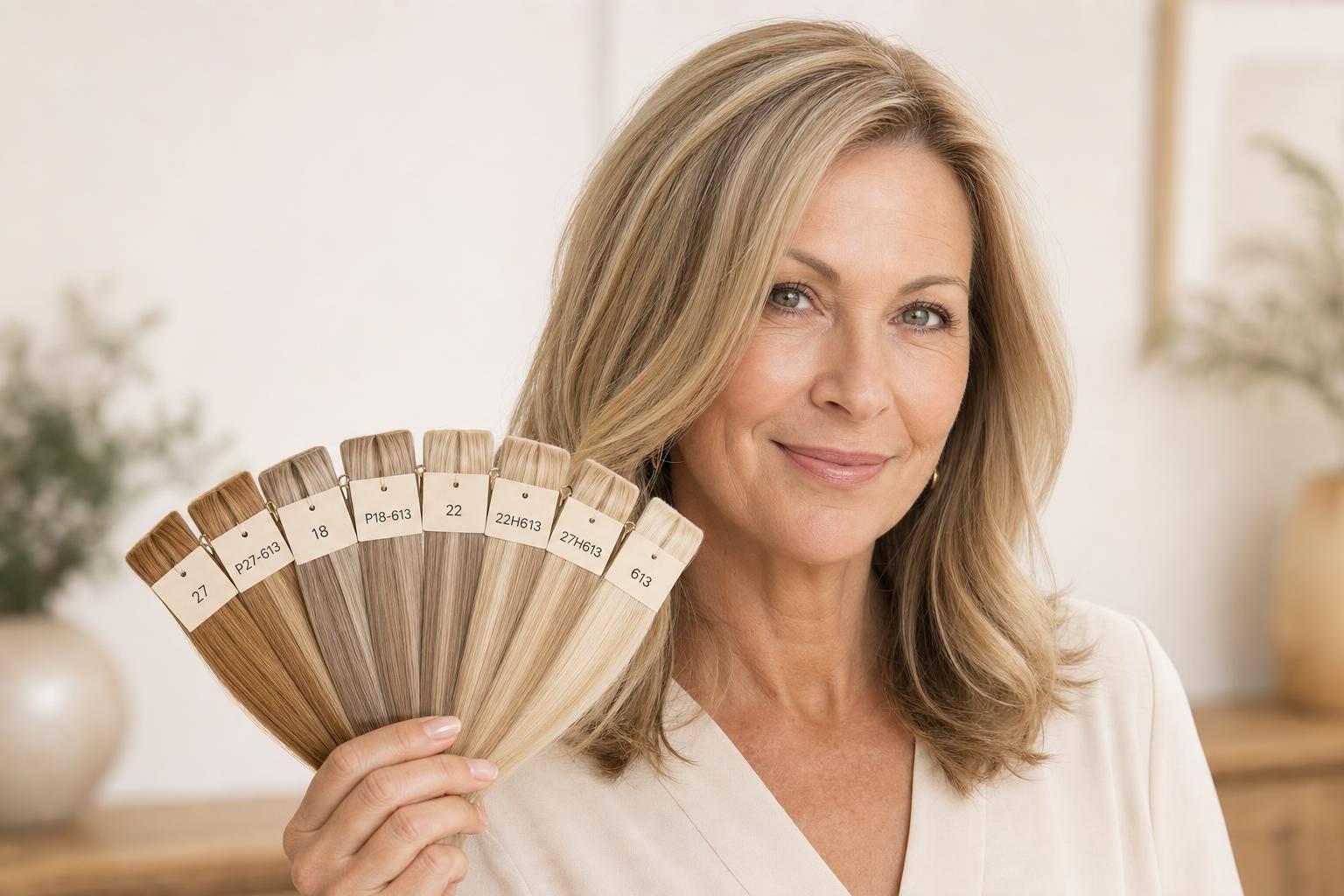
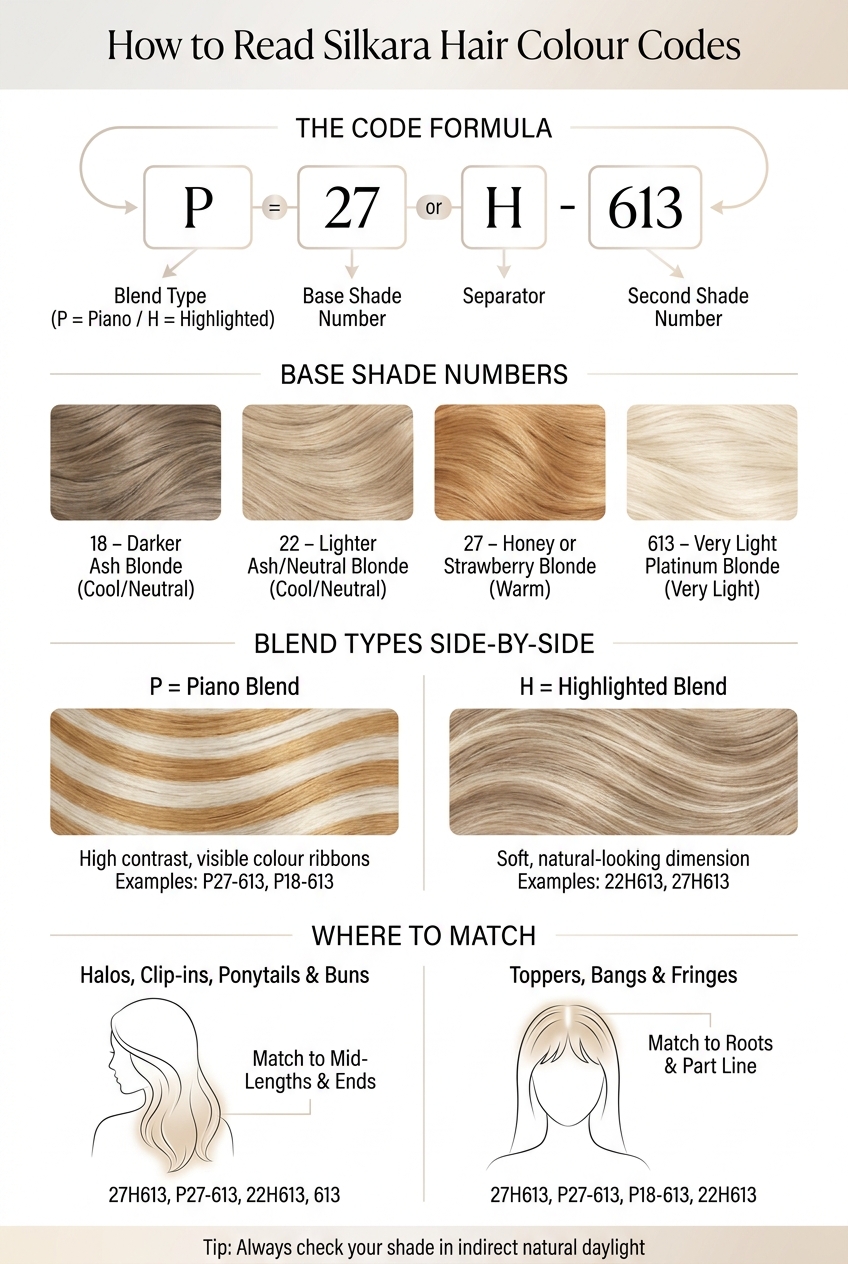
If I want a fast shade check, I read the code in 3 parts: number + letter + second number. That tells me the base shade, how the colours are mixed, and whether the piece uses one tone or two. In this guide, that means 18, 22, 27, and 613, plus P for piano blend and H for highlighted blend.
Here’s the short version:
- 18 = darker ash blonde, usually cooler
- 22 = lighter ash or neutral blonde
- 27 = honey or strawberry blonde, usually warmer
- 613 = very light platinum blonde
- P27-613 = bold ribbons of 27 and 613
- P18-613 = bold ribbons of 18 and 613
- 22H613 = softer highlights of 22 with 613
- 27H613 = softer highlights of 27 with 613
One code can tell me more than a product photo. Screens shift colour, and studies often show that digital colour can look different from device to device. So I use the code as my main guide, then check photos after that.
Silkara Hair Colour Codes Explained: P, H & Blend Types at a Glance
Quick comparison
| Code | Base look | Mix style | Best match area |
|---|---|---|---|
| 613 | Very light platinum | Single tone | Ends on light blonde hair |
| P18-613 | Cool ash blonde + platinum | Bold blend | Mids and ends |
| P27-613 | Warm honey blonde + platinum | Bold blend | Mids and ends |
| 22H613 | Neutral blonde + very light highlights | Soft blend | Mids and ends or root-area pieces |
| 27H613 | Warm blonde + creamy light highlights | Soft blend | Mids and ends or crown blending |
A simple way I think about it: start with the base number, then check the blend letter, then match the code to where the piece sits. For halos, clip-ins, ponytails and buns, I match mids and ends. For toppers, bangs and fringes, I check roots and the part line first.
That’s the whole system in one glance. The rest is just using it on the right hair piece and checking your colour in natural daylight.
sbb-itb-08feb2f
1. Read the base numbers first: 18, 22, 27, 613
Start with the number. It tells you the shade depth. Use the table below to match each base number to its tone.
What 18, 22, 27 and 613 mean
The numbers you’ll see most often in Silkara Hair codes point to set blonde levels:
| Base Number | Shade Description | Tone |
|---|---|---|
| 18 | Darker ash blonde | Cool / neutral |
| 22 | Lighter ash or neutral blonde | Cool / neutral |
| 27 | Honey or strawberry blonde | Warm |
| 613 | Very light platinum blonde | Very light |
How base shades behave across different hair pieces
The same light shade can look different depending on the hair piece. A single light shade like 613 may show less dimension on larger pieces. Mixed blonde bases such as 18, 22, or 27 add more variation, which can help larger pieces blend in a more natural way.
For crown pieces like toppers and fringes, match the base number to your roots. For blending pieces like [halos, ponytails, and clip-ins](https://silkarahair.com.au/collections/halo-hair-extensions), match it to your mids and ends.
Once you’ve got the base number clear, the letter tells you how the shade is mixed. Next, read the letters and separators to work out whether the shade is single, highlighted, or blended.
2. Decode blend letters and compare example codes
What P, H and blended formats mean
Once you know the base number, the next step is the blend marker. That tells you how the shade appears in the hair piece.
P stands for piano blend. In a piano blend, two shades show up in bold, distinct stripes. The result is high contrast and more visible colour separation.
H stands for highlighted. In a highlighted blend, the lighter shade is mixed through more finely, so the finish looks softer and more natural.
How to read P27-613, P18-613, 22H613 and 27H613
Read each code from left to right and the format becomes easy to follow.
- P27-613: piano blend of 27 and 613; bold warm ribbons.
- P18-613: piano blend of 18 and 613; cool ash-and-platinum ribbons.
- 22H613: highlighted blend of 22 and 613; soft neutral dimension.
- 27H613: highlighted blend of 27 and 613; warm, creamy dimension.
P27-613 vs. 27H613: both use the same two shades - honey blonde 27 and very light blonde 613 - but they look quite different in the hair. P27-613 shows stronger, more distinct ribbons. 27H613 mixes the lighter tone through the warmer base as fine highlights.
Comparison table: single, highlighted, rooted and piano blend
Use this table for a quick side-by-side look at how each shade type appears.
| Shade Type | Code Example | Visual Effect | Best For |
|---|---|---|---|
| Single / Solid | 613 | One tone throughout | Bleached or uniform platinum hair |
| Highlighted | 22H613 | Light, neutral blonde base with fine, very light highlights | Natural-looking dimension; matching hair with foil highlights |
| Highlighted | 27H613 | Warm honey blonde base with creamy very light highlights | Natural blondes with warm, sun-kissed tones |
| Rooted | - | Dark root blended into lighter lengths | Natural regrowth effect; best for matching darker roots with lighter ends |
| Piano Blend | P18-613 | Bold, distinct ribbons of cool ash blonde and platinum blonde | High-contrast, ash-blonde looks |
| Piano Blend | P27-613 | Distinct ribbons of warm honey and very light blonde | Visible, chunky dimension and warm blonde looks |
Use the blend pattern to judge placement, then match it to the right piece type.
Next, match that blend pattern to halos, clip-ins, ponytails, toppers and buns.
3. Match the code to the right Silkara Hair piece
Match halos, clip-ins, ponytails and buns to mids and ends
Now that you can read the code, the next step is matching it to where the piece sits on the head.
With halos, clip-ins, ponytails and buns, match the mid-lengths and ends, not the scalp. That’s the part the extension will sit against, so that’s the area that needs to blend.
If your roots are darker than the rest of your hair, check your ends in natural daylight. Shades like P18-613 or 27H613 can help smooth out that shift between darker roots and lighter lengths.
Match toppers, bangs and fringes to roots and part line
Toppers, clip-in bangs and fringes sit close to the scalp and hairline. So here, the part line and root area matter most.
If you’re dealing with thinning hair, visible scalp, or darker regrowth, H and P codes can add depth around the part line and make regrowth look softer. Silkara Hair’s colour match service can help here too. Send natural-light photos of your roots and lengths to narrow down the right code.
Product matching table by piece type
| Silkara Hair Product | Where to Match | Most Useful Shade Pattern | Example Codes |
|---|---|---|---|
| Halo extensions | Mid-lengths to ends | Highlighted or piano blend | 27H613, P27-613 |
| Clip-in extensions | Mid-lengths to ends | Highlighted or piano blend | 22H613, P18-613 |
| Ponytail extensions | Mid-lengths to ends | Highlighted or single | 27H613, 613 |
| Hair buns | Mid-lengths to ends | Highlighted or single | 22H613, 613 |
| Hair toppers | Roots and crown | Rooted or highlighted | 27H613, P27-613 |
| Clip-in bangs / fringes | Roots and hairline | Highlighted or rooted | 22H613, P18-613 |
Once you know the right match point, it gets much easier to narrow the code. After that, look at how your roots, mids and ends appear in natural light.
4. A simple process for choosing your shade
Check roots, mids and ends in natural daylight
Once you've read the code and matched the piece type, do a quick colour check to narrow down the exact shade.
Look at your roots, mids and ends in indirect natural light. Skip direct sun, because it can wash out colour and make shades look flatter than they are. If your roots are darker than your lengths, blended codes like P18-613 and 27H613 can help smooth out that contrast.
Use blended shades and Silkara Hair colour match support
If your hair has two tones, go for a blended P or H code instead of a single shade. It usually gives you a closer match, especially when your colour shifts from top to bottom.
Some products also include an AI virtual try-on tool, so you can preview how a shade looks before you commit.
Key points before selecting your shade
Read the base first, then the blend, then match the area the piece will sit against.
FAQs
How do I choose between P and H codes?
Choose based on the look you want.
P codes usually mean blended or multi-tonal shades. That gives you a more natural, dimensional finish.
H codes generally mean highlighted or rooted shades. These add more depth and contrast.
If you want a softer, blended effect, choose P. If you want a more defined highlighted or rooted look, choose H.
Which code suits darker roots and light ends?
Codes with H, like 22H613 or 27H613, usually point to a highlighted or rooted blend. That means you get a darker base with lighter blonde ends.
The result is a soft, natural shift from darker roots to lighter tips, which gives the colour more depth and a more natural look.
Should I match my roots or my ends?
Not necessarily. Your roots and ends don't have to match.
When you choose Silkara hair solutions, focus on a shade that works with your natural hair tone and the result you want. Highlighted or blended codes can give your hair a more natural, multi-dimensional look instead of a flat or dull finish.