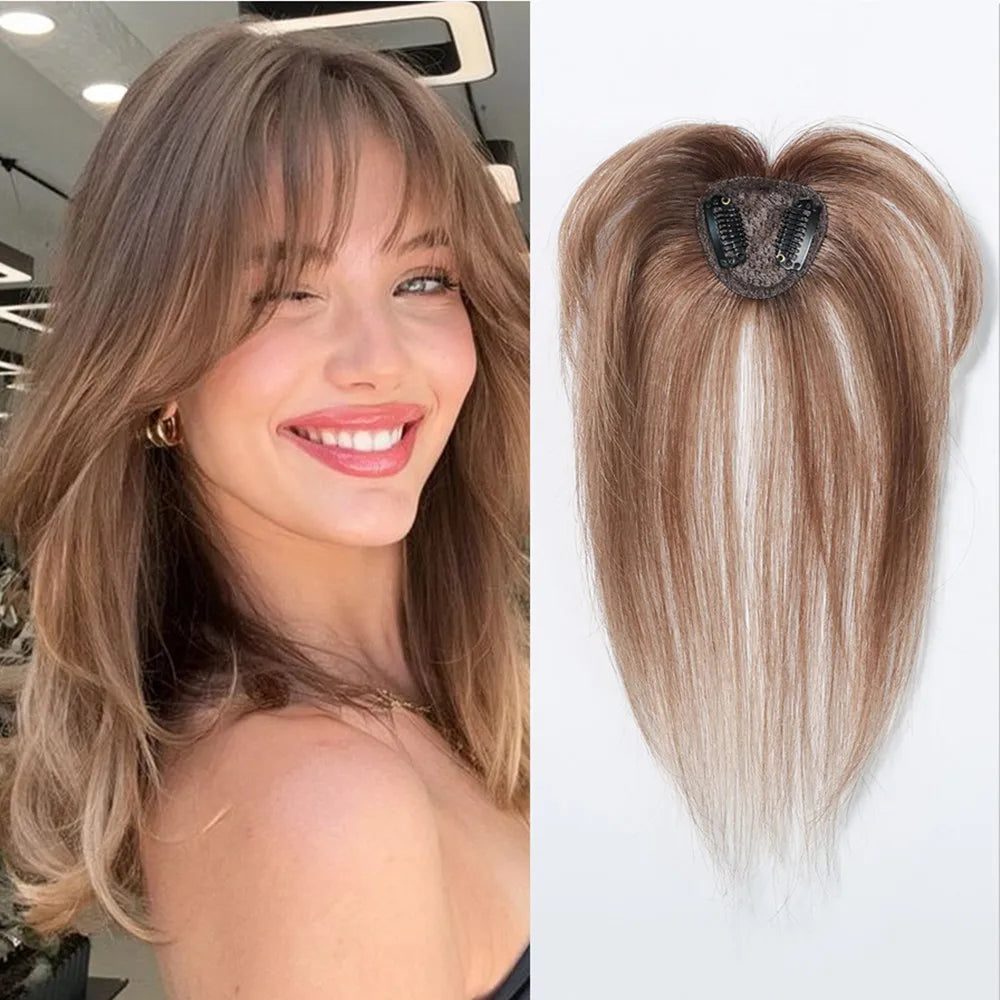

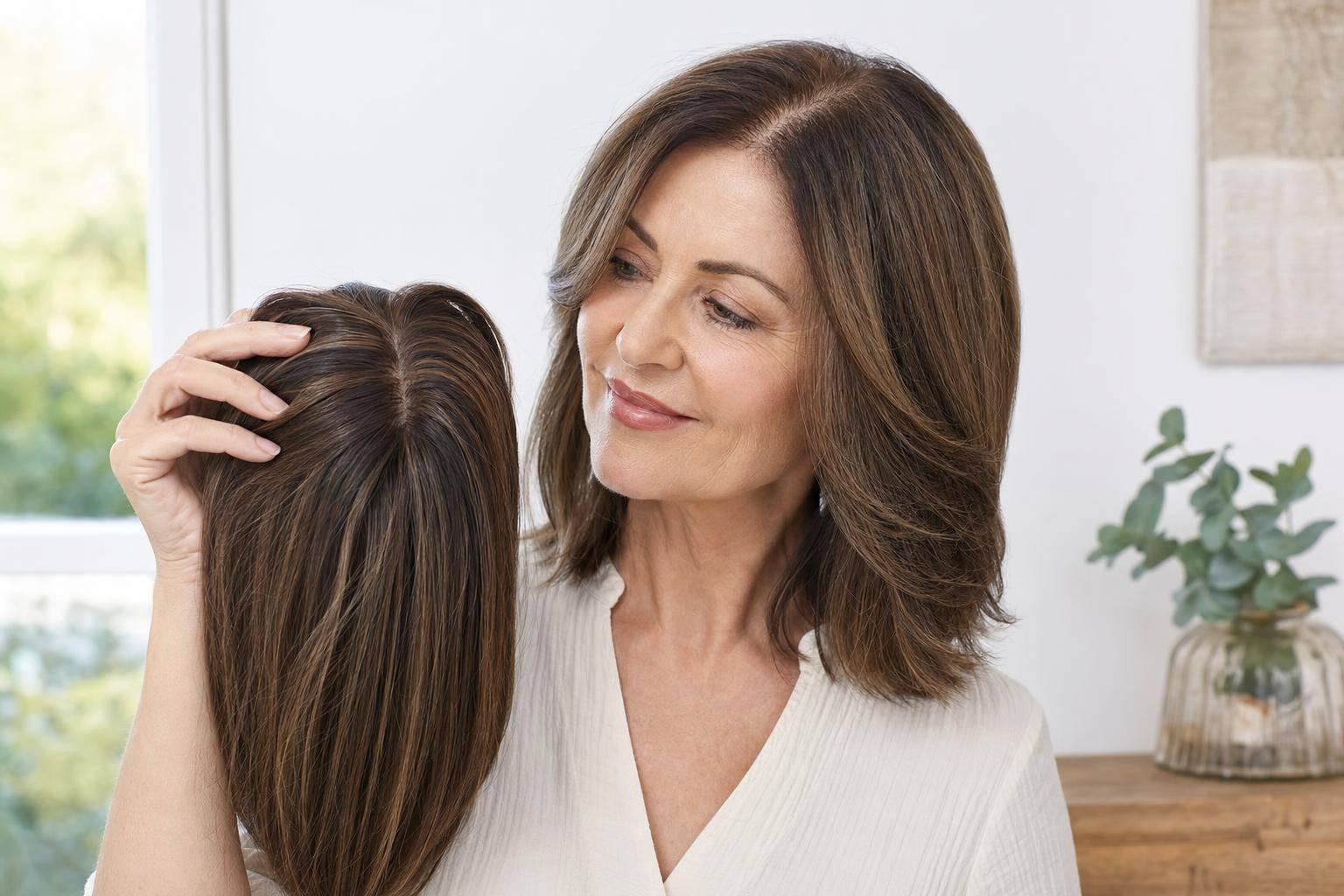
If your topper or extensions look right in one light and off in another, that’s normal. Hair colour shifts under different lighting, phone cameras can skew tone, and your roots, mid-lengths, and ends often aren’t the same shade anyway.
Here’s the short answer:
- Check colour in soft daylight near a window
- Match your mid-lengths and ends, not just roots
- Focus on undertone as much as depth
- Expect a close blend, not a perfect swatch copy
- Multi-tonal shades often hide small differences better than flat shades
A 1-shade difference can look minor once the piece is worn and styled, but the wrong undertone can stand out straight away. That’s why I’d judge colour on your visible lengths in natural light, with clean, dry hair and no flash photos.
| Check | Higher risk of mismatch | Lower risk of mismatch |
|---|---|---|
| Lighting | Warm indoor bulbs, bathroom lights, direct sun | Soft, indirect daylight |
| Match point | Roots or regrowth only | Mid-lengths and ends |
| Shade type | Flat single tone | Multi-tonal shade |
| Photo method | Flash, filters, auto-edited images | Clear daylight photos |
If I keep those four checks in mind, choosing a shade gets much less frustrating.
What causes a visible colour mismatch
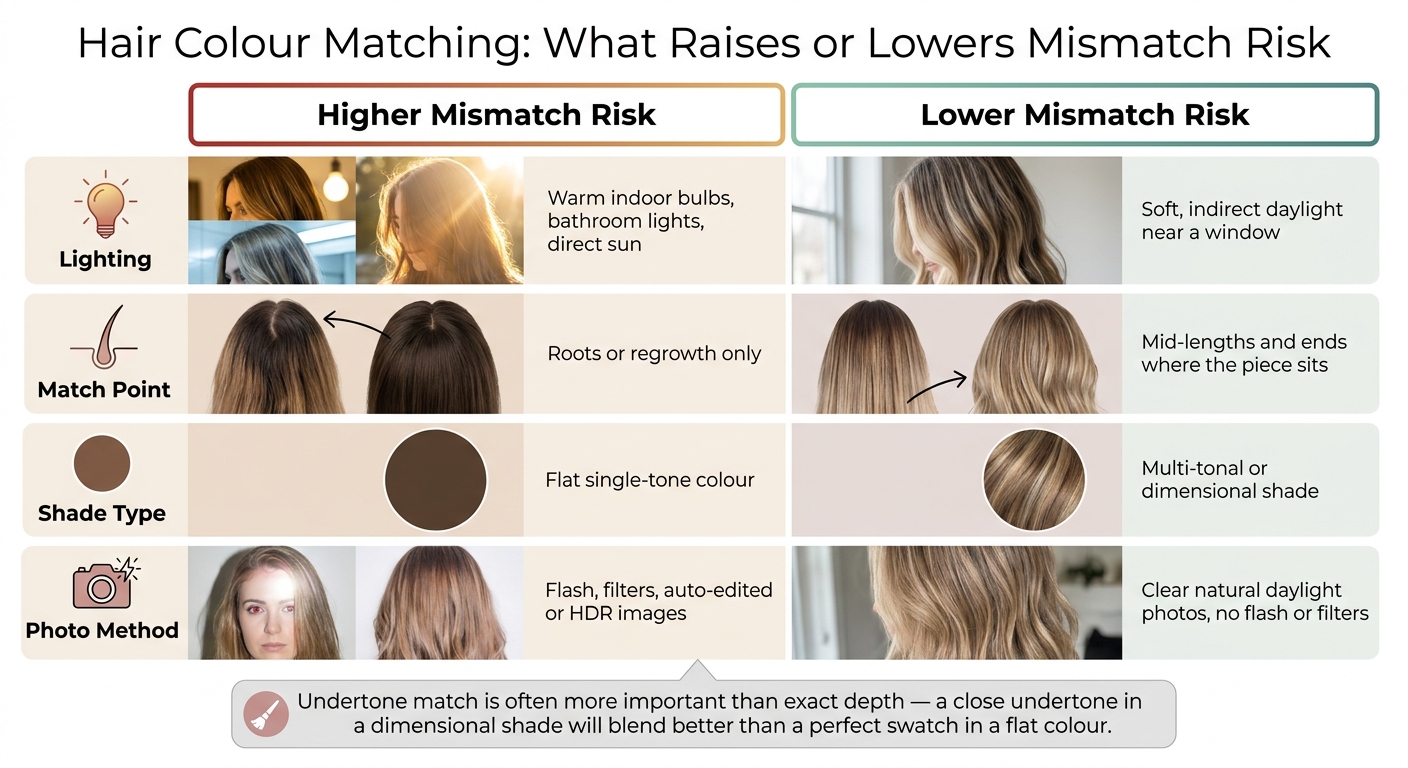
Hair Colour Matching: High vs Low Mismatch Risk Factors
A visible colour mismatch usually comes down to three things: lighting, natural variation, and the difference between flat colour and dimensional colour.
How indoor light, outdoor light and phone cameras affect colour
The light you use to check a shade changes what you see. Warm yellow bulbs, which are common in living rooms and bedrooms, can make hair look more golden or red. Cool bathroom lighting or fluorescent light can make it look ashier or flatter.
Natural indirect daylight is the best way to see the colour as it is. A simple way to do that is to stand near a window, with no direct sun hitting your hair.
Phone photos make things even trickier. Auto white balance, HDR settings, and exposure changes can all shift how colour looks in an image. The colour itself hasn't changed - the camera has. That's why shade checks should be done in neutral daylight, not based only on indoor lighting or a phone photo.
Why roots, mid-lengths and ends rarely match each other
Hair usually isn't one even shade from top to bottom. Roots are often darker, while mid-lengths and ends tend to be lighter from sun, colour, or regrowth.
That matters because a topper sits beside your mid-lengths and ends, not just your roots. If you match it to the regrowth at the roots, it can end up looking too dark or a bit separate from the rest of your hair.
For a better blend, match the visible length of your hair rather than focusing only on the roots.
Flat colour versus multi-tonal hair
Most natural hair isn't one flat shade. It has tonal shifts throughout, which is why it tends to look softer and more natural. A flat hairpiece can sit next to that variation and look like one solid block of colour, even when the depth level is close.
In a lot of cases, the issue isn't the wrong depth level. It's the lack of tonal variation. Dimensional colour tends to hide small shade gaps better because it reflects the movement and depth you usually see in natural hair.
Once you know if your hair looks flat or dimensional, it's much easier to judge the shade properly.
sbb-itb-08feb2f
How to check your true colour before choosing a shade
Once you know how light shifts colour, use this simple at-home check to narrow down the right shade for toppers and extensions.
Assess your hair in natural, indirect daylight
Check your hair near a window in soft, indirect daylight. Wear it down, clean, and fully dry.
If you take a photo, skip filters and flash. Take a clear photo in natural light from the front and back so you can record your true colour.
Match the mid-lengths and ends first
After checking your hair in daylight, match the area where the piece will sit: the mid-lengths and ends.
This matters even more if your colour has faded, if you have balayage, or if you’re blending grey. In those cases, a piece that matches the mid-lengths will usually blend in more smoothly.
If you’re stuck between two shades, go with the slightly lighter one. A lighter piece is often easier to blend than a darker one.
Quick colour-check comparison table
Use this guide to compare your options.
| What you're comparing | Higher mismatch risk | Better for blending |
|---|---|---|
| Lighting | Warm indoor light or direct sun | Soft daylight near a window |
| Area to match | Darkest roots or regrowth | Mid-lengths and ends where the piece sits |
| Colour type | Single-tone shade | Multi-tonal shade |
Why dimensional shades usually blend better
How highlights, lowlights and tonal variation soften a mismatch
That variation is a big reason a dimensional shade often blends better than a single flat colour. Natural hair already has depth built in. A dimensional shade mirrors those shifts in tone, so it tends to sit more quietly next to highlighted, balayaged or sun-faded hair.
Because dimensional shades use more than one tone, they usually work better with hair that already has variation. By contrast, a flat colour can look more flat in bright light, even when the depth level is close.
When a slight mismatch still looks natural once worn
A small shade gap often looks softer once the piece is worn. After it’s on, movement helps blur small differences, which makes them less obvious.
Undertone matters a lot here. Getting the undertone right - warm, cool or neutral - is often more important than matching the depth exactly. If the piece shares your hair’s undertone, it’s more likely to blend quietly into the full look. If the undertone is off, you can end up with a visible seam.
The goal is blend, not an exact swatch match.
How to improve blending and choose with confidence
Style the piece with your own hair for a softer blend
Once you've found the closest shade, the styling does a lot of the heavy lifting. Wear the piece with your usual parting, then blend your own hair through it. Curl or wave both together so the textures sit as one, not two separate layers. That small step can make a big difference.
If the finish still looks a little off, compare your photos with a shade match. Sometimes the issue isn't the colour itself, but how the hair is sitting.
If the length is slightly out, a stylist can do a dry cut or add light layers after the piece is fitted. This helps soften any visible step where your hair meets the piece, so it falls in a more natural way.
Use Silkara Hair colour support before you buy

If you're stuck between shades, use Silkara Hair's colour support before ordering. Send two clear photos - one from the front and one from the back - to info@silkarahair.com. Take the photos in natural, indirect daylight near a window, with your hair down and dry so the full length can be seen.
It also helps to include the product type you're looking at, such as a ponytail, halo or clip-in. Silkara Hair usually replies with a shade recommendation within 12–24 hours [1].
Conclusion: Aim for blend, not exact sameness
Hair colour changes under different lighting, and your roots, mid-lengths and ends often don't match perfectly anyway. So chasing an exact copy of your hair colour usually isn't realistic - and you don't need it to be. In most cases, a dimensional shade with the same undertone as your hair, and one that sits close to your mid-lengths and ends, will blend better than a flat shade picked just to match a swatch.
Aim for a close undertone match, choose the shade that works with your mid-lengths and ends, and let styling handle the rest.
FAQs
How do I know my hair undertone?
Check your hair in natural sunlight and look for the secondary tones under the main colour. Warm undertones tend to show golden, copper, amber, or red notes. Cool undertones usually look more ash, grey, silver, or violet. If your hair doesn’t lean clearly either way, it’s likely neutral.
You can also check your wrist veins. Green often points to warm undertones, while blue or purple usually suggests cool. If both gold and silver jewellery look good on you, your undertone is likely neutral.
Should I match faded ends or fresh colour?
Match your extensions or topper to your mid-lengths and ends, not your roots. Your roots are often darker because of new growth, but the mid-lengths and ends are the parts that need to blend.
Hair colour tends to shift and fade over time, so matching the ends usually gives you a smoother, more natural look. Multi-tonal shades often work best because they blend in with the variation already in your hair.
Can a stylist adjust the piece colour?
Yes, a professional stylist can adjust the colour of human hair pieces, including 100% Remy human hair extensions or toppers.
That said, human hair pieces don’t always react to colour the same way as hair growing from your scalp. So it’s best to book with a stylist who has experience working with alternative hair.
If you’re having trouble finding the right match, go a little lighter if you can. That’s usually the safer option. It’s much easier to darken a piece or add lowlights than it is to lighten one that’s already too dark.