
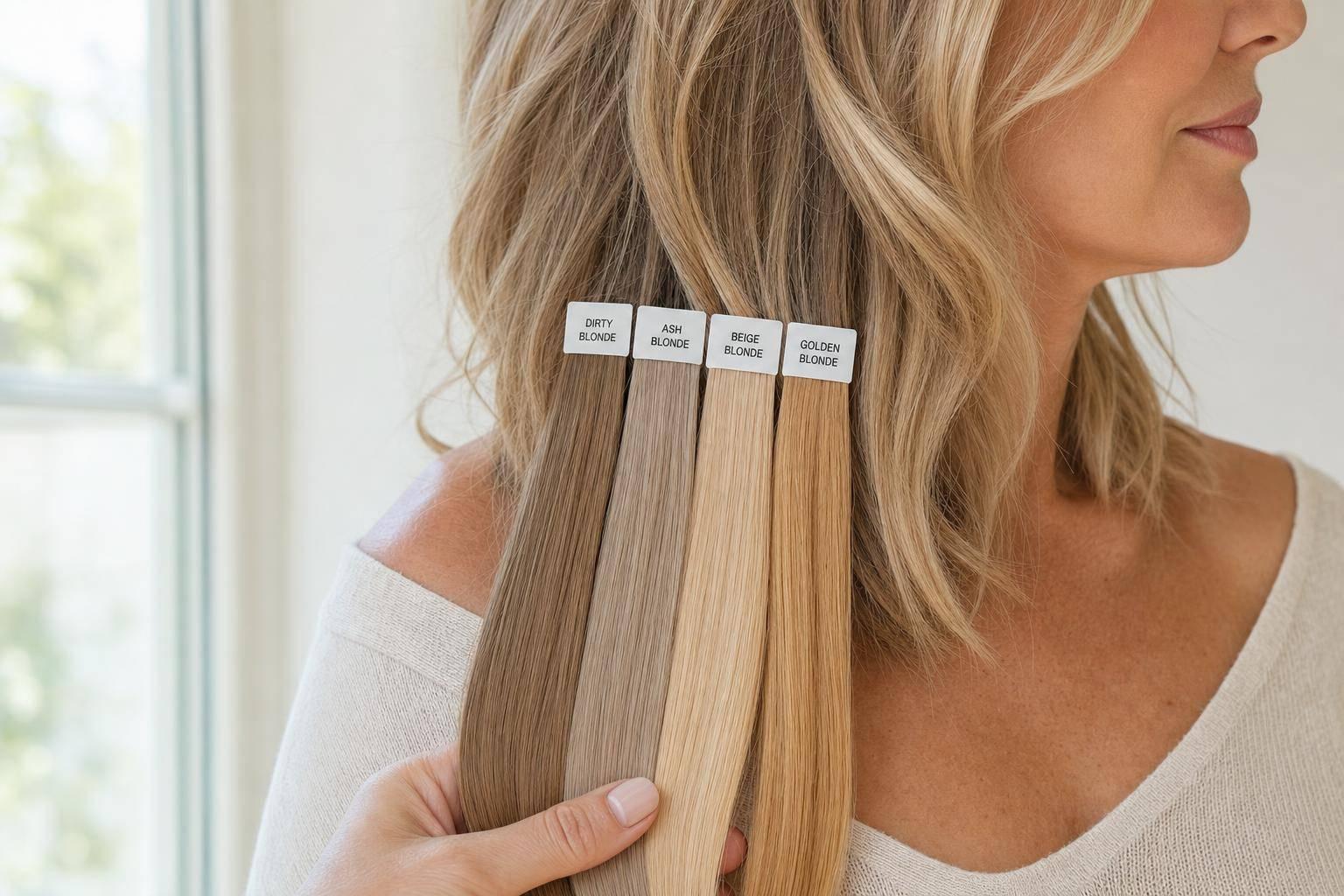
Most blonde colour-match mistakes come down to undertone, not depth. If I match a warm blonde extension to cool hair, or an ash piece to golden lengths, the join can look off fast, especially in daylight.
Here’s the short answer:
- Dirty blonde suits hair with a deeper, sandy, slightly warm or balanced look
- Ash blonde suits cool hair with grey, silver or smoky tones
- Beige blonde suits balanced blondes that sit between warm and cool
- Golden blonde suits honey, peach and yellow-gold tones
- For halos, clip-ins and ponytails, I’d match the mid-lengths and ends
- For toppers and clip-in fringes, I’d match the roots and hairline
A simple check at home can help:
- If my hair looks gold, honey or caramel in sunlight, it reads warm
- If it looks smoky, icy or muted, it reads cool
- If it looks sandy or balanced, it’s likely neutral
In practice, this matters because blonde shades that look close online can still clash in person. Even a small shift in tone can stand out near the crown, hairline or ends. That’s why I’d always check hair in natural daylight, where undertones are easier to spot.
Color Matching Blonde Hair Extensions by The Hair Shop

sbb-itb-08feb2f
Quick Comparison
| Shade | Undertone | Best match | Risk if wrong |
|---|---|---|---|
| Dirty blonde | Neutral to soft warmth | Darker blonde hair with sandy depth | Can look flat beside bright warm or icy cool hair |
| Ash blonde | Cool | Hair with no gold or copper pull | Can look stark on warm hair |
| Beige blonde | Neutral to cool | Soft, balanced blondes | Can look dull on very warm hair |
| Golden blonde | Warm | Honey or caramel-toned hair | Can look brassy on cool blondes |
My rule of thumb: match the undertone first, then the shade name. If I’m between two options, I’d use the main colour through the mid-lengths as my guide, because that’s where extensions usually need to disappear into my own hair.
How to tell if your hair is warm, cool or neutral
Before you choose from the Silkara Hair extensions collection, work out whether your blonde looks warm, cool or neutral. The easiest way to do that is in natural daylight. Start with the mid-lengths, then compare your roots and ends. Hair can shift a bit from top to bottom, so this quick check gives you a clearer read on the overall tone.
Once you've looked at it in daylight, you can sort it into one of three tone groups.
Warm undertones: golden, honey and caramel tones
Warm hair tends to pick up golden, honey, caramel or copper glints in sunlight [1][6]. If your blonde looks yellow, peachy or copper-toned in bright light, it reads as warm.
Cool and neutral undertones: ash, beige and balanced blondes
Cool hair looks smoky, silvery or icy in natural light [6][3]. If your blonde looks grey or softly muted instead of golden, it reads as cool. Neutral hair often looks beige or sandy, with a mix of warm and cool tones that feels more balanced [1][2][6].
Simple undertone checks you can do at home
A simple at-home check can help if you're still unsure:
- Silver usually suits cool undertones
- Gold usually suits warm undertones
- If both look good on you, you're likely neutral
Use these checks to place your hair in the dirty, ash, beige or golden blonde family. That gives you a solid starting point for finding the blonde family closest to your natural colour.
Dirty blonde vs ash blonde vs beige blonde vs golden blonde
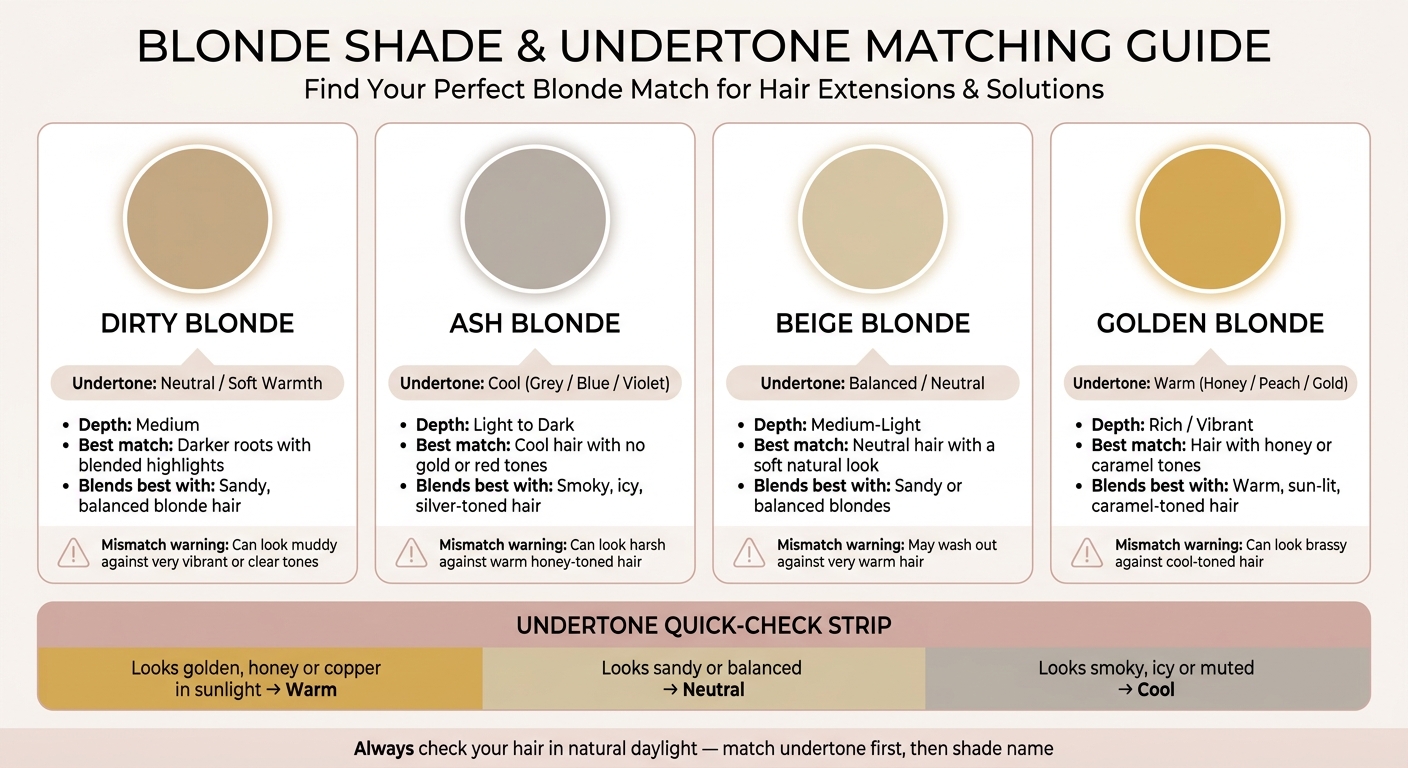
Dirty Blonde vs Ash Blonde vs Beige Blonde vs Golden Blonde: Which Shade Matches Your Hair?
Here’s how each blonde family looks in day-to-day terms. Start by looking at the deepest or warmest tones already in your hair, then line those up with the shade families below.
Dirty blonde: depth with soft warmth or neutral balance
Dirty blonde sits between light brown and medium blonde. It usually has a beige-sandy look with a bit of dimension, often with darker pieces running through the lengths. If your hair has darker roots and blended highlights, this is often the closest match.
Ash blonde: muted, cool and low on brass
Ash blonde is a cool-toned blonde with grey, blue or violet-based undertones. It has a smoky, muted finish and tends to suit cool undertones best. On warmer hair, it can start to look smoky in the wrong way or a bit harsh.
That contrast is often the fastest way to tell if your blonde reads cool or warm.
Beige blonde vs golden blonde: soft balance versus clear warmth
Beige blonde sits in the middle. It’s soft, creamy and neutral, without the stark grey look of ash or the clear yellow tone of golden blonde. Golden blonde, by contrast, is warm. It leans into honey, peach or gold tones and tends to work well on hair that already has honey or caramel running through it.
| Shade | Undertone | Depth | Blends best with | Mismatch effect |
|---|---|---|---|---|
| Dirty blonde | Neutral, beige, sandy | Medium | Darker roots with blended highlights | Can look muddy against very clear or vibrant tones |
| Ash blonde | Cool (grey, blue, violet) | Light to dark | Cool hair with no gold or red tones | Can look harsh against warm, honey-toned hair |
| Beige blonde | Balanced, neutral | Medium-light | Neutral hair and a soft natural look | May wash out against very warm hair |
| Golden blonde | Warm (honey, peach, gold) | Rich, vibrant | Hair with honey or caramel tones | Can look brassy against cool-toned hair |
Once you know where your hair sits, the next step is matching that undertone to the right Silkara shade family.
Which shade should you choose for your Silkara Hair piece?

Once you know your undertone, the next step is simple: match it to the right Silkara shade family, then think about where the piece will sit in your hair.
When warm highlighted blonde suits shades like P27-613
P27-613 is the closest match for warm, highlighted blonde hair. It blends honey and gold tones in a multi-tonal finish, so it tends to work well if your hair already has that warm, sun-lit look through the mid-lengths and ends.
If your hair pulls cool or ashy, this shade can stand out instead of blending in. That warmth will look more like a contrast than a smooth match.
When cooler shades suit ash-blonde or beige-blonde hair
Ash-blonde and beige-blonde hair usually pairs better with ash, platinum, or cool beige shades. If silver looked better on you than gold in the undertone check, it makes sense to stay in the ash or cool-beige family.
Using a warm golden blend on ash-blonde, beige-blonde, or low-warmth blonde hair can create a visible mismatch against those softer, muted tones.
Matching by product type: halos, clip-ins, toppers and clip-in bangs
Colour match comes first. Placement comes next.
- Halos, clip-ins and ponytail extensions should match your mid-lengths and ends, not your roots.
- Toppers and clip-in bangs need to match the root area and the hair around your face, because they sit at the crown or front hairline.
That small detail matters more than people think. A shade that looks spot-on at your ends can look off once it sits near your hairline.
If you're not sure which way to go, Silkara Hair offers a free colour match service. Send natural-light photos of your roots, mids, and ends, and the team can help point you to the right shade.
Conclusion: A simple way to choose the right blonde match
Now that the main shade families are clear, the last step is undertone. Start there: warm, cool, or neutral. Dirty blonde has a softer, muted look. Ash blonde leans cool. Beige blonde sits in the middle. Golden blonde leans warm.
Check your hair in natural daylight and pay most attention to the mid-lengths. That tells you more than the clip-in extensions you choose. It shows the undertone you need to match.
Warm hair - golden, honey, or amber-toned - pairs well with shades like P27-613. Cool hair works better with ash, silver, or platinum-leaning shades. Neutral hair sits between the two, with sandy or beige tones, and usually gives you the most flexibility [1][2][3][4][5]. If your hair is multi-tonal, the best match is often the shade that reflects the main tone through the mid-lengths.
Match the undertone first, then pick the shade family. If you're unsure, use the free colour match service for your halo hair extensions and send natural-light photos of your roots, mid-lengths, and ends for a colour match.
FAQs
What if my roots and ends are different blonde shades?
If your hair is a different shade from roots to ends, choose a hair extension colour that matches your mid-lengths. That usually gives you the smoothest blend from top to bottom.
Still not sure? Use our professional colour matching service for a flawless result.
Can I mix warm and cool blonde extensions?
Yes, especially if you choose neutral or balanced blonde shades. They tend to blend in more naturally, so the tones look intentional instead of fighting each other.
It helps to match the shade to your undertone:
- Warm undertones usually suit golden or honey blonde
- Cool undertones often work better with ash or platinum blonde
- Neutral undertones can usually wear both
How do I choose if I’m between beige blonde and dirty blonde?
Pay close attention to your natural hair’s undertones. Dirty blonde is usually a soft, neutral shade with light sandy and beige notes, while beige blonde tends to sit on the cooler side.
For the best colour match, compare the mid-lengths of your natural hair instead of the roots or ends. If you’re still not sure, use our professional colour-matching service.