
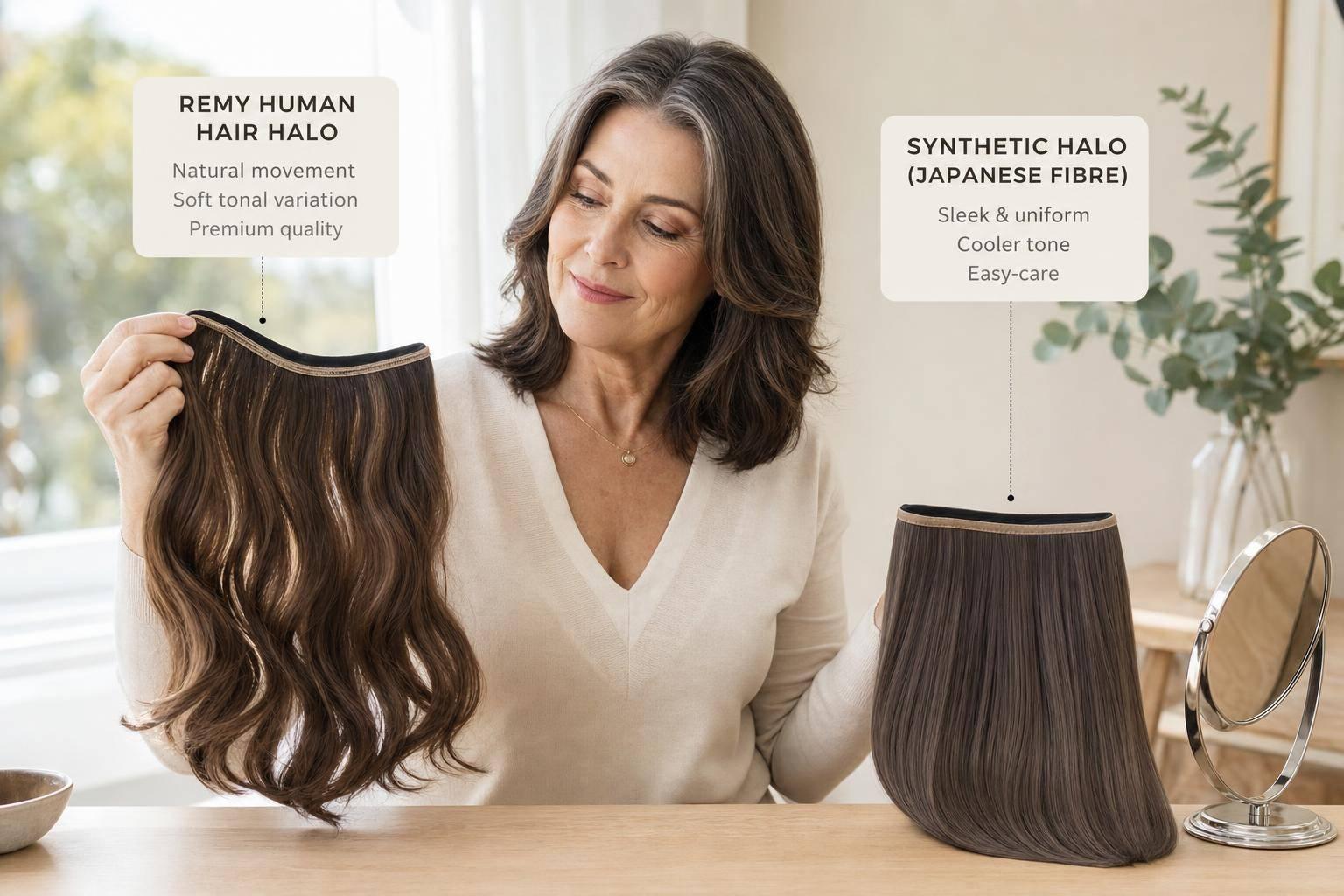
If I want the short answer: I’d pick synthetic for occasional wear and Remy human hair for regular wear.
Here’s why:
- Synthetic halos cost less upfront: A$55.00–A$79.00
- Remy human hair costs more upfront: A$295.99 sale or A$369.99 full price
- Human hair lasts longer: up to 10 months with daily wear
- Synthetic usually lasts: 3–6 months
- Human hair gives me more styling options: I can curl, straighten, and dye it
- Synthetic is lower effort: it keeps its pre-set shape and needs less styling
- Heat limits differ: human hair stays under 160°C; synthetic is heat-safe to 180°C
So if I wear a halo most days, the higher spend on human hair can work out better over time. If I only want it for events, weekends, or to test whether halos suit me, synthetic is the simpler buy.
The main trade-off is simple: human hair looks and moves more like my own hair, while synthetic is cheaper and easier to deal with day to day.
Quick Comparison
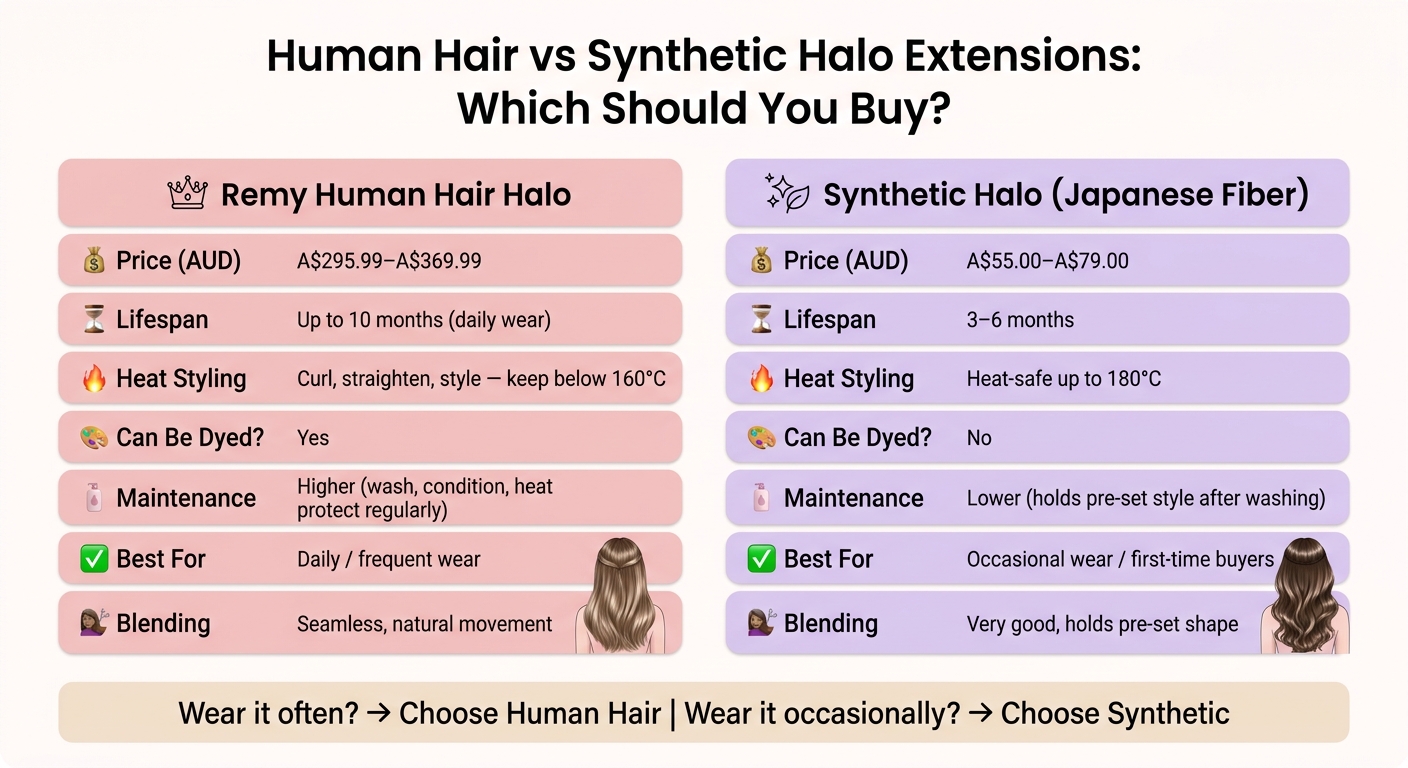
Human Hair vs Synthetic Halo Extensions: Full Comparison
| Feature | Remy Human Hair Halo | Synthetic Halo |
|---|---|---|
| Price | A$295.99–A$369.99 | A$55.00–A$79.00 |
| Lifespan | Up to 10 months | 3–6 months |
| Styling | Curl, straighten, dye | Limited restyling, no dye |
| Heat | Below 160°C | Up to 180°C |
| Upkeep | More care needed | Less care needed |
| Best for | Regular wear | Occasional wear |
If I’m choosing based on budget, wear frequency, blend, styling, and upkeep, that’s the decision in one view—whether you opt for halo hair extensions or a synthetic alternative.
sbb-itb-08feb2f
How Silkara human hair halos and synthetic halos differ
The main difference between Silkara’s two halo types comes down to the hair itself. One is made from 100% Remy human hair. The other uses a synthetic material called Japanese Fiber. That one choice affects almost everything: the look, the feel, the lifespan, and how much you can style it.
Remy human hair halo extensions
If you want a halo that looks and moves like your own hair, this is the stronger pick for regular wear.
Silkara’s Remy human hair halo is made with strands that stay aligned in the same direction. That helps cut down tangling and gives the hair a soft, smooth feel with natural movement. In plain terms, it tends to blend more closely with your own hair.
Because it’s real hair, you can curl it, straighten it, and dye it if needed. Just keep heat tools below 160°C to help protect the hair. It also needs the same kind of care you’d give your own hair: regular washing, conditioning, and heat protection to keep it looking smooth. One customer said hers lasted 10 months with everyday wear.
At A$295.99 on sale and A$369.99 at the regular price [2], it makes more sense for frequent wear and longer use.
Synthetic halo extensions
If you’re watching your budget or only plan to wear a halo now and then, the synthetic option is the easier entry point.
Silkara’s synthetic halo uses Japanese Fiber. This synthetic fibre is made to avoid the stiff, plastic-looking finish people often link with low-cost synthetic hair. It comes pre-styled in straight or wavy options, and that style holds between wears.
It’s heat-safe up to 180°C [3], but it can’t be dyed [3]. It also needs less day-to-day styling, which is handy if you want something low-fuss. The trade-off is simple: because the shape is pre-set, you get less freedom to restyle it.
With prices from A$55.00 to A$79.00 [2] and a usual lifespan of 3–6 months [4], it suits occasional wear and lower-maintenance styling.
| Feature | Remy Human Hair | Japanese Fiber (Synthetic) |
|---|---|---|
| Appearance | Natural look, low shine | Natural-looking, non-plastic shine |
| Texture | Soft, smooth, cuticle-aligned | Soft, natural-feel, pre-set style |
| Heat styling | Curl, straighten and style; keep below 160°C [2] | Heat-safe up to 180°C [3] |
| Can be dyed | Yes [2] | No [3] |
| Lifespan | Up to 10 months with daily wear [2] | 3–6 months [4] |
| Price (AUD) | A$295.99 sale / A$369.99 regular [2] | A$55.00–A$79.00 [2] |
Side-by-side comparison: appearance, price, lifespan and styling
Here’s the short version: synthetic is cheaper to buy, while human hair tends to last longer and gives you more styling freedom.
| Feature | Remy Human Hair Halo | Synthetic Halo (Japanese Fiber) |
|---|---|---|
| Appearance | Natural lustre, realistic finish | Quality matte finish |
| Feel | Cuticle-aligned, soft and smooth | Engineered to mimic human hair |
| Blending | Seamless, especially for fine or thinning hair | Very good; holds pre-set style |
| Price (AUD) | A$295.99–A$369.99 [2] | A$55.00–A$79.00 [2] |
| Expected lifespan | Up to 10 months with daily wear [2] | 3–6 months with daily wear [4] |
| Heat styling | Below 160°C [2] | 150°C–180°C [3] |
| Maintenance effort | Higher (washing, conditioning, oils) | Lower (holds style after washing) |
| Recommended wear | Daily, long-term use | Occasional wear |
Appearance, texture and how well each blends
The biggest difference shows up in how the hair moves. Human hair moves more like your own, which usually makes blending easier. If your hair is fine or thinning, that natural movement can help the halo sit into the mid-lengths and ends instead of looking separate.
Synthetic works well if you want a set-and-go option. It keeps its shape nicely, which is handy when you don’t want to style it each time. For the best match, choose the colour based on your mid-lengths and ends, not your roots.
If blending is your top concern, the next thing to look at is cost per wear.
Price in AUD and cost per wear
Human hair has the bigger upfront cost, but the longer lifespan can bring the cost per wear down over time. If you plan to wear your halo most days, that longer use can make the spend easier to justify.
Synthetic makes more sense for occasional wear. If you only reach for it now and then, the lower buy-in is often the better fit. Put simply: the more often you wear it, the more human hair starts to make sense.
Lifespan, heat styling and care
Human hair usually stands up better to regular wear, but it does ask more from you. You’ll need sulfate-free products, regular conditioning, and a lightweight hair oil between wears. Keep heat styling below 160°C to help protect the cuticle [2].
Synthetic is easier to live with day to day because it keeps its pre-set style after washing. The downside is less freedom to restyle it and a shorter lifespan. That’s why wear frequency matters more than the price tag alone.
When to buy synthetic and when to buy human hair
When a synthetic halo is the right choice
If price and ease matter most, start with synthetic. A synthetic halo makes sense for occasional wear, special events, or your first halo buy. At A$55.00–A$79.00, it gives you a fuller look and a ready-to-wear finish without the higher upfront spend [2].
It’s also a smart first step if you’ve never worn a halo before. You can get used to the fit, feel, and colour match before spending more on a premium piece. That makes synthetic a sensible pick when you only plan to wear it now and then.
When to choose Remy human hair
For frequent wear, human hair tends to be the better value over time. If you wear your halo often, Remy human hair is the better long-term buy [4][5]. It lasts longer with regular use, so the cost per wear drops as time goes on, even though the upfront price is higher.
Human hair is also the stronger option if your natural hair is fine or flat and you want the most natural blend possible. Because the cuticles stay aligned, the hair has a softer look and more natural movement, so it sits with your own hair more smoothly. You also get more freedom to style it.
The trade-off is upkeep. You’ll need to wash, condition, and use heat protection on a regular basis. If you wear your halo often and want a better blend with longer use, that extra effort usually pays off.
Conclusion: Which Silkara halo should you buy?
If you only plan to wear your halo now and then, go with synthetic. If you’ll wear it often, Remy human hair makes more sense.
For occasional wear, the Silkara Synthetic Secret Halo gives you a lower-cost way to add volume and length.
If your halo is going to be part of your regular routine, the choice is less about the upfront spend and more about blend, styling options, and how long it lasts. The Silkara Remy Human Hair Halo is worth the higher upfront cost at A$295.99 [2]. You can curl it, straighten it, and dye it to match your colour [1]. One verified customer said they got 10 months of daily wear from it [2].
Before you buy, use Silkara's free Colour Match service or AI Virtual Try-On to see how each shade blends with your hair [1][3].
FAQs
Which halo looks more natural in my hair?
Both our 100% Remy human hair and high-quality synthetic halo extensions are made to blend in with your natural hair when you choose the right match. Remy human hair gives you that more polished, salon-style finish, while synthetic halos are designed to copy the soft feel and natural movement of real hair.
For the smoothest blend, use our free colour matching service and match your halo to the mid-lengths and ends of your hair.
Is Remy human hair worth the higher price?
It comes down to your hair goals, your budget, and how often you plan to wear your extensions.
Remy human hair is worth paying more for if you want the most natural look and feel, longer wear, and the freedom to use heat styling tools. A synthetic halo makes sense if you want a lower-cost, low-fuss option for quick volume and easy everyday glam.
How do I choose between synthetic and human hair?
Choosing between synthetic and human hair comes down to how you live, what you want to spend, and how often you’ll wear your extensions.
Silkara’s signature Japanese fibre synthetic halos are a good fit for affordable, everyday glam and those quick confidence boosts before heading out the door. If you want a more luxe, longer-term option, our 100% Remy human hair halos offer better longevity and a smooth, salon-worthy blend.