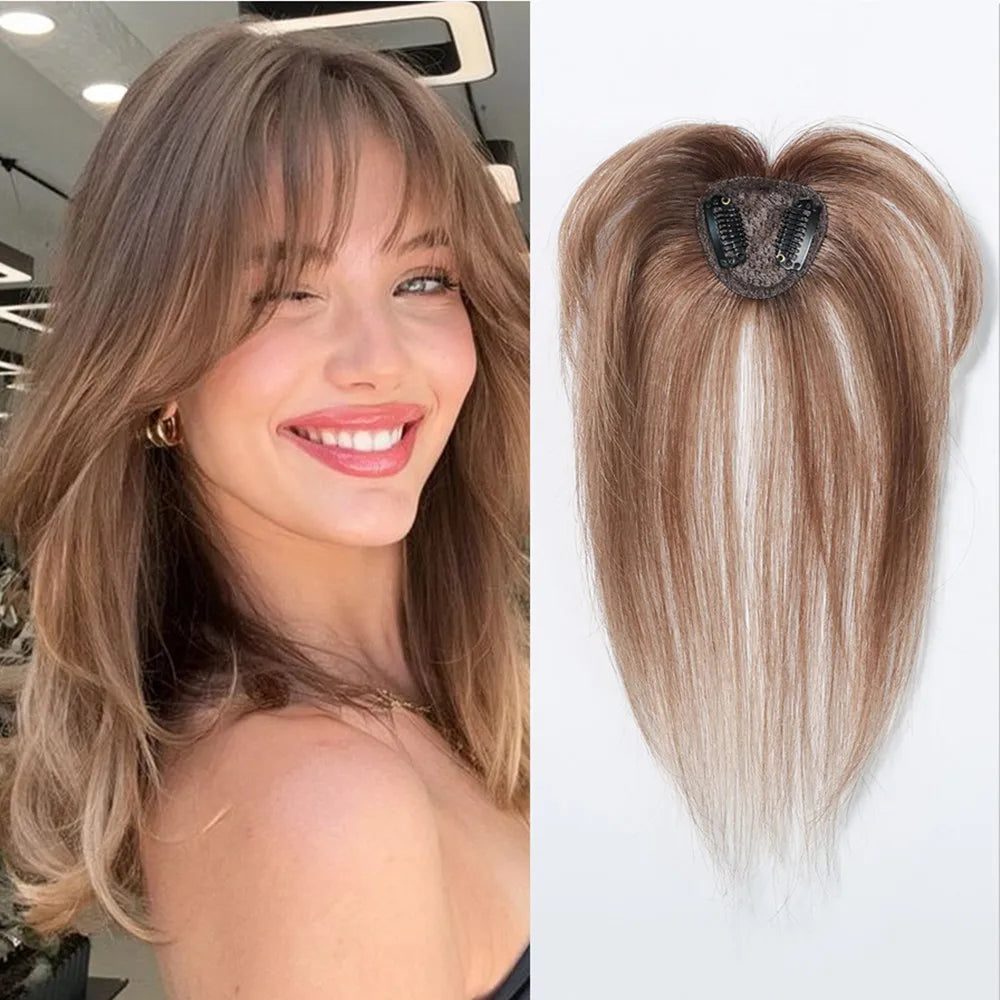

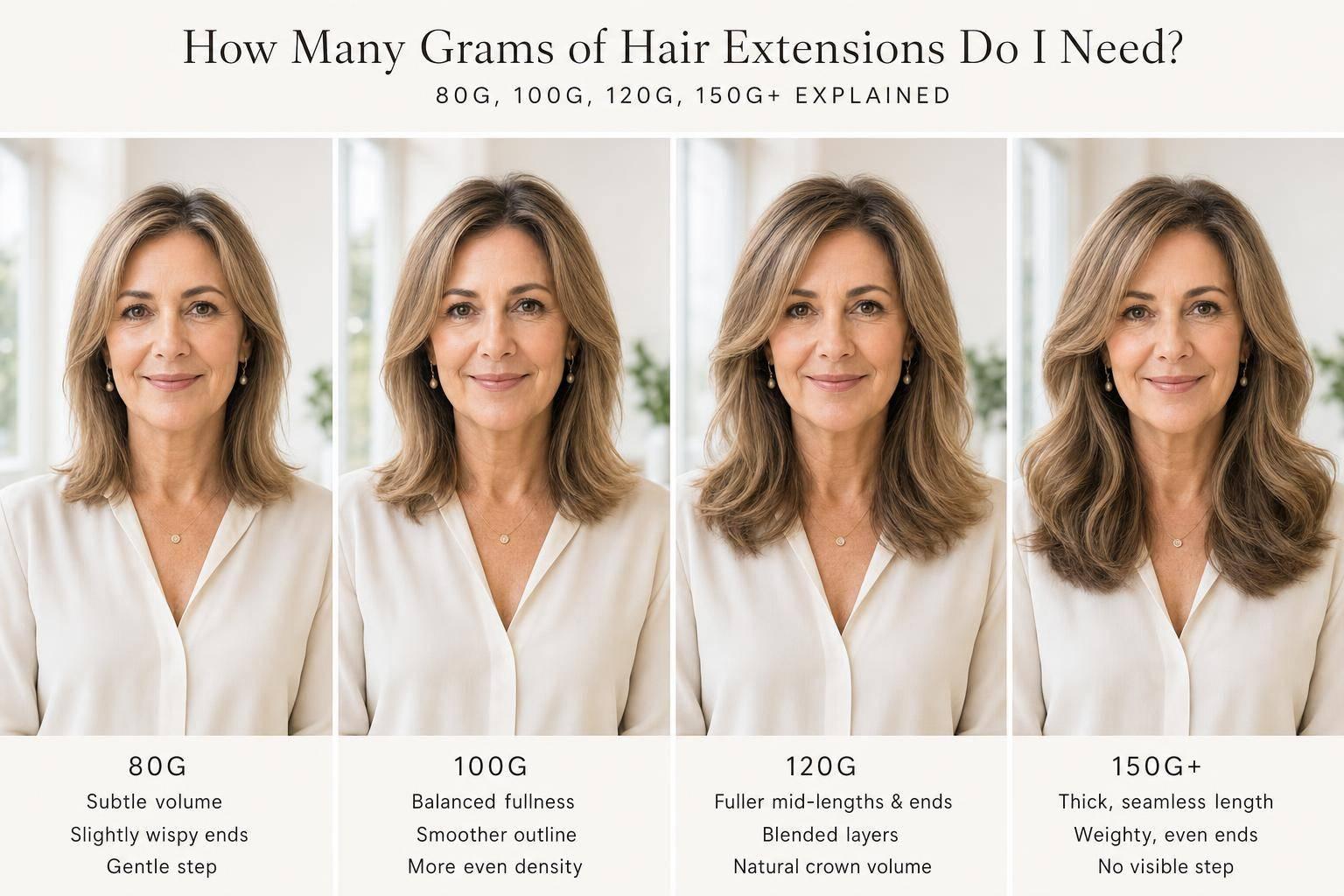
Most people need 80 g to 150 g+ based on two things: their natural hair density and whether they want volume, length, or both. I’d use 80–100 g for fine hair, 100–120 g for medium hair, and 150 g+ for thick or blunt-cut hair. If I’m adding more length, I’d go up in grams because longer hair can look thin through the ends if the set is too light.
Here’s the short version:
- 80 g: best for fine or thinning hair and light volume
- 100 g: suits fine to medium hair for light volume or a small length change
- 120 g: a common starting point for medium hair and daily wear
- 150 g+: better for thick hair, blunt ends, or a bigger change in length
- If I want volume only, I can stay lighter
- If I want volume + length, I usually need more hair
- A visible step between my hair and the extensions often means I need more grams
- If the set feels heavy or bulky, I may need less
Quick comparison
| Weight | Best for | Main use |
|---|---|---|
| 80 g | Fine or thinning hair | Soft volume |
| 100 g | Fine to medium hair | Light volume or slight length |
| 120 g | Medium hair | Everyday body and length |
| 150 g+ | Thick hair or blunt cuts | More length, more density, better blend |
One simple rule I’d keep in mind: grams mean how much hair is in the set, not how long it is. So two sets can be the same length, but the heavier one will look denser.
Hair Extension Grams Guide: How Much Do You Need by Hair Type & Goal?
The Ultimate Guide to Hair Extensions: How Much You Really Need for Perfect Coverage!
sbb-itb-08feb2f
How to choose grams based on your hair type
Use the weight ranges above as your starting point, then tweak them based on your hair density and what you want the extensions to do. Your natural density matters first. After that, your styling goal helps you pick the lower or higher end of the range.
Fine or thinning hair: lighter weights that blend naturally
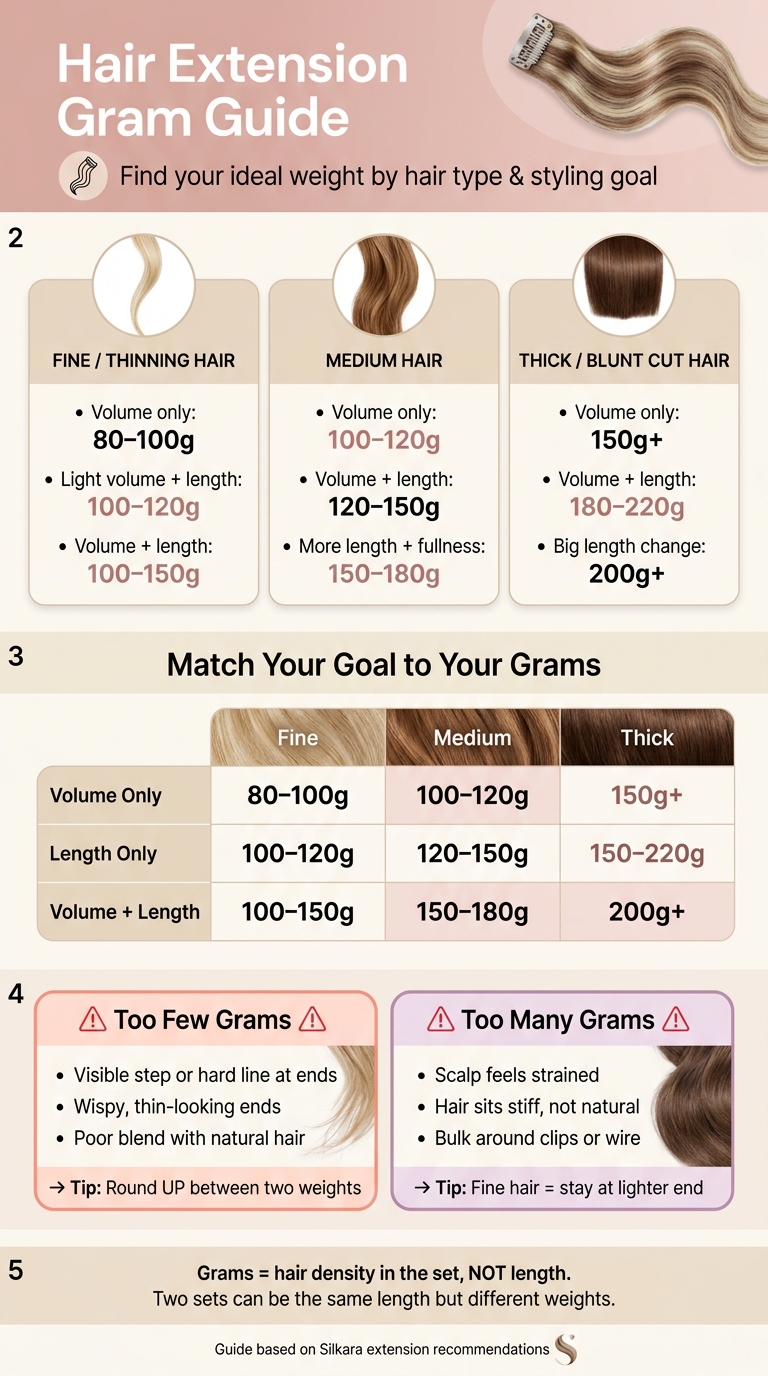
Fine or thinning hair has less density, so the scalp shows more easily and the strands are smaller. This hair type usually looks best with 80–100 g for added volume, or 100–120 g if you want soft length as well as fullness [1][4].
Too much weight on a delicate scalp can create tension and put extra strain on your roots. That’s why lighter sets often sit better and blend more smoothly. Layers also tend to work better at the lower end of the range. If your hair has blunt ends, though, you may need more grams so there isn’t a clear line where your natural hair finishes.
A simple way to think about it:
- Use the lower end if you mainly want volume
- Move up if you want more length or a smoother blend
As density goes up, the gram count usually needs to go up too, so the ends still look even.
Medium hair: balanced weights for volume and everyday wear
For everyday fullness, start with 100–120 g [1][4]. If you want volume plus extra length, 120–150 g is a better fit [4][9].
Sets that are too light can leave medium hair looking thin through the ends. Put simply, the extensions don’t have enough body to match the weight of your own hair. 120 g is a solid starting point for medium hair if you want both fullness and length.
If your ends are denser, you’ll usually need more grams to stop that visible step between your natural hair and the extensions.
Thick hair: higher weights to match dense ends
Thick hair, or hair cut very bluntly, needs more grams to blend well. For thick hair, start at 150 g+. If you’re going for a big length change, 180–220 g is often a more realistic range [1][4].
The clearest sign that you haven’t bought enough hair is a visible step - that hard line where your dense natural ends stop and the thinner extension starts. Blunt cuts make this stand out even more, because the edge of your natural hair is so sharp that lighter sets just won’t hide it.
Match your gram weight to your goal: volume, length or both
Once your hair type gives you a starting point, your styling goal helps you land on the right gram weight. If you only want more fullness, go lighter. If you want extra length as well, you’ll usually need more hair to keep the result looking even and full.
Volume only: adding fullness without much extra length
If your goal is volume only, stick with the lowest weight that still works for your hair density. Fine or thinning hair usually works best with 80 g–100 g, medium hair usually needs 100 g–120 g, and thick hair often still needs 150 g+ to match dense ends [1][3][4].
For the smoothest blend, keep your extension length close to your natural hair length - ideally within about 5 cm - when you're only adding volume [7].
Length only: why longer extensions need more grams
Longer extensions need more grams because the hair has to cover more surface area. Spread the same amount of hair over more length, and the ends can start to look thin at the ends [8][4].
This tends to stand out more with blunt or short natural haircuts. If you want extra length and your own ends are blunt, you’ll usually need 150 g–220 g to hide the transition line and avoid a visible step [2].
Volume and length together: when 150 g+ is the right call
If you want both length and fullness, the gram count usually needs to go up so the ends still look dense. Here’s a quick guide for that mix of goals [1][4]:
| Goal | Hair type | Grams |
|---|---|---|
| Volume + Length | Fine/Thin | 100 g – 150 g |
| Volume + Length | Medium | 150 g – 180 g |
| Volume + Length | Thick/Blunt Cut | 200 g+ |
If you’re choosing between two weights, go with the heavier set. Too little weight can look wispy and unnatural [8]. If your hair is fine or sensitive, stay closer to the lighter end of the range [1][3].
Use these ranges to narrow down your choice before matching Silkara hair extensions to your hair type.
Silkara halo and clip-in recommendations by hair type
Silkara halo extensions: easy volume and soft length
Silkara halo extensions work well for fine to medium hair if you want fast, at-home volume without dealing with clips. The invisible wire sits across the crown, which means less stress on individual strands [7].
A common guide for Silkara halos is:
It also helps to line up the halo length with your own hair length. A simple rule of thumb:
Silkara clip-in sets: flexible placement and custom fullness
If you want more control over where the hair sits, or you wear your hair up a lot, clip-ins give you more freedom. They’re also a better fit for blending shorter layers or blunt cuts, where placement matters more.
For Silkara clip-in sets, the usual weight guide looks like this:
- Fine hair: 50–100 g for volume, 120–150 g for volume and length [1][2][4]
- Medium hair: 120–150 g for balanced fullness and length [2][4]
- Thick hair: 180–220 g+ to blend dense ends and avoid a visible step [1][4][6]
Once you’ve worked out the right gram weight, the next step is matching the shade and density with Silkara’s colour tools.
Using Silkara colour matching and virtual try-on to confirm your choice
Silkara offers a free colour match service. Upload a photo taken in natural light, away from direct sun, so the team can match your mid-lengths and ends as closely as possible [7][5].
You can also use Silkara’s AI virtual try-on on selected products to check density and blend before buying. For the best view with any digital colour tool, turn your device brightness up to maximum. It’s also smart to allow for a small variation of about 5–10% because screens can show colour a bit differently, and natural hair batches can vary too [4].
How to tell if you need more or fewer grams, plus a quick recap
Once you've picked a starting weight, the next step is simple: check how the hair looks and feels. That’s what tells you if you’re in the right range.
Signs you have too few grams
If you’re stuck between two weights, these fit checks can help.
The clearest sign is a visible step - a hard line where your natural hair ends and the extensions begin. That usually means the set is too light. If the ends look wispy instead of full, there isn’t enough hair to match your natural density [2][6][8].
When you’re choosing between two options, it’s usually better to go a bit heavier. Too little weight tends to show straight away [8].
Signs you have too many grams
A set can also feel too heavy. If your scalp feels strained, the hair sits stiff instead of moving naturally, or you notice bulk around the clips or wire, the weight is likely too much for your hair density [1][2][7]. Fine hair will usually sit in the lighter ranges already covered above.
How to check your fit
Use this table as a quick guide to sense-check your chosen weight:
| Goal | Fine Hair | Medium Hair | Thick Hair |
|---|---|---|---|
| Volume only | 80–100 g | 100–120 g | 150 g+ |
| Length and volume | 100–120 g | 120–150 g | 180–220 g+ |
If you’re unsure between two gram weights, round up rather than down [8].
FAQs
Can I mix two gram weights?
Yes. Mixing different extension types or weights is a common way to customise your length and volume.
For example, you might use a halo for your base length, then add smaller clip-in wefts around the front for face framing or a bit more fullness. It’s a simple way to fine-tune the look instead of relying on just one piece to do all the work.
The main thing is to keep the textures close to each other and make sure the total weight still feels comfortable. If the combination is too heavy, it can sit awkwardly, feel annoying to wear, or make your natural hair look bulky instead of blended.
Do layers affect how many grams I need?
Yes. Layers can help extensions blend in with your own hair more naturally. But your hair’s thickness and length are still the main things that affect how much weight you need.
If your hair is very thick or has a blunt cut, layers can make the transition look smoother. Shorter or blunt hair often needs more weight to hide the join, while layers can help create a more seamless finish.
What if I’m between two weights?
If you’re stuck between two weights, go a little heavier. In most cases, the extra hair will blend better, sit more neatly in layers, and help prevent obvious gaps.
Too much hair can feel a bit bulky, sure. But a little extra is usually easier to work with and style than too little. If the set is too light, it often won’t blend well with your own hair.