
If your hair sits at shoulder length, the best blend usually comes from matching the extension type to your cut and using enough grams to hide the step at the ends. From what I see in the article, halo extensions suit layered hair worn down, flat PU clip-ins suit fine hair and blunt cuts better, and stitched-weft clip-ins suit medium to thick hair when you want more styling options.
Here’s the short answer:
- Layered shoulder-length hair: halo or flat PU clip-ins
- Blunt shoulder-length hair: clip-ins usually blend better than a halo
- Fine hair: around 80–120 g
- Medium hair: around 120–160 g
- Thick or blunt-cut hair: around 160–220 g+
- Best short extension length for blending: about 14–16 in / 36–41 cm
- Longer lengths like 20 in / 51 cm or 24 in / 60 cm can show the join more if the ends are thick
The big issue is simple: shoulder-length hair often creates a visible shelf where your own hair stops and the extensions start. In the article, blend depends on 4 things: cut shape, target length, hair thickness, and set weight. A blunt cut is harder to hide than layers, and a set that is too light can leave the ends looking thin.
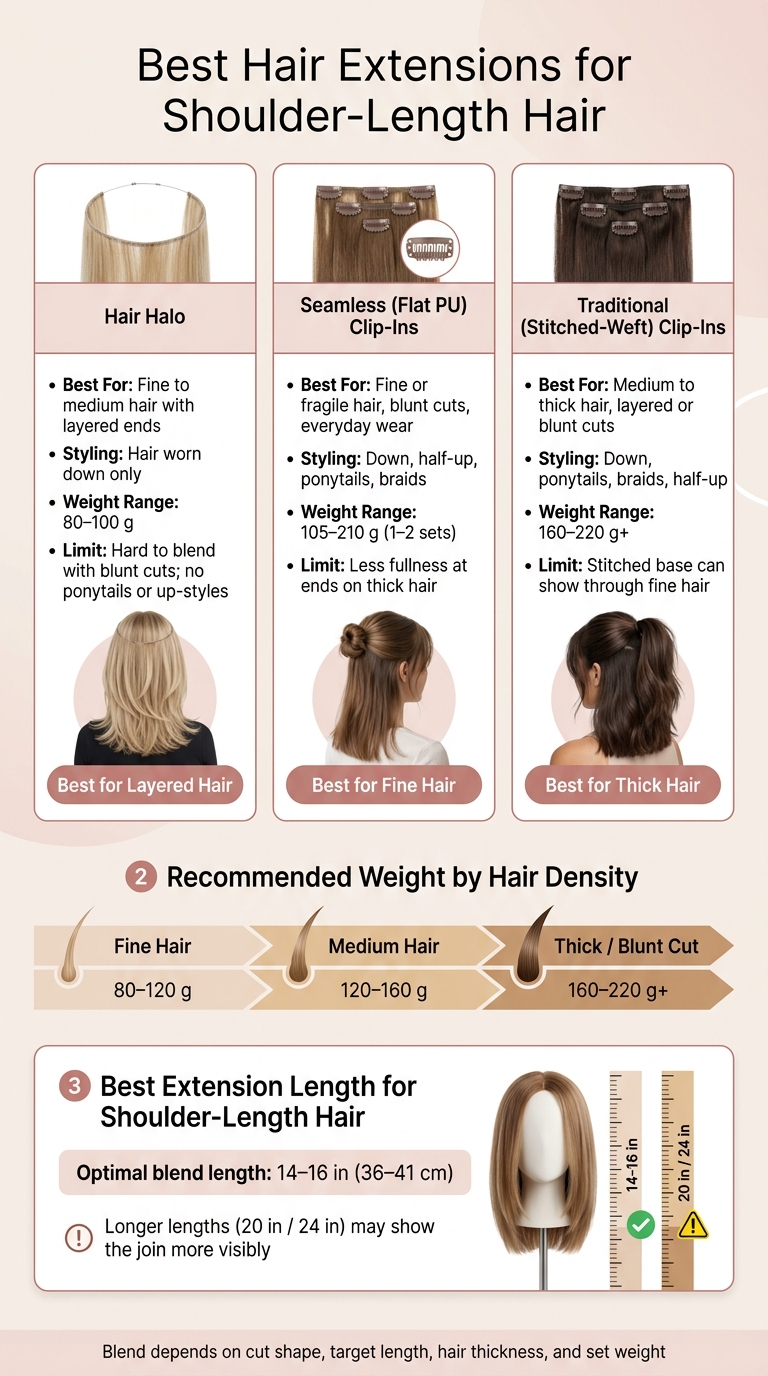
Best Hair Extensions for Shoulder-Length Hair: Quick Comparison Guide
HOW TO: Cut Hair Extensions to Blend with Short Blunt Hair
sbb-itb-08feb2f
Quick comparison
| Type | Best for | Main limit | Best wear style |
|---|---|---|---|
| Hair Halo | Fine to medium hair with layers | Harder to hide on blunt cuts | Hair down |
| Flat PU Clip-Ins | Fine hair, fragile hair, blunt cuts | Can lack volume at the ends on thicker hair | Down, half-up, ponytails |
| Stitched-Weft Clip-Ins | Medium to thick hair, more styling freedom | Base can show more on fine hair | Down, braids, ponytails, half-up |
My takeaway: if your ends are blunt, I’d lean toward clip-ins. If your hair is layered and you mostly wear it down, a halo can work well. And if your hair is thick, the grams matter just as much as the attachment type.
Below, the article breaks down how each option blends, where it falls short, and which one tends to work best by cut and density.
1. Silkara Hair Halo Extensions
Silkara Hair Halo extensions use one continuous weft attached to a clear wire that sits around the crown. The wire holds the weight, so there’s no tension on the roots [1].
Blend by Cut Type
With halo extensions, blending shoulder-length hair starts at the cut line. If your hair has layers, a halo usually blends in well. A blunt shoulder-length cut is harder to hide because a single weft can’t break up that straight edge.
That’s where styling helps. Soft waves or a textured blow-dry can blur the line and make the join less obvious on blunter cuts [1][3].
Length, Weight and Density
Once the cut shape is sorted, length and weight play a big part in how visible the join looks. Silkara offers halo extensions in:
- 12–14" (30–35 cm) at 80 g
- 16–18" (40–45 cm) at 80 g
- 20" (51 cm) at 100 g [3]
For shoulder-length hair, shorter lengths tend to keep the join softer and easier to hide. The 20" set adds more length, and the extra weight can help balance thicker ends. Fine or thin hair will often blend with one halo, while very thick hair may need more than one piece [3].
Styling, Comfort and Limits
This type of extension isn’t suited to high ponytails or sleek up-styles because the wire sits around the crown [1]. It works best when worn down, especially with loose waves or a soft blow-dry.
If you’re using heat, keep it below 160°C to help protect the hair [3].
2. Silkara Hair Seamless Clip-In Extensions
Seamless clip-ins work well on shoulder-length hair when you want more volume without a chunky, obvious join. They use an ultra-flat PU base that sits close to the scalp, so the roots look smoother [2]. Each full set includes 7 pieces and weighs 105 g, which is usually enough for a smooth blend on shoulder-length hair.
Blend by Cut Type
With shoulder-length hair, the 7-piece setup gives you good control over where the extra fullness goes. If your cut is blunt, add more hair through the sides and back to soften that straight end line. If your hair has layers, spread the pieces through the mid-lengths and ends so the finish looks more even.
Once the placement is sorted, the next thing that matters is the match between the extension length and the set weight.
Length and Weight Match
For shoulder-length hair, 14–16 in (about 36–41 cm) tends to give the cleanest blend. Anything shorter can make the join easier to spot.
Hair Density Suitability
| Natural Hair Density | Suggested Weight | Notes |
|---|---|---|
| Fine / Thin | 1 set (105 g) | Adds volume without excess bulk |
| Medium | 1–2 sets (105–210 g) | Adjust based on how full you want the finished style |
| Thick | 2 sets (210 g total) | Helps avoid a mismatch between your natural hair and the extension ends |
Styling and Comfort
The small clips stay fairly discreet, even in finer hair [2]. For the flattest result, clip the widest weft into the back section first, then add the side pieces. After that, heat-style the extensions with your own hair to soften the join, which can make a big difference on blunt shoulder-length cuts [2].
The flat base also works well for styles like:
- half-up looks
- ponytails
- braids
Traditional clip-ins use a different structure again, with a simpler fit and more visible sectioning.
3. Silkara Hair Clip-In Extensions
Traditional clip-ins use a stitched weft base. Because of that, they don’t sit as flat as seamless sets and need more top-layer hair to keep them hidden [4]. They’re a good pick for women who want more freedom when styling, but they’re not as discreet on fine hair or blunt shoulder-length cuts. So while traditional clip-ins give you the most styling range, they’re not the flattest option when blend is the main goal.
Blend by Cut Type
Blunt ends tend to make the join more obvious, while layered ends help soften it. Traditional clip-ins can work well on blunt shoulder-length cuts because each weft can be placed in a way that breaks up that hard end line [1]. They do feel bulkier at the root than seamless sets, but they’re easier to position when you need extra coverage.
Length and Weight Match
For shoulder-length hair, 16 in (41 cm) usually gives the cleanest blend. 20 in adds more length, while 24 in often needs extra heat styling to soften the join [5]. A lighter set suits fine hair, a standard full set suits medium hair, and a fuller set suits thick hair.
The next thing to look at is whether your natural hair density can hide the wefts without the tracks showing.
Hair Density Suitability
| Natural Hair Density | Recommended Fit | Notes |
|---|---|---|
| Fine / Thin | Tracks may show more easily | Fine hair shows tracks sooner; a smaller set reduces that risk [4] |
| Medium | Balanced coverage | Standard fit for a clean blend |
| Thick | Fuller coverage needed | Thick hair needs more coverage to avoid a visible step [2] |
Styling and Comfort
Ponytails, braids, and half-up styles are all possible with clip-ins in a way that a halo can’t match [1]. Since clip-ins attach straight to your natural hair, they can create some tension at the roots after several hours of wear [1].
That mix of coverage, comfort, and styling freedom is what shapes the best fit. The next step is matching each extension type to the kind of blend you want most: discretion, volume, or styling flexibility.
Where Each Type Works and Where It Falls Short
Shoulder-length hair tends to show extension joins more easily. Blunt ends, uneven density, and visible attachment points can all give the game away. At this length, the main test is simple: how well does each type hide the join at the ends?
The halo is the fastest option to put on. But it blends best when your own ends are feathered or layered. If your hair is blunt and thick, the join is much more likely to show. When that happens, a flatter system with more control over placement usually makes more sense.
Seamless clip-ins work well for fine or fragile hair because the silicone or PU base sits closer to the scalp. That makes the attachment points easier to hide. The trade-off is at the ends. On medium-to-thick hair, they can fall short on fullness, so the transition may look uneven unless you use a fuller set.
Traditional clip-ins give you more control over placement, which helps on thicker hair. They also come with enough pieces to help break up a blunt end line. The downside is the stitched weft base doesn’t sit as flat as a seamless set. On fine hair, that can make the extensions easier to spot, especially in pulled-back styles.
| Extension Type | Best Use | Drawbacks | Least Suited To |
|---|---|---|---|
| Halo | Fine to medium hair; feathered or layered ends | Hard to blend with blunt cuts; limited styling versatility | Thick, blunt-cut hair |
| Seamless Clip-Ins | Fine or fragile hair; everyday wear | Less fullness at the ends; not ideal for dramatic volume | Those seeking maximum volume at the ends |
| Traditional Clip-Ins | Medium to thick hair; layered or blunt cuts | Stitched weft base can show through fine hair | Fine or fragile hair |
From here, the choice comes down to which type gives your cut the cleanest blend at the ends.
Which Extension Type Blends Best for Your Hair
The cleanest blend usually comes down to two things: your haircut shape and your hair density.
Here’s the simple version. Layered shoulder-length hair often works well with a halo. Blunt cuts tend to suit seamless or traditional clip-ins, because separate wefts can help soften that shelf line. Traditional clip-ins are often a good fit for medium-to-thick hair when you want more coverage and more room to style.
Weight matters too. Fine hair usually works well at 80–120 g, medium density at 120–160 g, and thick hair or blunt cuts often need 160–220 g+ so the ends match your own hair and you don’t get that obvious step [4][5].
| Hair Type / Cut | Best Extension Type | Recommended Weight |
|---|---|---|
| Fine, layered ends | Halo or Seamless Clip-Ins | 80–120 g |
| Medium density | Seamless or Traditional Clip-Ins | 120–160 g |
| Thick or blunt cut | 2 sets of seamless clip-ins or fuller traditional clip-ins | 160–220 g+ |
A good rule of thumb: wear a halo if you mostly leave your hair down. Go with clip-ins if you want half-up styles, braids, or ponytails.
For shoulder-length hair, the best blend usually starts with matching the attachment type to the cut, then using enough weight to smooth out the step.
FAQs
Can shoulder-length hair look natural with extensions?
Yes - shoulder-length hair can look natural with extensions if the blend is done well.
With halo extensions, this is often one of the easier short cuts to work with because there’s enough length to hide the wire. Your natural hair should usually be around 15–18 cm long, and adding only 5–10 cm tends to make the transition look smoother.
For clip-in extensions, go for lightweight, flat, seamless styles. Your own hair also needs to be long enough to cover the attachment points. Waves or curls can help hide the join and make everything look more natural.
How do I stop a blunt cut from showing a shelf?
Blend the shift between your natural hair and the extensions so it looks less obvious. The easiest fix is to curl or wave both together. That helps break up any blunt line and makes the whole look feel more natural.
You can also ask a stylist for light, soft layers in your natural hair, or have the extensions trimmed while you’re wearing them. Seamless extensions with a thinner profile can help cut down visible bulk too.
What if my hair is between fine and medium thickness?
If your hair sits somewhere between fine and medium, you’ve got a lot to work with. In most cases, you can wear clip-in extensions or halo extensions without much fuss.
Your hair usually has enough density to hold extensions in place well, but not so little that they’re hard to hide. That gives you a nice middle ground: both options can blend in naturally while adding extra volume, length, or both when you want it.