
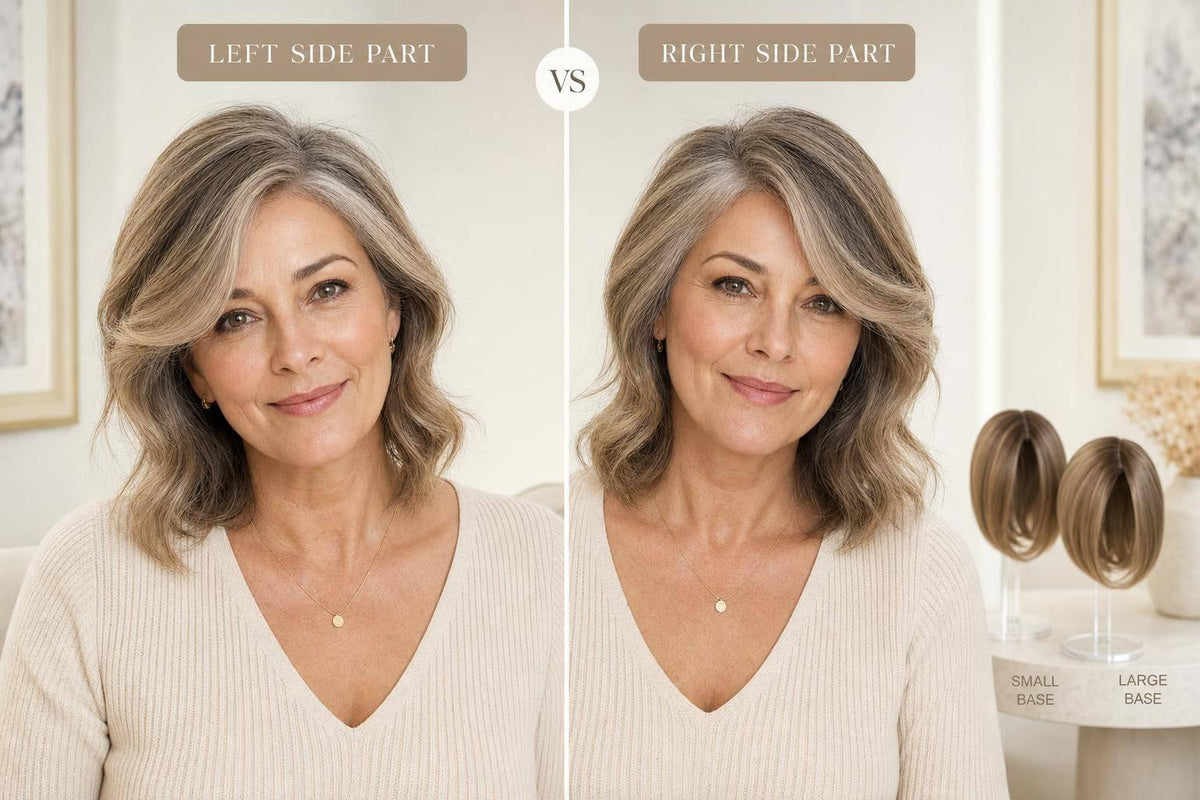
Pick the part that matches your natural hair part. That is the short answer. If your topper follows the same direction as your own roots, it is usually easier to blend, easier to place, and less likely to show a second part line.
Here’s the simple breakdown:
- Left side part topper: best if your hair falls left
- Right side part topper: best if your hair falls right
- Centre part topper: best if your hair splits down the middle
- Flexible topper: best if your part shifts or is hard to pin down
I’d also check where thinning shows most before buying. A topper sits over the crown and part area, so even a small mismatch can stand out fast. If the base is too small or the part sits in the wrong spot, blending gets harder.
Quick Comparison
| Option | Best for | Main plus | Common issue if wrong |
|---|---|---|---|
| Left side part | Hair that parts left | Lower styling effort | A second visible part if your hair falls right |
| Right side part | Hair that parts right | Lower styling effort | Poor blend if your roots pull left |
| Centre part | Midline thinning or even growth on both sides | Good for middle coverage | Can look too straight at the scalp |
| Flexible / multi-directional | Parts that move around | You can shift the part | May need more styling time |
A useful detail: many people have a natural part linked to the cowlick or hair whorl at the crown. If you are unsure, comb damp hair back, push it forward, and watch where it splits on its own. That gives you the part to match.
So if I had to sum it up in one line, it would be this: match the topper part to your natural part first, then choose the base size for the thinning area.
sbb-itb-08feb2f
Find your natural part before choosing a topper
Start with clean, damp hair. Comb it straight back from your forehead, place one hand at the crown, where your head starts to curve, and gently push the hair forward. The spot where your hair separates and falls on its own is your natural part.
Once you know how your hair falls, you can match it to a left, right, or centre part.
How to tell if your part is left, right or centre
After your hair falls forward, look at where it splits. If it separates more to the left, you have a left-side part. If it separates to the right, you have a right-side part. A centre part lines up with the centre of your nose. A natural side part often sits in line with the arch of your eyebrow - not too close to the ear and not too close to the middle. [3]
Still not sure? Check your hair whorl - the spiral at the crown. A clockwise whorl usually points to a left-side part, while a counter-clockwise whorl usually points to a right-side part. [4] Matching your topper to that direction makes blending easier.
Check where the part looks widest or most exposed
Once you know your part direction, look closely at where thinning stands out most. See whether the wider or thinner area runs along the centre line, along one side of the part, or across the crown. This matters because the part placement and base size need to work together. If thinning shows through in a certain spot, the topper part needs to sit in the right place to cover it well.
If your front hairline makes the part hard to spot, use the crown cowlick as your starting point. That gives you the part direction to match when choosing a topper.
Left side part vs right side part vs centre part
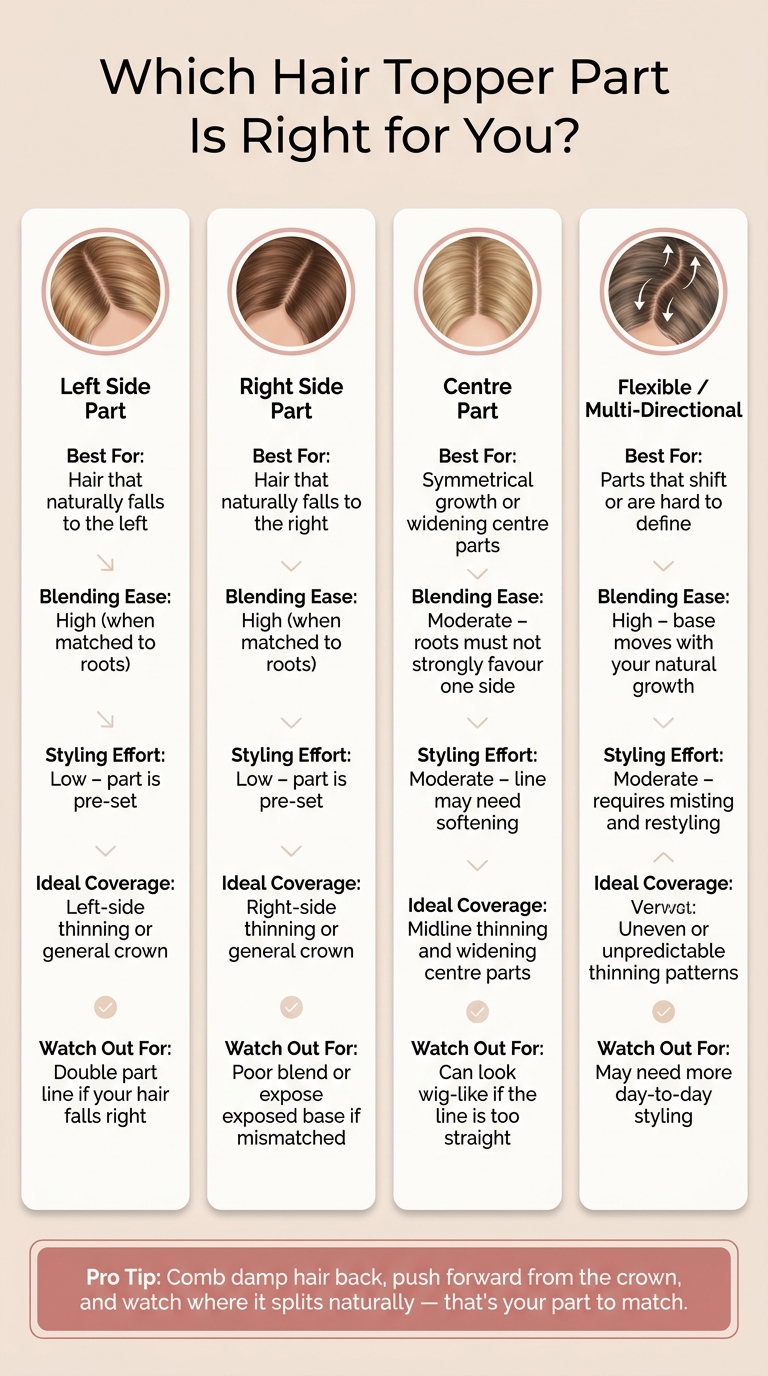
Left vs Right vs Centre Part Hair Topper: Quick Comparison Guide
Pick a topper part that lines up with your natural part. That’s the simplest way to get a clean blend and keep the thinning area covered where you need it.
Left side part toppers
A left side part topper has a built-in part line placed left of centre. It tends to blend best when your own roots already fall to the left, because the topper follows the same direction as your natural part.
If your hair naturally falls to the right but you wear a left side part topper, you can end up with two visible part lines. One comes from your own hair, and the other comes from the topper. That gap can make the mismatch stand out straight away.
Right side part toppers
A right side part topper works the same way, just in reverse. It suits hair that naturally parts to the right.
If the part direction doesn’t match your own growth pattern, blending gets harder. It can also pull the base away from the spot where thinning shows most, which defeats the point of wearing the topper in the first place.
Centre part toppers
A centre part topper usually works best when thinning runs down the middle of your scalp, or when your hair grows fairly evenly on both sides. It’s a practical option if your centre part is getting wider and your roots don’t strongly pull left or right.
One detail matters here: the centre line itself. If it looks too straight, the result can look wig-like against the scalp.
"The most reliable factor in deciding where to style your hair is your most dominant cowlick... start your part at the center of that cowlick and let it lay in the direction the hair grows." - Greg Kristopik, Owner, Old Dog Barber Shop [1]
A slightly softened line tends to look more like a natural scalp part. If your roots lean clearly to one side, a centre part topper often takes more work to blend. In that case, a side part topper will often look more natural and need less day-to-day styling.
Use this quick guide to compare how each part sits against your natural growth.
| Feature | Left Side Part | Right Side Part | Centre Part |
|---|---|---|---|
| Natural match | Best for left-leaning growth | Best for right-leaning growth | Best for symmetrical or neutral growth |
| Blending ease | High when matched to roots | High when matched to roots | Moderate; roots must not strongly favour one side |
| Styling effort | Low - part is pre-set | Low - part is pre-set | Moderate - line may need softening |
| Common issues | Double part if hair falls right | Double part or exposed base if mismatched | Can look wig-like if line is too straight |
| Ideal coverage | Left-side thinning or general crown | Right-side thinning or general crown | Widening centre parts and midline thinning |
Flexible and multi-directional toppers: best when your part changes or is hard to define
If your natural part isn’t fixed, pick a base that gives you some room to move.
When your part shifts around, or it’s just plain hard to pin down, a flexible base tends to work better. Monofilament and silk bases make it easier to move the part to match your natural growth, while still keeping the scalp area natural-looking. That matters most when your roots don’t sit neatly on one side.
How mono and silk bases let you change the part
To change the part, mist the roots, redraw the part with the comb tail, then set it with low heat. The base lets the hair fall with your scalp pattern instead of fighting against it, so it looks more like a natural continuation of your own growth.
Why the wrong fixed part makes blending harder
A fixed part gives your roots less freedom to fall where they naturally want to. That can make the topper sit against your growth pattern instead of with it. If your part shifts because of cowlicks or uneven growth, a fixed line simply can’t follow it.
How to choose the right topper part with Silkara Hair

Start with your natural part. That gives you the clearest guide for both the part line and the base size. Once you know whether your hair parts to the left, right, or centre, you can narrow things down by base size and how much movement you want in the part.
The base should sit slightly past the thinning area so the clips can grip stronger hair [2]. That small detail makes a big difference. If the base is too small, blending can be harder and the topper may not feel as secure.
A simple checklist before you buy
Run through these points before you buy:
- Your natural part direction - left, right, or centre
- Where thinning shows the most - this helps you choose the right base size
- How much part flexibility you want - fixed for one set part, or mono/silk if you want to change it
If your part tends to shift, or it sits somewhere between left and right, a multi-directional human hair topper gives you more room to move the part later.
Key takeaways
- Match the topper to your natural part - left, right, or centre - so it blends more smoothly with your roots
- A fixed part that doesn't follow your natural growth pattern can be harder to blend
- If your part changes, go for a multi-directional base
FAQs
What if my part changes day to day?
If your part shifts from day to day, you’re not stuck with a single look. Many toppers can be restyled at home, so you can change the part to suit how you want your hair to sit.
Lightly mist the roots with water and comb the hair straight back. Then use the tail of the comb to make your new part. Finish with a blow-dryer and nozzle, aiming at the roots so the hair sits smooth and flat.
How do I choose the right base size?
Use a soft tape measure to check the length and width of the thinning or flat area. Then add 1–2 cm so the clips have enough room to grip strong, healthy hair.
If your measurements sit between standard sizes, go a little larger for better coverage. For a close, comfortable fit, it’s worth getting professional advice on the base shape that suits you best.
Can I restyle a fixed-part topper?
It depends on how the topper is built. Monofilament and lace base toppers give you more movement, so it’s usually easier to shift the part where you want it.
A fixed-part topper can often be restyled too. Lightly mist the roots with water, use a comb to set the new part, then blow-dry with a nozzle to guide the hair into place. If the topper uses synthetic fibres, stick to the lowest heat setting or check that it’s heat-friendly first.