
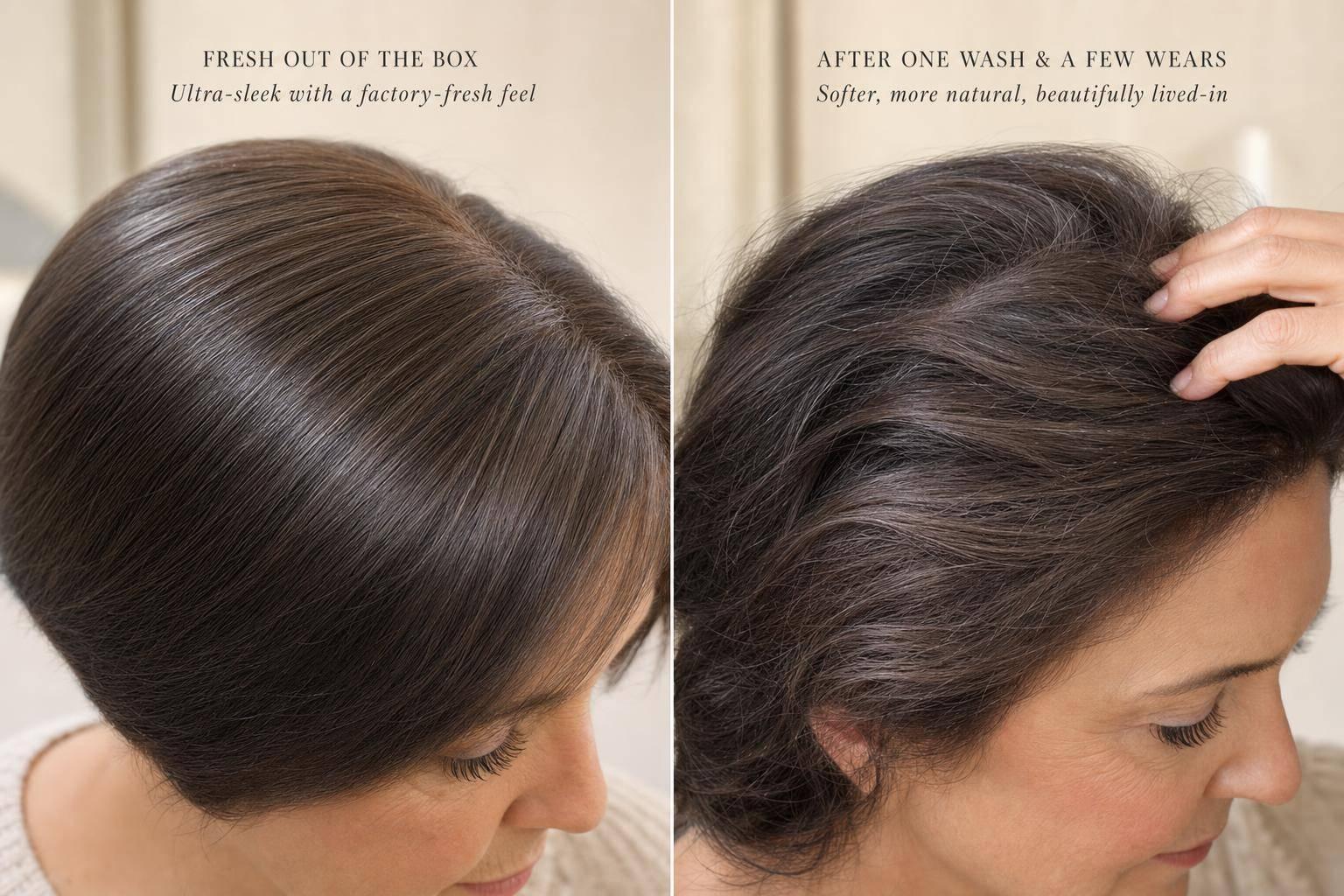
If human hair feels too silky, too dry, or a bit like synthetic hair at first touch, that usually points to processing - not fake hair. In most cases, the hair has been cleaned, coated, conditioned, styled, and packed before it gets to you. That can change how it feels on day one.
Here’s the short version:
- Too slippery or glassy? A silicone coating may be sitting on the surface.
- Dry after the first wash? The coating may have rinsed out, leaving the hair’s normal feel behind.
- Tangles fast? Cuticles may not be aligned, or the hair may have been heavily processed.
- Feels different from your own hair? Texture, density, and base fit may be the issue - not just hair quality.
- What should I do first? Wash it once, use conditioner, air-dry it, and judge it after that.
A few facts matter here:
- Silicone coatings often wear off after 3 to 6 washes.
- Human hair pieces dry out faster because they do not get scalp oils.
- Remy hair with aligned cuticles tends to feel smoother and tangle less than mixed-direction hair.
My take: the first wash tells you more than the first touch. If the hair settles, moves well, and stays soft with gentle care, that’s a good sign. If it turns rough, mats, or loses its feel fast, the issue is more likely processing, coating, or a poor match to your own hair.
That’s the main point of this article: don’t judge human hair straight out of the box - judge it after one gentle wash and a few wears.
How to Tell the Quality of Human Hair Extensions- DoctoredLocks.com

sbb-itb-08feb2f
How processing changes the feel of human hair
Not all human hair is handled the same way before it gets to you. How it's collected, sorted, and treated has a direct effect on how it feels in your hand, how it moves, and how well it lasts with regular wear. The main things that shape that feel are cuticle alignment, surface coatings, and chemical treatment.
Remy hair and cuticle alignment
The cuticle is the outer layer of each hair strand. It's made up of tiny overlapping scales, a bit like roof tiles. In Remy human hair, those cuticles stay aligned from root to tip. That matters because aligned cuticles help the hair feel smoother and tangle less. When every strand runs in the same direction, the hair tends to move more naturally too.
Non-Remy hair is different. Its cuticles are often mixed in different directions, which can lead to friction and tangling. To deal with that, manufacturers may use a chemical stripping process to smooth the cuticle scales. At first, the hair can feel soft and polished. But that smoothness comes at a cost: the hair has already been weakened at a structural level [2].
If you want a topper that keeps feeling natural after repeated washing and wear, cuticle alignment isn't a small detail. It's one of the main things doing the heavy lifting.
Silicone coatings and an overly silky feel
Some human hair pieces are coated with silicone during manufacturing. This gives the hair a slick, almost glass-like finish. On first touch, that can seem like a good sign. But sometimes it's hiding the hair's actual texture.
The issue is simple: silicone doesn't stay forever. It usually washes away after 3 to 6 washes [1]. Once that happens, the hair underneath starts to show itself.
If the base hair is high grade and the cuticles are aligned, it should still feel soft and easy to handle. If the coating was hiding lower-grade or unevenly processed hair, you may start to notice tangling and dryness pretty fast. A handy check is to rub a dry strand between your fingers. Silicone-coated hair can feel overly slick or like there's a layer sitting on top. Natural high-grade hair usually has a slight texture instead of that slippery finish [1].
Once the coating is gone, there's nowhere to hide. What you're left with is the hair's actual feel.
Over-processing, colouring, and dryness
Chemical treatment doesn't just change softness on day one. It also affects how the hair behaves over time. Colouring and bleaching are common in hair manufacturing, and if they're done with care, they don't always ruin the hair. But heavy processing can do damage.
Repeated dyeing, harsh bleaching, and other strong chemical treatments can weaken the cuticle layer in a big way. Hair like this may look fine straight out of the box, then start to feel dry, scratchy, or fragile after it's been worn and styled for a while [2].
This becomes a bigger issue with daily wear. A piece might feel nice in the packaging, but that doesn't mean much if it goes downhill after regular brushing, washing, and styling. Over-processed hair also tends to struggle with more heat styling later on. It can lose softness and become harder to manage.
Put plainly, the state of the cuticle at the start shapes how long a topper keeps its look and feel.
Why texture often changes after washing and styling
What the first wash can tell you about the hair
The first wash removes the factory finish, residue, and any coating sitting on the surface. So the hair may stop feeling as slippery as it did straight out of the box.
That shift is normal. It’s often the point where you start to feel the hair as it actually is, not how it was prepped for sale. Good hair should still feel soft and easy to handle, just less coated and more natural.
How heat and frequent washing cause dryness
Once that surface finish is gone, day-to-day care matters a lot more. Topper and extension hair doesn’t get oils from the scalp, so it dries out faster than natural growing hair.
That’s why washing too often can be hard on it. It can leave the hair dry and brittle over time. Hot water, harsh shampoos, and high heat make that happen faster. Lukewarm water and low heat help slow that dryness down.
How to bring back softness with gentle care
If you want that cleaner texture to stay soft instead of turning dry, gentler care usually makes the biggest difference.
Use:
- a sulphate-free cleanser
- a moisturising conditioner through the mid-lengths and ends
- a wide-toothed comb, starting at the ends and working upward
That approach helps limit breakage. Air-dry when you can. If you do need heat, keep it low.
If the hair starts to feel dry, soak it in water and conditioner. Then use a small amount of argan oil on the mid-lengths and ends to add softness between washes. Over time, habits like these give you a clearer sense of the hair’s condition.
How to judge topper quality by feel and behaviour
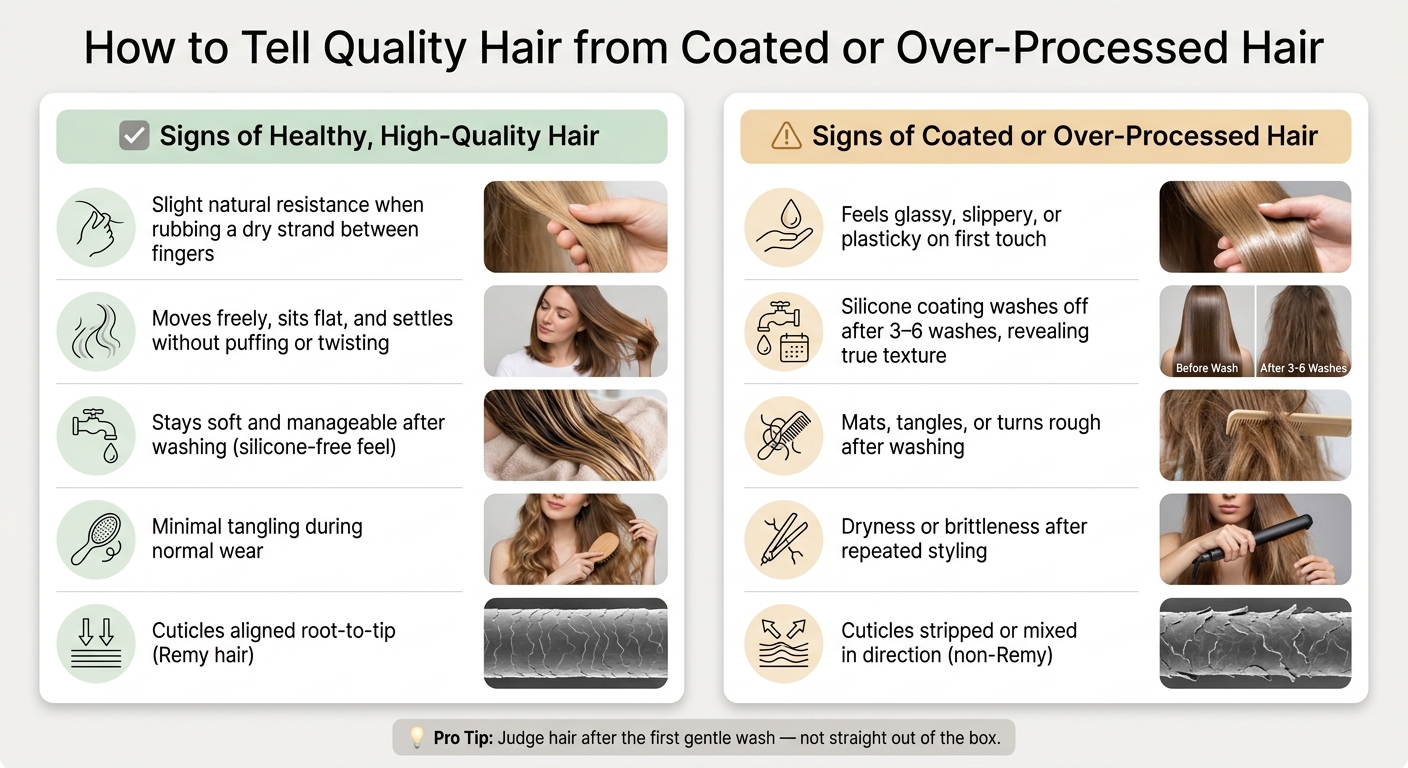
Human Hair Feel: Signs of Quality vs. Over-Processing
Signs the hair is healthy and natural-looking
Once that box-fresh finish fades, pay attention to how the hair feels and moves. Good Remy hair usually has a slight natural resistance when you rub a dry strand between your fingers. That small bit of texture can point to aligned cuticles.
The hair should move freely, sit flat, and not puff up or twist in odd directions. During normal wear, tangling should stay minimal. If it swings and settles like your own hair, that’s a good sign.
Signs the hair may be coated or over-processed
Judge quality by looking at three things together: feel, movement, and how the hair responds after washing. One clear red flag is hair that feels glassy, slippery, or plasticky when you rub a dry strand. High-quality natural hair has a slight, healthy texture, while coated hair can feel overly smooth [1].
That “too silky to be true” feel can seem nice at first. But if the hair loses its nice finish fast, mats easily, or starts behaving differently after a wash, that can point to coating or heavy processing.
Why base size, density, and texture match also matter
Hair quality is only one part of the picture. A topper can still look off if the base size, density, or texture doesn’t match your own hair.
What you want is simple: it should blend in and move like your hair, not just match the colour. If the density is too thick, the base is the wrong size, or the texture fights against your natural pattern, the topper can look a bit “stuck on” even if the hair itself is good.
Conclusion: What to do if your human hair piece feels different than expected
If your topper or extensions feel drier or slicker than you expected, the first wash often changes that. In many cases, that shift is temporary, not a sign the hair is fake.
Once you know the hair is coated or freshly processed, start with a gentle reset. Mix a small amount of shampoo into cold water and let the piece soak for about 5 minutes. Then follow with a conditioning soak and let it air-dry on its own. Add a small amount of argan oil to the mid-lengths and ends so it blends more naturally with your own hair. Between washes, treat it gently and use a wide-toothed comb.
After the first wash, protect the finish with low-heat styling and a light touch. Gentle washing and low-heat care help bring back softness and movement.
If the hair still feels different, judge it by how it wears, not by softness alone. The best result comes from matching texture, density, and colour to your own hair. If it still feels off after gentle care, the issue is usually the fit, the texture match, or the processing quality.
FAQs
How do I tell if it’s coated?
A silicone coating often gives the game away the moment you touch the hair out of the packet. It usually feels very shiny and almost too smooth. Sellers often use this kind of coating to cover up lower-grade, non-Remy hair.
The bigger clue shows up after a few washes. If the hair starts to feel dry, tangles more easily, or loses that soft feel, the coating is probably washing away. High-quality Remy human hair keeps its natural movement and softness with regular care.
Can human hair feel fake at first?
Yes. It’s common for human hair toppers and extensions to feel a bit different when you first open them. That usually comes down to the manufacturing process, not the quality of the hair.
A light silicone or conditioning coating can make the hair feel extra silky, or even slightly plasticky, at first. Once that protective layer washes out, the texture may feel different from your own hair because it doesn’t get your scalp’s natural oils.
When should I worry about poor quality?
Be concerned if your hairpiece shows structural breakdown. That can look like heavy tangling, matting, or dryness that gets worse even after washing and styling.
Poor-quality hair can also feel brittle, lose its shine after the first few wears, and shed too much at the roots. In some cases, the weight feels uneven, which can make the piece sit stiffly instead of lying flat against your scalp.