
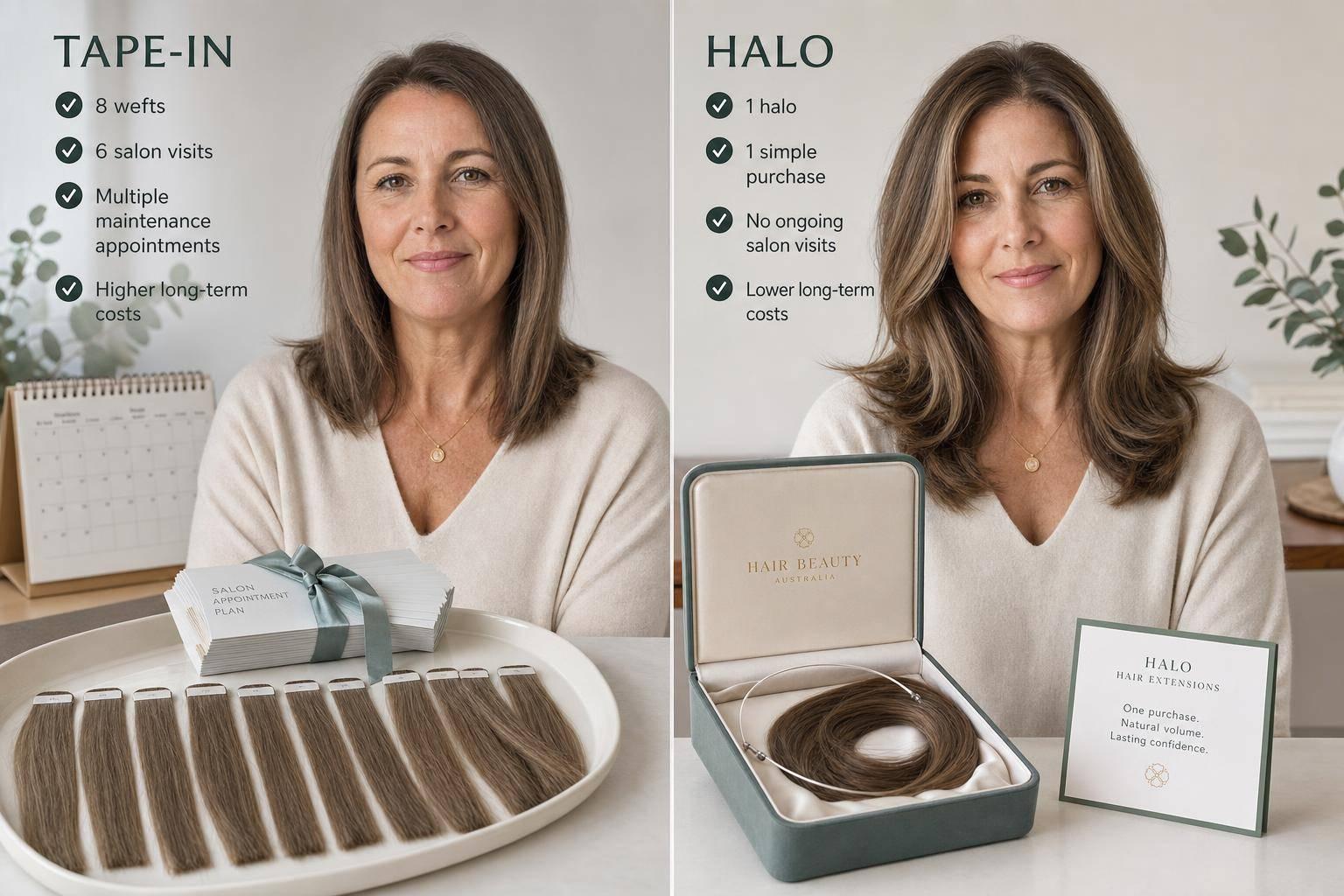
If I’m looking at cost over 12–24 months, halo extensions usually cost less than tape-ins. The reason is simple: halos are a one-time buy, while tape-ins come with salon fitting, move-ups every 6–8 weeks, and removal costs.
Here’s the short version:
- Halo extensions: about $160–$750 AUD upfront
- Tape-in extensions: about $400–$1,400 AUD upfront, with premium sets up to $2,000–$3,000 AUD
- Tape-in maintenance: about $250–$500 AUD per visit
- Halo lifespan: about 6–12 months, sometimes 18–24 months with good care
- Tape-ins over 24 months: can reach $8,000–$10,000 AUD
If I want lower long-term spend, home application, and less strain on fine hair, halos are often the better pick. If I want all-day wear, including exercise and swimming, tape-ins may still suit me better even though the total cost is much higher.
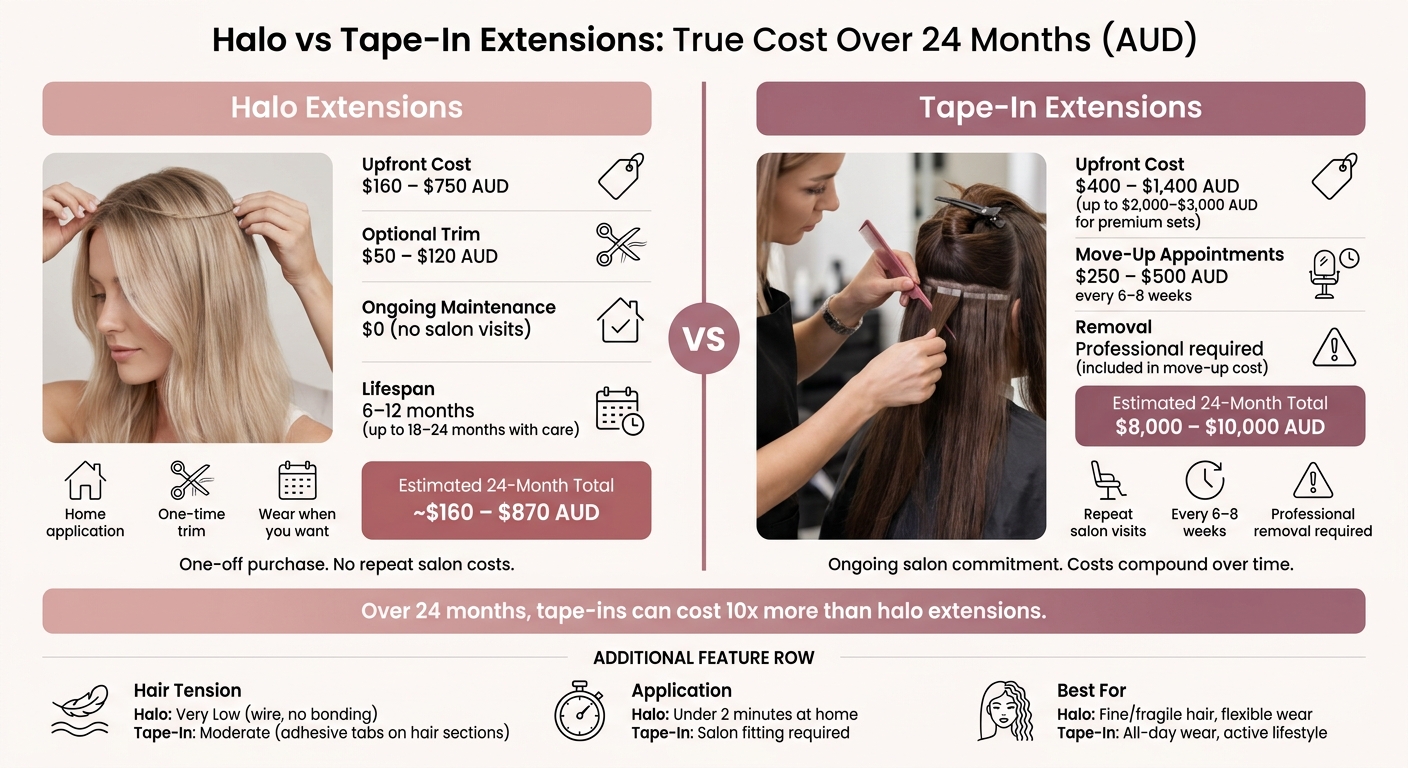
Halo vs Tape-In Extensions: True Cost Over 24 Months (AUD)
Your Ultimate Guide to Hair Extensions | Halo, Tape-Ins, Fusion, Weft, etc.
sbb-itb-08feb2f
Quick Comparison
| Option | Upfront cost | Repeat costs | Wear style | Best fit |
|---|---|---|---|---|
| Halo extensions | $160–$750 AUD | Low aftercare costs | Remove and reapply when needed | Fine hair, lower spend, no salon visits |
| Tape-in extensions | $400–$1,400 AUD | $250–$500 AUD every 6–8 weeks | Worn daily | All-day wear, active lifestyle |
Bottom line: if I care most about what I’ll spend over time, halos usually win by a clear margin.
Halo extensions: one-off purchase, home application and lower ongoing costs
A halo is a one-off purchase: you buy it once, fit it at home, and skip salon install and removal fees. For women who want removable extensions without repeat salon visits, that simple setup can cut the total cost a lot. The main spend after that tends to be aftercare, not fitting.
Upfront price and basic home care costs
In Australia, a quality human hair halo set (20–22 inches) usually costs $160 to $750 AUD [2]. If you want a one-off trim to help it blend better with your own hair, add $50 to $120 AUD [2].
Basic care brings a small extra spend. That usually means:
- sulphate-free shampoo and conditioner
- detangling spray
- heat protectant
- an extension brush or silk pillowcase [2]
From there, the big factor is lifespan. The longer the hair lasts, the more value you get from that first spend.
Reuse, lifespan and savings outside the salon
With proper care, quality halo extensions usually last 6 to 12 months [3][6]. If you treat them with extra care, they can last up to 18 to 24 months [1][4]. That’s where halos start to look very cost-friendly.
They’re also quick to put on. Application takes under two minutes [1]: place the wire over your head like a headband, pull a thin layer of your own hair over it, and you’re done.
Compared with tape-ins, halos cut out repeat move-up and removal fees. Tape-in move-up appointments happen every 6 to 8 weeks and cost between $150 and $400 AUD each [2]. With a halo, that cost is zero.
To help the hair last, wash it every 15 to 20 wears, let it air-dry, and store it on a hanger or stand [1][3][4]. So when people compare halo costs with other extension types, the real test is that 12–24 month window.
Tape-in extensions: higher ongoing spend from installation and maintenance
Tape-ins begin with a salon fitting, and the cost doesn’t stop there. The bigger expense shows up over time, because maintenance usually comes around every 6 to 10 weeks. Once you look at the full spend across 12 to 24 months, the gap becomes much clearer.
First-visit costs in AUD
Your first salon appointment usually includes both the hair and the fitting. For a half head, expect to pay $400 to $800 AUD. A full head usually lands between $700 and $1,400 AUD [1]. If you go for a premium or high-end full set, the price can jump to $2,000 to $3,000 AUD [5].
Move-up appointments, removal and adhesive upkeep
As your own hair grows, the tape bonds move further down from the roots. That’s why most people need a move-up appointment each cycle. At that visit, the stylist removes the old adhesive, cleans the wefts, adds new adhesive tabs, and fits them again [1].
Each move-up costs $250 to $500 AUD per visit [1]. It adds up fast. Over 12 months, maintenance alone can add thousands on top of what you paid at the start [5]. Stretch that to two years, and total spend can climb to $8,000 to $10,000 AUD [5].
There’s another cost people sometimes miss: removal. Tape-ins need a professional to take them out. Attempting to pull tape bonds off at home without a bond remover risks significant hair breakage [1]. So each cycle brings more salon labour, more time in the chair, and more spend. That repeat upkeep is what makes the total-cost gap much easier to see in the next comparison.
Side-by-side comparison: cost, hair tension and daily convenience
Here’s how the two options compare on the stuff that tends to matter most: cost, hair stress, and day-to-day ease.
| Feature | Halo Extensions | Tape-In Extensions |
|---|---|---|
| Upfront cost (AUD) | $160 – $750 | $400 – $1,400 (hair + first fitting) |
| Ongoing upkeep | None | Every 6–8 weeks at a salon |
| Hair tension | Very low; rests on a wire | Moderate; attached to small sections of your natural hair |
| Wear pattern | Remove and reapply as needed | All-day wear |
Which option usually costs less over 12–24 months
Over 12 months, halos usually stay close to the original purchase price, while tape-ins keep adding costs through move-ups and removal [1][2]. Push that out to 24 months, and the difference often gets bigger. A halo is still a one-off buy, while tape-ins still need regular salon maintenance.
How each method affects fine, fragile or thinning hair
Cost over time isn’t just about salon bills. It’s also about how much strain each method puts on your own hair.
A halo sits on an invisible wire across the crown, so nothing is bonded, glued, or clipped onto your natural strands. Tape-ins use adhesive tabs fixed to small sections of your hair, which means that weight stays on those strands for weeks at a time [4].
For women with fine, fragile, or thinning hair, that can make a big difference. If your hair is already delicate, repeated weight may affect how often you need breaks between installs or extra care to keep things in good shape. That can add to the total cost over time. Halos come off at night, so your hair gets a rest. Tape-ins can still work well, but they depend on having enough natural hair to hold and hide the bonds [4].
Daily wear versus wear-when-you-want flexibility
Convenience plays a part too, because salon time isn’t free, and neither is the time you spend getting there, sitting through appointments, and doing upkeep.
Tape-ins are made for all-day wear. Once fitted, they’re suited to exercise and swimming. Halos work more like wear-it-when-it-suits-you hair. You put them on when you want more length or volume, then take them off before bed, workouts, or a swim [1][5].
That difference matters. The more often you need salon visits to keep your extensions looking right, the more your total spend tends to climb.
Halos suit women who want removable wear with no repeat salon bookings. Tape-ins suit women who want all-day wear and don’t mind the upkeep.
Conclusion: When halo extensions make more financial sense
If long-term cost is your main concern, halo extensions usually come out ahead. They don't come with install, move-up, or removal fees, and that can make a big difference over time. But price isn't the whole story.
The better option comes down to how you plan to wear your extensions. If you want them in all day and live a pretty active life, especially if that includes swimming, tape-ins may suit you better even with the extra salon cost. On the other hand, if you want something you can take in and out, have fine or fragile hair, and would rather skip salon visits, halos make a lot of sense for both cost and day-to-day ease.
Picking the right method from the start can also save you money you didn't plan to spend. Choose the wrong type, and the costs can pile up over time, no matter what you paid upfront.
The most cost-effective extension is the one that fits your hair, your lifestyle, and your budget.
FAQs
How often do tape-ins need redoing?
Tape-in extensions usually need a maintenance appointment every 6 to 10 weeks. For most people, 6 to 8 weeks is the usual timing to keep them secure and looking well blended as your natural hair grows.
At these appointments, your stylist removes the extensions, cleans off the adhesive, and moves the wefts back up closer to the roots. That helps reduce tangling, matting, and damage.
Are halo extensions better for thin hair?
Yes. Halo extensions are a good option for thin hair because they sit on an invisible wire instead of attaching straight to your own strands.
That means less tension, less adhesive, and no bonding on delicate hair. They work best for mild thinning and add lightweight volume with a lower risk of strain on your natural hair.
Can I wear halo extensions every day?
Yes. Halo extensions work well for everyday wear if you want extra volume or length without committing to semi-permanent options.
They’re easy for beginners, fast to put on and take off at home, and flexible enough to wear whenever it suits you. To keep them in good shape, put them on in the morning and take them off before bed.