
Articles

Halo Hair Extension Length Guide: 14, 16, 18, 20 & 22 Inches Explained
Picking halo length is simpler than it looks: if your hair is shoulder-length, start at 14–16 in (35–40 cm); if it’s around bra length, look at 18–20 in (45–50 cm); if you want hair to sit about halfway down your back, 22 in (56 cm) is usually the first length to check. I’d use the body-placement chart as a guide only. The final look shifts based on your height, your natural hair length, and your texture. For example, waves and curls can look 2–4 in (5–10 cm) shorter, and keeping the gap between your own hair and the halo to about 10 cm (4 in) often gives a neater blend. 14 in / 35 cm: just below shoulders 16 in / 40 cm: upper chest 18 in / 45 cm: around bra line 20 in / 50 cm: mid-back 22 in / 56 cm: about halfway down the back Quick comparison Halo length Approx. length Usual finish Best starting point 14 in 35 cm Just below shoulders Shoulder-length hair 16 in 40 cm Upper chest Shoulder to collarbone hair 18 in 45 cm Bra line Bra-length hair 20 in 50 cm Mid-back Bra to mid-back hair 22 in 56 cm Halfway down back Longer look from bra or mid-back hair My quick rule: go for the shortest length that gives you the look you want. That usually makes blending easier and keeps the finish cleaner. Halo length chart: 14, 16, 18, 20 and 22 inches compared Halo Hair Extension Length Guide: 14 to 22 Inches Compared The table below shows where each Silkara Hair halo length tends to sit on the body. Length Approx. CM Body Placement 14 in ~35 cm Just below shoulders 16 in ~40 cm Upper chest 18 in ~45 cm Bra line 20 in ~50 cm Mid-back 22 in ~56 cm Halfway down the back Treat this chart as a guide, not a hard rule. Your height, natural hair length, and hair texture can all change how the final result looks. 14 and 16 inch halos: shoulder and collarbone length A 14 in halo, which is about 35 cm, usually sits just below the shoulders. A 16 in halo, or about 40 cm, tends to fall around the upper chest. These shorter lengths work best if your own hair sits around shoulder or collarbone length. They’re a good fit when you want a softer finish and a bit more fullness without adding a dramatic jump in length. 18 and 20 inch halos: bra line and mid-back length An 18 in halo, around 45 cm, usually falls near the bra line. A 20 in halo, around 50 cm, tends to sit at mid-back. If you want a more noticeable change in length, these are often the sweet spot. They give you more impact than shorter halos while still blending well for many wearers. 22 inch halos: halfway down the back A 22 in halo, about 56 cm, usually reaches mid-back and can fall halfway down the back. If your goal is hair that sits halfway down your back, this is the length to look at first. The next section explains why the same halo length can sit a bit differently from one person to another. sbb-itb-08feb2fWhat affects the final result: height, natural hair length and texture The chart is only a starting point. Where a halo ends up depends on your height, your own hair length, and your texture. How your height changes where each length falls Height changes how the same halo length sits on the body. On a petite frame under 160 cm (5'3"), a 20-inch halo can fall lower down the back. On a taller frame over 173 cm (5'8"), that same piece may sit higher [1]. In plain terms, shorter frames often get more visible length from the same halo, while taller frames usually need a longer halo to get that same look [1]. That’s why your own hair length is the next thing to check. How your natural hair length affects blending The gap between your natural hair and the halo plays a big part in how well everything blends. The bigger the gap, the harder it is to make the finish look smooth. For the cleanest blend, keep that gap within about 10 cm (4 in) [1]. Once the length is close, density and layers start to do most of the heavy lifting. How density, layers and texture change the finish Density matters as well. Fine hair tends to blend better with lighter, shorter halos, while thicker hair can handle longer, fuller lengths with less fuss [1]. Blunt cuts usually make the join easier to spot. Softening the ends with light layers can help, and having a stylist trim or layer the halo while you’re wearing it can make a significant difference [1]. Texture changes things too. If you plan to wear the hair wavy or curly, choose a halo that’s 2 to 4 inches longer than your target finished length [1]. Next, match those factors to shoulder-length, bra-length and mid-back hair. Which halo length suits shoulder-length, bra-length and mid-back hair Once you know where each length sits, the next step is simple: match it to your own hair length so the blend looks clean and natural. If your natural hair is shoulder-length If your hair sits around shoulder length, 14-inch and 16-inch halos are usually the best place to start. A 14-inch halo adds volume without changing your length too much. A 16-inch halo usually falls around the collarbone or mid-bust, which makes it a good fit for most people who want a smooth, easy blend. You can go longer. An 18-inch halo gives you a more noticeable change, but it often takes more blending to make it look smooth. If your hair is fine or thin, 14 or 16 inches tends to work best, because longer halos can look sparse at the ends and may pull the natural hair down. Bra-length hair can take more length, but the blend still has to look smooth. If your natural hair is around bra length If your hair is around bra length, 18-inch and 20-inch halos usually give the most balanced result. An 18-inch halo adds fullness with a balanced finish. A 20-inch halo drops to mid-back length. If you want your hair to sit about halfway down your back, 22 inches gives a more dramatic look. Mid-back hair follows the same rule: go for the shortest length that still gives you the finish you want. If your natural hair is already mid-back length If your natural hair is already mid-back, the choice comes down to how much change you want. A 20-inch halo adds fullness and a slight boost in length. A 22-inch halo gives a longer, fuller finish and may sit lower depending on your height. If your ends are blunt, a light trim may help the halo blend better. Natural Hair Length Best Length Result Shoulder-length 14–16 inches Natural volume and an easy blend Bra length 18–20 inches Balanced length and volume Mid-back 20–22 inches Fuller hair with a subtle to dramatic length boost Conclusion: How to pick your Silkara Hair halo length Use the chart as a last check, then tweak your choice based on your height and hair texture. Here’s the simple version: 14–16 inches works for shoulder-length hair 18–20 inches works for bra-length hair 22 inches works if you want the hair to sit about halfway down your back [1] For the neatest blend, keep the halo close to your natural length [1]. Want a bit more drama? Go longer if you’re after extra length or plan to wear it wavy or curled [1]. If your goal is hair that falls about halfway down the back, 22 inches is the pick. FAQs Should I size up for waves or curls? Yes. Waves and curls add bounce and volume, so the hair usually looks shorter once it's styled. If you want to keep your planned length, go for extensions that are 2 to 4 inches longer than your target result. That extra length helps the hair sit closer to the look you want after styling. What if I’m between two halo lengths? If you're stuck between two halo lengths, look at the finish you want and the length of your natural hair. For the smoothest blend, we generally suggest picking a halo that's no more than 2 to 4 inches longer than your current hair. Go with the longer option if you want a more dramatic, flowing look. Pick the shorter option if you'd rather keep the change subtle and soft. Still not sure? Our expert team can give you a personalised recommendation from a photo taken in natural light. Can a halo still blend with blunt-cut hair? Yes, but the blend matters even more. If your blunt cut is very thick and you’re adding a lot of extra length, the match may not look perfect on its own. A simple fix is to add a few extra inches and place soft layers where the halo sits. That helps the transition look smoother. You can also soften the line by mixing lengths, like 14" and 16", instead of using just one length. Related Blog Posts Halo vs Clip-In Extensions: Pros and Cons Guide Halo Hair Extensions Explained: Types, Styles & How to Choose the Perfect Match Halo Hair Extensions vs. Clip-In Extensions: Which One Is Right for You? 5 Everyday Hairstyles You Can Do in Minutes with Halo Extensions
Learn more
Virtual Try-On Results vs Real Life: What To Expect
Virtual try-on is useful, but it is not exact. In most cases, it gets you about 70–80% of the way there, and colour previews sit at roughly 70% tone accuracy. That makes it good for checking shape, length, face framing, and colour direction - but less exact for density, blending, texture, placement, and lighting. If I were using it to shop for a topper, halo, clip-ins, bangs, ponytail, or bun, I’d use it like this: Use the preview for direction, not a final answer Trust shape more than detail Double-check colour with daylight photos Measure topper base size in cm Read density and fit details before ordering Expect the in-person look to shift based on haircut, clipping, styling, head shape, and your own hair texture That’s the core point: the screen shows an idea; wear shows the result. If I keep that in mind, I’m far less likely to be disappointed. I Tested AI Hair Color Matching for Extensions - Here’s What Happened sbb-itb-08feb2fQuick comparison What I can usually trust more What I treat with care Face framing Exact colour match General length Thickness and volume Overall shape Root blending Basic crown coverage view Placement on my head Warm vs cool colour direction Texture, movement, and shine So if I want to get more from virtual try-on, I use it to narrow choices first, then I confirm the parts AI can miss with photos, measurements, and product specs. How AI Hair Virtual Try-On Works AI maps your face shape and hairline, then places a digital hairstyle over your photo. For the clearest result, pull your hair back, use soft daylight, and keep the camera at eye level. Shadows, filters, and steep angles can throw off the placement. What the Software Reads From Your Photo The software looks at your face shape, hairline position, and facial proportions to work out where the digital style should sit. Lighting plays a big part here. Poor light can create shadows that the system reads the wrong way. Most tools also work from a single static image. So they’re reading a flat photo, not how your hair moves or how texture shifts in person. What AI Predicts Well AI is most useful for showing direction, not exact results. For Silkara Hair shoppers, that’s often what matters most when judging fringe shape, length, and crown coverage. It’s also fairly good at showing how a shade may read against your complexion, whether it looks warmer, cooler, lighter, or darker. The same goes for face framing. You can get a solid sense of whether a style works with your features, even if the final in-person result may look a bit different. That’s why some try-on results look close, while others still need a real-world check. Where Virtual Try-On Is Accurate and Where It Falls Short Virtual Try-On vs Real Life: What AI Gets Right and Wrong Virtual try-on realism usually lands at around 70–80% accuracy [2]. That’s a useful benchmark, but not a guarantee. Think of it as a working limit. AI tends to read shape first, and that’s also where it performs best. Where it starts to wobble is with finish, density, and movement. Usually Close: Face Framing, Length and Overall Shape This is why AI tends to do best with shape rather than fine detail. It reads silhouette and proportion more reliably than the small stuff. General length comparisons also come through well, so in most cases you can trust the broad feel of whether a style looks short, mid-length, or long on your face. Less Exact: Colour, Density and Texture The finer points are less dependable. Colour tools can point you in a warm-versus-cool direction, but they can’t account for undertones, porosity, or previous colour history. Virtual colour tools usually reach about 70% colour tone accuracy [1], so they’re better used as a guide than an exact preview. AI also tends to make hair look fuller than it may appear in person. For toppers and extensions, that means the model can suggest the right style direction while still missing how well the hair blends. The biggest gap between screen and real life shows up in detail-level features. What AI Shows Well What Can Change in Real Life Face framing, silhouette and general proportions Cowlicks and growth patterns can change how hair parts and sits General length relative to your face Curl shrinkage and neck length change where the style falls Colour direction, such as warm vs cool tones Undertones, porosity and previous colour history change the result Topper placement and crown coverage Scalp visibility, blending and edge detection change the finish Overall volume and fullness effect Natural density and daily styling change the result On screen, you’re looking at a static snapshot. Real life adds movement, gravity, head shape, and texture. Results can shift once haircut, placement, and blending enter the picture. Why Real-Life Results Can Look Different Virtual try-on gives you a solid sense of a style’s shape. But once you wear the piece on a real head, a few other things come into play: placement, movement and how it blends with your own hair. That’s usually where the result starts to shift. The preview shows an idea. Real wear shows how the piece looks after it’s cut, clipped and styled. The main differences usually come down to fit, density, texture and lighting. Haircut, Placement and Blending The first mismatch often shows up where the piece meets your natural hair. If your hair hasn’t been layered or trimmed to blend into the piece, you can end up with a visible step between lengths. It’s a bit like joining two fabrics with different hems - the line stands out. Clip placement matters as well. Even a small shift can change how a topper sits at the crown or how a halo falls at the back. A piece that looked spot-on in the preview can sit a little off in person if the placement changes by even a small amount. Density, Texture and Growth Patterns Your own hair thickness and growth direction also shape the final look. Fine or thinning hair may give toppers less grip, while cowlicks or widow’s peaks can affect how clip-in bangs or fringes sit. Texture plays a part too. If your hair is uneven in texture, coverage can look different in person than it did in the preview. That’s one of those small details that seems minor at first, then makes a clear difference once the piece is on. Styling, Lighting and Head Shape The final result depends on how the piece sits, moves and catches the light once it’s worn. Getting close to a polished preview often takes some styling, such as blow-drying, smoothing or curling, along with a bit of product. Head shape and facial asymmetry can shift the way a halo, topper or fringe sits too. And colour can be sneaky: the same shade may look different under indoor lighting than it does in daylight. How To Use Virtual Try-On Wisely With Silkara Hair Use the preview to narrow your options, then check the practical details before you order. With Silkara Hair, virtual try-on works best as a filter. The product details are what should back up the final decision. Once you know where AI can get things wrong, the next step is simple: use it to build a shortlist. Use AI for Direction, Not Exact Results Use virtual try-on to narrow options, not to promise the final look. It helps you rule out styles that clearly don't suit you - like a fringe that feels too heavy, an extension length that looks too long, or a topper coverage area that seems bigger than you need. So use the AI to sort through the big choices: curtain fringe vs. straight fringe halo vs. clip-in lighter colour family vs. darker Then double-check the fine points with product information and colour matching. After that, look at the details AI can't measure. Confirm Colour, Base Size and Fit Before Ordering Once the AI has pointed you in the right direction, three things are worth checking properly before you commit. Colour is the hardest one. Screens show colour differently from real hair, so digital shades are only a guide. Silkara Hair offers a free colour matching service using customer photos. Use clear daylight photos facing a window, without heavy filters or harsh overhead light. That gives a better read on your hair tone than an AI preview. Base size matters most for toppers. AI can estimate coverage, but it can't measure the exact area of thinning on your scalp. Measure the thinning area with a soft tape measure in centimetres, then compare it with the base measurements in the product details. If the base is too small, it won't cover enough. If it's too large, blending can be harder. Density and volume should also be checked in the product specs. A halo extension wears differently from clip-ins, and the density listed on each product gives you a clearer sense of the finished weight and volume than a digital overlay can. What to Check Why the Preview Falls Short What to Do Instead Colour Screens show colour differently from real hair, so digital shades are only a guide Send a natural-light photo for free colour matching Topper base size AI can estimate coverage, but not the exact area of thinning Measure the thinning area in centimetres with a soft tape measure Density and volume Previews often look fuller and more idealised than real hair Read product specs for actual hair weight and thickness Application method The preview shows style, not wearability or maintenance Match the piece to your hair thickness and daily routine Conclusion: Set Realistic Expectations and Get Better Results AI virtual try-on helps with shape, length, and colour direction, but it can't fully show density, growth patterns, root blending, or lighting. That's why expectations matter just as much as the tool itself. Treat virtual try-on as a way to explore, not a promise. That simple shift usually leads to better satisfaction with the final result. Once you look at it that way, the next checks are pretty straightforward. The same idea applies to any Silkara Hair piece, from toppers and fringe pieces to halo extensions, clip-ins, ponytails, and buns. The AI preview helps narrow your options. Then colour matching, product photos, and base size guidance help confirm the fit. Silkara Hair's colour matching, product photos, and base size guidance make it easier to choose with more confidence. FAQs How accurate is virtual try-on really? Virtual try-on is a handy way to get a feel for how a style, colour or accessory might look with your face shape and proportions. But it’s best to treat it as a guide, not an exact preview. AI can’t fully recreate your hair density, texture, growth patterns, or how your hair reacts to humidity and wind. For the closest result, use a clear, front-facing photo taken in natural daylight, with your hair tied back. Why does the real-life result look different? Real-life results can look different from virtual try-on images because AI works in a controlled digital setting, while your hair has to deal with physics and your own anatomy. A virtual preview gives you an idealised, static version of a style. It doesn't always show your natural hair density, texture, growth patterns, daily styling habits, or how the hair solution will blend with your features, hairline, and existing hair. What should I check before ordering? Use the virtual try-on as a guide to see how different styles or colours may look with your features, rather than as an exact preview. What you see on screen can differ from what you get in person, depending on your hair density, texture, and growth pattern. Before you buy, use our free colour match service and check your measurements with a soft tape measure. Leave 1 to 2 cm so the clips can attach securely to healthy hair. Related Blog Posts 6 Ways to Match Hair Extensions to Natural Hair Color Why Doesn’t My Colour Match Exactly? How To Take Photos For The Best Colour Match Why Multi-Dimensional Colours Blend Better Than Solid Colours
Learn more
Why Human Hair May Feel Different Than Expected
If human hair feels too silky, too dry, or a bit like synthetic hair at first touch, that usually points to processing - not fake hair. In most cases, the hair has been cleaned, coated, conditioned, styled, and packed before it gets to you. That can change how it feels on day one. Here’s the short version: Too slippery or glassy? A silicone coating may be sitting on the surface. Dry after the first wash? The coating may have rinsed out, leaving the hair’s normal feel behind. Tangles fast? Cuticles may not be aligned, or the hair may have been heavily processed. Feels different from your own hair? Texture, density, and base fit may be the issue - not just hair quality. What should I do first? Wash it once, use conditioner, air-dry it, and judge it after that. A few facts matter here: Silicone coatings often wear off after 3 to 6 washes. Human hair pieces dry out faster because they do not get scalp oils. Remy hair with aligned cuticles tends to feel smoother and tangle less than mixed-direction hair. My take: the first wash tells you more than the first touch. If the hair settles, moves well, and stays soft with gentle care, that’s a good sign. If it turns rough, mats, or loses its feel fast, the issue is more likely processing, coating, or a poor match to your own hair. That’s the main point of this article: don’t judge human hair straight out of the box - judge it after one gentle wash and a few wears. How to Tell the Quality of Human Hair Extensions- DoctoredLocks.com sbb-itb-08feb2fHow processing changes the feel of human hair Not all human hair is handled the same way before it gets to you. How it's collected, sorted, and treated has a direct effect on how it feels in your hand, how it moves, and how well it lasts with regular wear. The main things that shape that feel are cuticle alignment, surface coatings, and chemical treatment. Remy hair and cuticle alignment The cuticle is the outer layer of each hair strand. It's made up of tiny overlapping scales, a bit like roof tiles. In Remy human hair, those cuticles stay aligned from root to tip. That matters because aligned cuticles help the hair feel smoother and tangle less. When every strand runs in the same direction, the hair tends to move more naturally too. Non-Remy hair is different. Its cuticles are often mixed in different directions, which can lead to friction and tangling. To deal with that, manufacturers may use a chemical stripping process to smooth the cuticle scales. At first, the hair can feel soft and polished. But that smoothness comes at a cost: the hair has already been weakened at a structural level [2]. If you want a topper that keeps feeling natural after repeated washing and wear, cuticle alignment isn't a small detail. It's one of the main things doing the heavy lifting. Silicone coatings and an overly silky feel Some human hair pieces are coated with silicone during manufacturing. This gives the hair a slick, almost glass-like finish. On first touch, that can seem like a good sign. But sometimes it's hiding the hair's actual texture. The issue is simple: silicone doesn't stay forever. It usually washes away after 3 to 6 washes [1]. Once that happens, the hair underneath starts to show itself. If the base hair is high grade and the cuticles are aligned, it should still feel soft and easy to handle. If the coating was hiding lower-grade or unevenly processed hair, you may start to notice tangling and dryness pretty fast. A handy check is to rub a dry strand between your fingers. Silicone-coated hair can feel overly slick or like there's a layer sitting on top. Natural high-grade hair usually has a slight texture instead of that slippery finish [1]. Once the coating is gone, there's nowhere to hide. What you're left with is the hair's actual feel. Over-processing, colouring, and dryness Chemical treatment doesn't just change softness on day one. It also affects how the hair behaves over time. Colouring and bleaching are common in hair manufacturing, and if they're done with care, they don't always ruin the hair. But heavy processing can do damage. Repeated dyeing, harsh bleaching, and other strong chemical treatments can weaken the cuticle layer in a big way. Hair like this may look fine straight out of the box, then start to feel dry, scratchy, or fragile after it's been worn and styled for a while [2]. This becomes a bigger issue with daily wear. A piece might feel nice in the packaging, but that doesn't mean much if it goes downhill after regular brushing, washing, and styling. Over-processed hair also tends to struggle with more heat styling later on. It can lose softness and become harder to manage. Put plainly, the state of the cuticle at the start shapes how long a topper keeps its look and feel. Why texture often changes after washing and styling What the first wash can tell you about the hair The first wash removes the factory finish, residue, and any coating sitting on the surface. So the hair may stop feeling as slippery as it did straight out of the box. That shift is normal. It’s often the point where you start to feel the hair as it actually is, not how it was prepped for sale. Good hair should still feel soft and easy to handle, just less coated and more natural. How heat and frequent washing cause dryness Once that surface finish is gone, day-to-day care matters a lot more. Topper and extension hair doesn’t get oils from the scalp, so it dries out faster than natural growing hair. That’s why washing too often can be hard on it. It can leave the hair dry and brittle over time. Hot water, harsh shampoos, and high heat make that happen faster. Lukewarm water and low heat help slow that dryness down. How to bring back softness with gentle care If you want that cleaner texture to stay soft instead of turning dry, gentler care usually makes the biggest difference. Use: a sulphate-free cleanser a moisturising conditioner through the mid-lengths and ends a wide-toothed comb, starting at the ends and working upward That approach helps limit breakage. Air-dry when you can. If you do need heat, keep it low. If the hair starts to feel dry, soak it in water and conditioner. Then use a small amount of argan oil on the mid-lengths and ends to add softness between washes. Over time, habits like these give you a clearer sense of the hair’s condition. How to judge topper quality by feel and behaviour Human Hair Feel: Signs of Quality vs. Over-Processing Signs the hair is healthy and natural-looking Once that box-fresh finish fades, pay attention to how the hair feels and moves. Good Remy hair usually has a slight natural resistance when you rub a dry strand between your fingers. That small bit of texture can point to aligned cuticles. The hair should move freely, sit flat, and not puff up or twist in odd directions. During normal wear, tangling should stay minimal. If it swings and settles like your own hair, that’s a good sign. Signs the hair may be coated or over-processed Judge quality by looking at three things together: feel, movement, and how the hair responds after washing. One clear red flag is hair that feels glassy, slippery, or plasticky when you rub a dry strand. High-quality natural hair has a slight, healthy texture, while coated hair can feel overly smooth [1]. That “too silky to be true” feel can seem nice at first. But if the hair loses its nice finish fast, mats easily, or starts behaving differently after a wash, that can point to coating or heavy processing. Why base size, density, and texture match also matter Hair quality is only one part of the picture. A topper can still look off if the base size, density, or texture doesn’t match your own hair. What you want is simple: it should blend in and move like your hair, not just match the colour. If the density is too thick, the base is the wrong size, or the texture fights against your natural pattern, the topper can look a bit “stuck on” even if the hair itself is good. Conclusion: What to do if your human hair piece feels different than expected If your topper or extensions feel drier or slicker than you expected, the first wash often changes that. In many cases, that shift is temporary, not a sign the hair is fake. Once you know the hair is coated or freshly processed, start with a gentle reset. Mix a small amount of shampoo into cold water and let the piece soak for about 5 minutes. Then follow with a conditioning soak and let it air-dry on its own. Add a small amount of argan oil to the mid-lengths and ends so it blends more naturally with your own hair. Between washes, treat it gently and use a wide-toothed comb. After the first wash, protect the finish with low-heat styling and a light touch. Gentle washing and low-heat care help bring back softness and movement. If the hair still feels different, judge it by how it wears, not by softness alone. The best result comes from matching texture, density, and colour to your own hair. If it still feels off after gentle care, the issue is usually the fit, the texture match, or the processing quality. FAQs How do I tell if it’s coated? A silicone coating often gives the game away the moment you touch the hair out of the packet. It usually feels very shiny and almost too smooth. Sellers often use this kind of coating to cover up lower-grade, non-Remy hair. The bigger clue shows up after a few washes. If the hair starts to feel dry, tangles more easily, or loses that soft feel, the coating is probably washing away. High-quality Remy human hair keeps its natural movement and softness with regular care. Can human hair feel fake at first? Yes. It’s common for human hair toppers and extensions to feel a bit different when you first open them. That usually comes down to the manufacturing process, not the quality of the hair. A light silicone or conditioning coating can make the hair feel extra silky, or even slightly plasticky, at first. Once that protective layer washes out, the texture may feel different from your own hair because it doesn’t get your scalp’s natural oils. When should I worry about poor quality? Be concerned if your hairpiece shows structural breakdown. That can look like heavy tangling, matting, or dryness that gets worse even after washing and styling. Poor-quality hair can also feel brittle, lose its shine after the first few wears, and shed too much at the roots. In some cases, the weight feels uneven, which can make the piece sit stiffly instead of lying flat against your scalp. Related Blog Posts Factors Affecting Human Hair Extensions Durability Human Hair Toppers Weft hair extensions, use case, types and benefits Why Doesn’t My Colour Match Exactly?
Learn more
How To Blend A Topper Into A Bob Haircut
A topper blends into a bob when four things match: flat base, right length, light density, and the same part. If one is off, a bob shows it fast. Here’s the short version of how I’d do it: Start with clean, dry hair so clips hold better. Flatten bulk at the crown and sides so the base sits close to the scalp. Choose a topper slightly longer than the bob - about 2.5–5 cm longer gives room to trim. Keep density light to moderate (around 120% density) so the top doesn’t look too thick next to the sides and back. Place the front edge 2.5–5 cm behind the hairline and clip in front, back, then sides. Leave a little of your own hair out at the front and sides to cover the base edge. Point-cut the join instead of cutting straight across, so the ends look softer. A bob has less room to hide mistakes than long hair. The crown is more visible, the outline is sharper, and extra bulk on top can show at once. That’s why I’d focus on prep, placement, and light finishing - not heavy styling. A few numbers matter here: 15–30 cm topper lengths tend to suit most bob lengths, and trimming with the topper just 2.5–5 cm longer than your cut makes blending much easier. Use this as your quick guide before you start: Area What I’d aim for Base Small or compact, sitting flat Length 2.5–5 cm longer than the bob Density Light to moderate Front placement 2.5–5 cm behind hairline Clip order Front → back → sides Finish Point-cut, light thinning if needed If I wanted the blend to last all day, I’d keep the shape light, match the texture to the bob first, and check the part and edges in natural light. Prepare the bob so the topper sits flat Start with clean, dry and detangled hair A bob shows every bump, so the hair underneath needs to be smooth before you clip in the topper. Oil and product build-up can stop the clips from gripping well [1]. "Wash and dry your hair thoroughly to keep it fresh and free from heavy oils." - Noelle Salon [1] Once your hair is fully dry, brush it through from root to ends. Knots and tangles near the roots can stop the base from sitting flush against the scalp and may leave ridges under the topper. If your hair feels a bit too slippery, mist the roots with dry shampoo or texture spray to give the clips more grip. It also helps to match your natural hair texture to the topper before clipping it in. With the hair clean and dry, the next job is to deal with any extra bulk around the crown. Flatten bulky spots at the crown and sides Bulk at the crown and sides can stop the topper from sitting flat. Thick bobs often hold volume right where the topper base needs to go. When that happens, the topper can lift away from the scalp and take on a helmet-like look. Before you place the topper, check the crown and sides for any bulky sections. Pin those areas flat against the head with bobby pins. As you secure each clip, press the base flat against your head. That small step can help stop bumps from forming underneath. After clipping it in, run your fingers along the edges of the base. If you feel bumps, unclip the topper and pin the natural hair underneath a bit tighter before trying again. A smooth base helps the topper sit flush. Once the base is flat, match the topper's length, density and parting to the bob. sbb-itb-08feb2fMatch the topper to the bob before you clip it in Once your bob is prepped and lying flat, check the topper before you clip it in. The length, density, part, and base size need to suit the cut as a whole. If one of those is off, the blend can look awkward fast. Length, density and parting must work together Pick a topper that's 2.5–5 cm longer than your bob. That extra length gives you space to trim and feather the ends after it's clipped in, so it melts into your cut instead of leaving a blunt line. Density is where short styles often go sideways. If there's too much hair in the piece, the shape can turn round and puffy, which makes the topper stand out. "A common mistake is going too thick. That creates a 'mushroom head' effect and instantly gives the hairpiece away." - Leo, Hairstylist [3] For bobs, natural or moderate density tends to work best for a soft finish. The part matters too. Match the topper's parting to your own. If you normally wear a side part and place a centre-part topper on top, it will usually show. Fit table: matching a topper to a bob Use this table to line up topper length, density, and base size with your bob. Bob Style Recommended Topper Length Ideal Density Best Base Parting Strategy Jaw-length bob 15–20 cm Light to moderate Small silk or monofilament Align with your natural part; place the front edge 2.5–5 cm behind the hairline Chin-length bob 20–25 cm Natural or moderate Compact silk Centre or side part; leave a thin section of your own hair at the front to soften the edge Longer bob (lob) 25–30 cm Moderate Medium mono or silk Multi-directional parting; blend into existing layers The base should cover the thinning area, but it shouldn't run into the denser crown and sides. If it reaches thicker hair, the clips can end up sitting on bulk instead of flat against the scalp. When that happens, the topper may lift and look less secure. Once the fit looks right, clip it in and blend the front, part line, and sides. Place, secure and blend the topper into the bob How to Blend a Topper Into a Bob Haircut: Step-by-Step Guide Position the topper and secure the clips in the right order Once your topper matches your bob, it’s time to clip it in properly so it sits flat and blends in with your own hair. Open all the clips before you place the topper. This helps you avoid pulling on your own hair while you’re trying to secure it. [1] Set the topper over your head and line up its part with your natural part. The front edge should sit about 2.5-5 cm behind your natural hairline. That small gap matters. It gives you room to pull some of your own hair forward and cover the base edge, which helps hide the join. If your hair is fine or silky, lightly roughen each clip point first so the clips have a better grip. [1][2] "Place the front clip about 1-2 inches behind your natural hairline. Secure the front clip first. Hold the base flat and taut against your head. Clip the back next, then the sides." - Henry Xiang, Founder at Alpha Hair [2] Clip the topper in this order: front first, then the back, then the sides. As you go, keep the base flat against your head. After that, check around the edge for any bumps, lifting or gaps. If a section isn’t sitting right, unclip it and secure it again. [1][2] Blend the front, part line and side sections Once the base is secure, the next step is making the front and sides look soft and natural. Leave out a few thin sections at the front and sides, then smooth them over the base edge with your fingers. This helps keep the blunt line of the bob from looking too harsh. Use a paddle brush or a wide-tooth comb to blend the topper into your bob, and keep one hand lightly on the base while you do it so nothing shifts out of place. [1][2] If the part still looks a bit sharp, use a root concealer spray or powder that matches your natural colour to soften the line. Then move your head from side to side and check that the topper stays secure. [1][2] Finish the shape and keep the blend natural all day Trim, layer and style the topper with the bob Once the topper is secure and the front is blended, the last step is making it look like it belongs with the bob. The goal is simple: style the topper and your bob as one shape, not two separate pieces. Start by styling the bob first. Straighten it, add a wave, or softly bevel the ends based on how you normally wear it. That matters because you want to trim the finished shape, not the unfinished one. When the bob already sits the way you like, the join is much easier to tidy up. Then use sharp scissors to point-cut where the topper meets your bob. Hold the scissors vertically and snip into the hair at a 45° angle instead of cutting straight across. That gives you a softer, feathered edge rather than a blunt line that can make the join stand out. If the area still feels a bit heavy, use thinning shears about 5–8 cm from the ends to take out some weight. [4] For very short bobs, the front hairline can be the hardest part to hide. In that case, a topper with a built-in fringe can do a lot of the work for you by helping cover the front join. [1][2] Key points to remember for a smooth bob blend "Always cut less than you think you need. You can always trim more, but you can't put hair back!" - Henry Xiang, Founder, Alpha Hair [4] Finish with small tweaks. Point-cut the join, soften the ends, and check the part in natural light. FAQs Can I wear a topper with a very short bob? Yes, you can absolutely wear a hair topper with a very short bob. It’s a simple way to add volume and coverage without wearing a full wig. For the most natural look, pick a lightweight topper that matches your hair length, density, and texture. With the right fit and clip placement, it can blend in well and feel secure and comfortable. How do I stop a topper looking bulky on a bob? Choose a smaller, lightweight topper so the base sits flat against your scalp and blends with your natural hair density. If there’s too much volume, it can swamp fine hair and make the separation stand out more. Size matters too. A base that’s too large can add bulk, while one that’s too small may not stay in place well. A professional stylist can trim and layer the topper while you’re wearing it, which helps it sit and look more natural. Should I trim the topper myself or see a hairdresser? For the most polished, natural finish, it’s a smart idea to see a professional stylist. They can cut and blend the topper while you’re wearing it, so it melts into your bob and looks like part of your own hair. You can style a human hair topper at home. But for precise shaping and a flawless, customised result, a stylist makes a big difference. Related Blog Posts The Ultimate Guide to Choosing a Hair Topper for a Seamless Hairline Why Does My Topper Look Bulkier Than Expected? Common Mistakes That Make Hair Toppers Look Unnatural Why A Bang Topper Often Looks More Natural Than A Fringe
Learn more
Can I Cut Or Thin My Hair Topper?
Yes - if your topper is human hair, I can cut, layer, and thin it, but I need to keep it light and careful. If I cut too much, I can’t put the hair back. That matters because trimming changes coverage, blend, and how long the topper lasts. Most human hair toppers last about 6–12 months, and some can last up to 2 years with gentle styling and small trims. Before I touch scissors, here’s the short version: Human hair toppers can be cut, layered, and lightly thinned Synthetic toppers can usually be trimmed for length, but thinning is riskier I should trim small amounts only, especially around the crown and front If the topper looks puffy, bulky, or too dense, light shaping may help If it has a lace or silk base, or needs layers or fringe work, a hairdresser is the safer choice For home trims, I should stick to tiny tidy-ups on the ends only A few simple signs tell me a topper may need shaping: it’s too long for my haircut, it sits high at the crown, the part line looks heavy, or the front pieces don’t sit well around my face. Area What I can do Main caution Length Trim ends, soften shape Every cut is permanent Density Light thinning through mid-lengths or ends Too much can show the base Fringe/front Tidy and shape on dry hair Wet cutting can end up too short Crown/hairline Minor shaping Base damage is easy here Synthetic fibre Small length trim only Thinning often goes badly My rule of thumb: cut less than I think I need. If I’m making a first cut, changing the style, or thinning near the base, it’s better to have a hairdresser do it. Here’s the plain-English guide to what I can cut, when thinning makes sense, and when I should leave it alone. What you can safely do to a topper Cutting length, layers and soft ends You can trim a topper to match your haircut. If the topper is too long, it can look separate from your own hair even when the colour match is spot on. For length, point cutting works well. The scissors are held at a 45-degree angle and snipped into the ends, which gives a softer edge [1][2]. Long layers also help. They add movement and stop the topper from looking flat [1][2]. Removing bulk from thick sections If a topper feels heavy through the mid-lengths or the ends look too dense, thinning shears can take out extra weight. Keep thinning 2–3 inches from the ends and cut diagonally instead of straight across [1]. That takes out bulk bit by bit without going near the base, which is where you need the most density for coverage. Toppers come in low (110–120%), medium (130%), and high (150–180%) density [2]. On fine hair, a high-density topper can look bulky. Thinning can bring it closer to the way your own hair falls, so both sit together more naturally [2]. Shaping hair toppers with bangs and front pieces Bangs, a fringe, and front pieces can be refined into wispy or curtain effects with careful trimming [1][2]. At the front and sides, those small sections do a lot of the visual work. Shaping them well can make the blend look more seamless [1][2]. Always shape bangs on dry, styled hair, not wet. Wet hair sits longer than it falls once dry, so trimming it wet can leave you with a fringe much shorter than you meant to cut [1]. Go slowly, trim in tiny increments, and leave the ends a little longer. Hair often settles shorter once styled [1]. Once you know what can be trimmed safely, the next step is working out whether the topper needs a cut at all. sbb-itb-08feb2fDIY Hair Topper Fix: Trimming & Blending for Beginners! | UniWigs Airy Elegance When cutting or thinning a topper makes sense Not every topper needs cutting. But there are three common cases where a trim or light thinning can help. Matching a shorter haircut or existing layers If your topper is longer than your natural hair, it will often need a trim so everything lines up. This comes up a lot after a haircut change, especially if you've moved to a bob, lob or another shorter style[1]. Reducing density for a more natural blend If a topper feels too full or sits higher than your own hair, the result can look bulky or puffy. When that bulk shows up at the crown, the fix is often shaping rather than a full restyle[2]. Thinning can help if the topper looks too full at the crown or hairline, or if it feels too dense next to your natural hair[1][2]. Blending with other hair pieces A topper can also be cut or thinned so it blends better with other hair pieces. In most cases, that means matching the length and the front sections[1]. For bigger changes, or if the base is fragile, the next step is working out whether a hairdresser should handle the trim. Professional customisation versus at-home trims Hair Topper Trimming: Professional vs. DIY – What's Safe to Cut? Once you know the topper needs shaping, the next step is simple: work out whether it needs a hairdresser or just a very small trim at home. When to see a hairdresser A hairdresser is the right choice for first cuts, layers, fringe work, density changes, or any blending that needs to sit neatly with your own hair. If the topper looks bulky at the hairline or creates a hard join, it needs professional blending. This matters even more with a lace or silk base. A slip of the scissors near the base can weaken that natural scalp look. A stylist can also cut the topper and your own hair together, which helps avoid a harsh line where the piece ends.[2][4] If all it needs is a slight tidy-up, a careful home trim may be enough. What you can do carefully at home For home upkeep, only trim a topper that has already been shaped by a professional. At-home trims should stay small and be for maintenance only. Take off a tiny amount at a time, then stop once the ends look even. Point-cutting helps soften the ends and avoids blunt lines.[1][4] Even a small cut has an effect. Every snip changes how the topper blends, how much coverage it gives, and how long it lasts. Comparison table: professional cut versus DIY trim Professional stylist DIY home trim Who it suits First-time owners, complex styles, lace or silk bases Experienced users doing minor maintenance What can be safely done Full restyle, layers, fringe, crown blending, density adjustment Lightly trimming the ends only Main risks Higher cost and a need for topper-specific experience Over-cutting, blunt lines, base damage After the cut, the next question is how it changes blend and longevity. How cutting and thinning affect longevity, blending and results Protecting coverage and wear life After the cut, the big issue is coverage and how long the topper will hold up. Every cut is permanent: once hair is removed, it cannot be replaced[1]. If you take out too much density, you can expose the base or reduce coverage[1][5]. That said, a careful cut can help the topper last longer. When a topper is easier to style and blend, you usually need less heat and less day-to-day handling[1][3]. And that can make a big difference over time. With gentle care, a quality human hair topper can last 6–12 months, and up to 2 years with conservative styling[1][5]. Regular washing and heat styling can roughen the ends, so small maintenance trims may still be needed[1]. Blending starts before the scissors Blending doesn't start with cutting. It starts earlier, with the right colour, density, base size, length, and whether you need a hair topper with bangs[1][5]. Get those choices right first. That means less correcting later, and less chance of over-cutting[1][5]. In plain terms, the better the topper suits you from the start, the less you need to do with the scissors. Conclusion: go conservative for the most natural result The safest move is to stay conservative. Cut less than you think you need[1]. You can always take more off; you can't put hair back. FAQs How do I know if my topper needs thinning? Your topper may need thinning if the ends feel too thick, bulky, or heavy, or if it doesn’t blend in with your own hair. If it creates a blunt line or doesn’t have much soft movement, thinning can help give it a more feathered finish. A simple way to check is to compare sections of the topper with your natural hair. If the topper looks much denser or sits too heavily, that’s usually a clear sign it needs a bit of work. Can cutting a topper make it look less natural? No. Cutting a hair topper usually helps it look more natural by helping it blend with your own hair, sit better, and feel less bulky. When it’s done well, cutting, layering, and thinning can give the topper a softer, more seamless finish. For the best result, see a professional who has experience with hairpieces. How often should I trim my hair topper? There’s no fixed schedule for trimming your hair topper. Just trim it when it needs a tidy-up so it keeps its shape, holds its style, and blends in with your own hair. A lot of people get their topper cut and blended by a hairdresser when they first buy it. After that, if the ends start to look a bit tired or the shape doesn’t suit your style anymore, a light trim can help it look neat again. The main thing is to go slowly. Trim very small amounts at a time so you don’t take off too much. Related Blog Posts The Ultimate Guide to Choosing a Hair Topper for a Seamless Hairline Why Does My Topper Look Bulkier Than Expected? Common Mistakes That Make Hair Toppers Look Unnatural How To Blend A Topper Into A Bob Haircut
Learn more
Why A Bang Topper Often Looks More Natural Than A Fringe
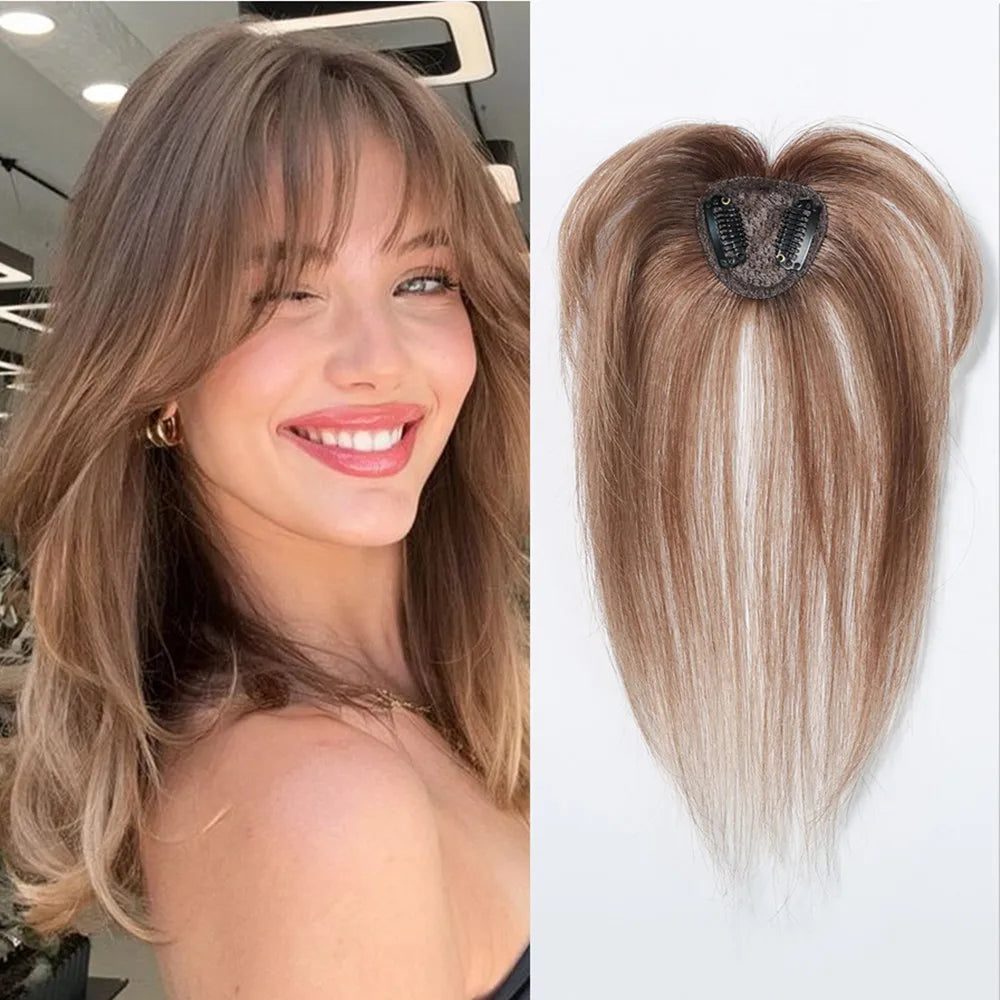
If your hair is fine or thinning, a bang topper will often look less obvious than a clip-in fringe. I’d put it down to one main thing: it covers the top of the head as well as the front, so the bangs have more hair to blend into. Here’s the short version: A clip-in fringe starts at the hairline A bang topper sits about 1.3–2.5 cm behind the hairline A topper covers the crown and part line That extra coverage helps hide sparse spots, flat roots, and thin temples Low heat styling, around 71–85°C, helps blend the fringe after fitting If I compare the two, the issue isn’t just the bang shape. It’s the difference in density between the front piece and the hair behind it. On thin hair, that contrast can make a fringe piece stand out fast. A topper helps by giving the bangs a better base and a softer start point. Quick comparison Option Where it sits What it covers Main issue on fine hair Best use Clip-in fringe At the front hairline Forehead only Join line, thin hair behind it, movement can show clips If the rest of the top hair is dense enough Bang topper 1.3–2.5 cm behind the hairline Fringe + crown + part line Can look off if too dense or placed too far forward If you need top coverage as well as bangs I see the topper as the better pick when you want bangs to look like they belong with the rest of your hair, not like a separate piece. Bang Topper vs Clip-In Fringe: Which Is Better for Fine Hair? Why a clip-in fringe can look obvious on fine or thinning hair On fine or thinning hair, a clip-in fringe can do the opposite of what you want. Instead of hiding sparse areas, it can draw more attention to them. The big issue is coverage, not just the fringe shape. Front-only coverage leaves the crown and part line exposed A clip-in fringe covers the forehead only. The crown, part line, and temples stay visible. If the hair behind the fringe is fine or thinning, that contrast can make the fringe look like a separate piece rather than part of the hair. When there’s less density behind it, the jump in volume stands out straight away[3]. Movement and attachment issues can reveal the piece Because the piece clips in at the hairline, there often isn’t much natural hair there to hide the join. On fine hair, the clip line can show, especially in bright daylight[3][1]. And once wind or day-to-day movement comes into play, the fringe can shift or lift away from the forehead and show the attachment point[1]. Cowlicks and thinner temples make things even trickier. A front-only fringe usually doesn’t have enough width to blend with the way the hair naturally grows. So instead of melting in, it can leave a visible edge that gives the whole thing away[3][2]. That is where a topper with bangs changes the result. How a bang topper creates a more realistic blend A bang topper combines crown coverage with an integrated fringe, then clips in around the perimeter. That extra coverage changes how the fringe sits, moves, and blends with your own hair. The base supports natural direction, volume and scalp coverage Because the base covers the crown and part line, the hair looks like it’s growing from the scalp instead of sitting on top of it. For fine or thinning hair, that difference can make all the difference. The hair can fall back and out to the sides, which helps it blend with your natural hair from more than one direction instead of dropping forward from a single clip point [1][4]. The larger base also clips into stronger hair outside the thinning area. That helps with security and comfort, especially if you want the piece to feel steady through the day [1][4]. The other big shift is where the fringe starts. The fringe falls from behind the hairline instead of sitting on it With a clip-in fringe, the hair begins right at the hairline. A bang topper sits behind the natural hairline, so the fringe falls forward from behind your own hair instead of lying flat over it [2][3]. That small placement change can stop the piece from looking stuck on, which is a common issue with front-only pieces. It can also soften the look of a high or broad forehead [1]. Once the placement is right, the base size and fringe shape do most of the work. sbb-itb-08feb2fWhen a topper with bangs is the better fringe option A topper comes into play when the fringe needs to blend with more than just the front hairline. If the front fringe needs backup from the top of the head, a topper with bangs is usually the better match. Hair concerns that benefit from extra top coverage Some hair concerns need coverage across the top, not only at the forehead. That includes thinning at the temples, a widening part, low crown volume, and front breakage. In those cases, the extra top coverage gives the fringe a fuller, more natural-looking base. Flat roots are another big one. If the hair sits close to the scalp, the fringe can end up looking limp or a bit disconnected. A topper adds lift at the crown first, then the fringe can be styled to sit better. Styling goals that need more than a front fringe Wispy bangs and curtain bangs tend to look softer when they fall from a fuller top section rather than from a thinner front edge alone. The final finish also comes down to a few details: base size, density, and fringe shape. Those three things have a big impact on how natural the result looks. How to choose, fit and finish a Silkara Hair bang topper Once the shape is right, the fit is what makes the fringe blend in instead of looking separate. Choose the right base size, density and fringe shape Start with a base size that fits the area you want to cover. Then look at density. If your own hair is fine and the topper is too dense, it can look heavy and a bit obvious. Keeping the density close to your natural hair helps the topper look like part of your hair instead of something sitting on top of it [2]. Fringe shape is the detail that pulls the look together. In general: Curtain bangs soften the face Side-swept bangs suit round or square faces Straight-across bangs suit longer faces [3][1] There’s one small detail people often miss: even if the density is right, the topper can still look off if it sits too far forward. Place the topper behind the hairline for a softer finish For a softer result, clip the topper 1.3–2.5 cm behind your hairline. Secure it into the stronger hair a bit further back, then brush a small amount of your own hair over the edge to help it blend [3]. Once it’s clipped in, use a round brush and low heat - around 71°C to 85°C - to blend the fringe into your own hair [3][1]. If you need to trim it, do that after the topper is secured so the length works with your face shape and where the piece actually sits [3][1]. Conclusion: Better coverage is what makes bangs look natural A front-only fringe can stand out when there isn’t much volume through the top, simply because there’s less hair to blend into. A bang topper gives you crown coverage first. That gives the fringe a fuller base to fall from and helps it sit in a way that looks more like natural hair growth. Get the colour match, base size and placement right, and the fringe looks like your own hair. FAQs Will a bang topper work for very thin temples? Yes. A bang topper can help hide thinning at the temples because the built-in fringe sits over sparse or fragile sections at the front. For the most natural look, a lace-front base helps create the look of hair growing from your scalp. A close match in hair density, along with proper placement, helps it blend in naturally. How do I match topper density to fine hair? Choose a topper with light density and a low weight so it blends smoothly with fine hair. In most cases, wispy or airy styles look more natural than blunt, heavy cuts. To help hide the base and keep it in place, gently backcomb the roots where the topper attaches. Then use a light texturising spray for extra grip. Silkara Hair’s free colour matching service can also help you get a more natural-looking finish. Can I trim a bang topper after fitting it? Yes, you can trim a bang topper to suit your face shape and the look you want. In fact, many come slightly longer on purpose, so they can be shaped after fitting and styling. Just make sure you only trim it once it’s clipped in place and blended with your natural hair. Because it’s human hair, it can be cut like your own hair, but it won’t grow back. So go slowly, trim small amounts at a time, or see a professional stylist if you’re not sure. Related Blog Posts Human Hair Topper with Bang Fringe vs Bang Topper: Which One Is Right For You? Why Can I See The Clips In My Bangs? Fine Hair? These Are The Best Toppers And Bangs For You
Learn more
Common Mistakes That Make Hair Toppers Look Unnatural
Most hair topper problems come down to five things: placement, colour match, blending, density, and base fit. If I get those right, the topper is far less likely to stand out. If I get even one wrong, the hairline, part, or crown can look off in daylight. Here’s the short version: Place it about 1.3 cm behind the hairline so my own hair softens the front. Match colour in daylight, not indoor lighting, with close attention to undertones. Blend the cut and texture so there isn’t a hard line between my hair and the topper. Pick density that suits my own hair or the topper can look bulky. Choose the right base size and type so it sits flat and covers the thinning area. A topper usually looks less natural when it is too thick, too flat in colour, poorly placed, or sitting above the scalp instead of against it. One simple check can help: before I head out, I look at the hairline, part, sides, and crown in daylight. That small step often catches the problem fast. Mistake What usually gives it away Simple fix Wrong placement Front edge shows or a gap appears Set it around 1.3 cm behind the hairline Poor colour match Shade looks off outdoors Check colour near a window or outside Weak blending Visible join between hair and topper Trim and style both together Too much density Hair looks puffy or heavy Go for light or medium density if my top is sparse Wrong base Lifting, clips showing, edges visible Measure the thinning area and add 2.5 cm In short: a natural topper is less about the topper alone and more about how well it matches my hair, scalp area, and haircut. The rest of the article breaks down each mistake and how to avoid it. 5 Hair Topper Mistakes vs. Natural-Looking Fixes 5 Top ❌ Hair Topper MISTAKES ❌ to Avoid (First Topper Buyer's Guide!) sbb-itb-08feb2fWhat Makes a Hair Topper Look Natural? A natural-looking topper comes down to a few parts working together: placement, colour, blending, and density. If even one of those is off, the topper can stand out. That’s why each one can turn into a problem point, and why the rest of this article digs into them one by one. Placement is often the first thing people notice when a topper looks obvious. It needs to sit flat against the scalp, with no lifting or gaps. The usual sweet spot is about 1.3 cm behind your hairline, so your own hair softens the front edge [2]. Colour is another common giveaway, especially in daylight. Hair that looks flat or all one tone can seem artificial, because natural hair usually has slight tonal shifts. A topper with that bit of dimension tends to blend better. One without it can look a bit too uniform. Then there’s blending and base construction. The topper’s texture should match your own hair [7]. The base should lie flat, and the part should resemble the scalp, especially at close range. Density matters too. If there’s too much hair packed into the piece, it can create a bulky “helmet” effect [1]. With those basics in place, the first mistake to avoid is placement. 1. Incorrect Placement Placement is the easiest topper mistake to spot. Get it wrong and the topper stands out straight away. If it sits too far forward, the front edge can show against your forehead. If it sits too far back, you end up with a clear gap between your own hair and the topper[2][8]. Once you’ve set the position, line up the part before you clip it in. Use a tail comb to match the topper’s part with your natural part[8]. Then lightly backcomb the clip areas so the topper sits flat and stays in place[2][8]. After that, check the front edge in daylight to make sure it stays hidden[8]. 2. Poor Colour Matching Choosing a topper from an indoor photo can be misleading. Artificial light changes the way colour looks, so a shade that seems right inside can look off in daylight. What you want is a match for how your hair looks outdoors, not under ceiling lights. Undertones matter most. If your natural hair has warm golden tones and you pick a topper with cool ash tones, the difference will stand out the moment you step outside. The same goes for toppers with a flat, single-tone shade. Next to natural hair, which usually has small shifts in colour, they can look a bit fake. Check your hair in natural daylight, ideally outdoors or near a window, before choosing a shade [4]. Silkara Hair also offers a free colour match service that checks undertones and highlights from photos. If the shade looks close but the topper still seems separate, the problem is usually blending. 3. Insufficient Blending Blending is what makes a topper look like part of your own hair. At this point, you want one smooth shape, not two separate sections. If you put a blunt topper on layered hair, or a layered topper on blunt hair, you'll often end up with a visible line. That line is usually what gives the topper away. The easiest fix is to have the topper trimmed and lightly layered while you're wearing it. That way, it can be shaped to match your haircut instead of fighting against it. Human hair toppers can also be cut, thinned and heat-styled to suit your hair. And yes, styling matters more than many people think. If your hair is smooth but the topper has bend or volume, they won't sit together well. Style both in the same way. Blending Challenge Practical Fix Blunt transition line Ask for soft face-framing layers or light thinning Texture mismatch Curl or straighten your natural hair and topper in the same sections Flat crown or part Mist the roots and blow-dry upward for lift A fringe can make things much easier because it removes the need to hide the front hairline. If the topper still looks bulky after blending, the next thing to check is density. 4. Choosing the Wrong Density If the blend looks right but the topper still seems bulky, density is usually the issue. This is one of the most common reasons a topper looks obvious. When the topper has much more hair than your own, the contrast can feel sudden. The result? Hair that looks heavy, puffy, or a bit out of place. A good way to judge density is to check your crown and part line in natural light. Then compare that area with the sides and back of your hair. If you can see more scalp at the top, a light or medium-density topper will often blend better. Density Level Best For Light Early-stage thinning, fine hair, widening part line Medium Moderate crown thinning, average hair thickness Higher density Significant thinning or very thick surrounding hair If a topper feels slightly too thick, a human hair topper can be thinned or layered by a professional to take out some of the bulk. If the density seems right but the topper still sits oddly, the next thing to check is the base size and construction. 5. Using the Wrong Base Size or Construction Even if the hair density is spot on, a topper can still look off when the base size is wrong. The base is what everything sits on, so if it doesn't line up with the area you're trying to cover, the whole piece can give itself away. A base that's too small can leave thinning spots exposed. One that's too large may shift around and show the edges or clips, which makes the topper stand out [3][6]. Start by measuring the thinning area from front to back and from side to side. Then add 2.5 cm (1 inch) to both measurements so the clips can grip onto denser hair [9]. Size is only part of it. The type of base matters just as much. A silk base hides knots well and gives the look of a natural scalp. A mono base is breathable, which can suit sensitive scalps. A lace front can work well if thinning starts near the hairline and you want to wear hair away from your face [9][5]. Here’s a quick guide: Thinning Pattern Recommended Base Size Part line thinning 5x5 – 6x6 Crown thinning 6x7 – 7x7 Diffuse thinning across the top 7x8 – 8x9 Advanced thinning 8x9 – 10x10 A well-made base should lie flat against the scalp. If the base is stiff or the sizing is off, the edges can become visible and the topper may lift, which makes it look artificial [1]. "If the wrong base is chosen for your hair type or stage of hair loss, the base can appear thick or raised, causing the topper to lift away from the scalp. When this happens, the piece immediately appears artificial." - Karen Dowsey, Founder, Frankie Hair Toppers [1] Next, use the quick reference to compare each mistake with the natural-looking result. Mistake vs Natural-Looking Result: A Quick Reference Here’s a quick recap of the main topper mistakes and the fix for each one. Use it as a fast scan before you head out. Mistake What It Looks Like Better Approach Placed too far forward Front edge shows at the hairline Position the front edge about 1.3 cm behind your natural hairline and blend your own hair over the edge [2] Misaligned part Part lines do not align Use a tail comb to nudge the topper's part until it lines up with your natural part [6] Styling not integrated Join line shows Style both sections together [6] Density too high Volume looks too bulky Match density to your natural hair, or have the piece lightly thinned [1] Base too rigid or poorly fitted Base lifts or looks raised Choose a base construction that sits flush against the scalp [1] Before you buy or wear a topper, do a few quick checks. Look at the hairline, part, and sides—or consider a clip in hair topper with bangs to simplify the front edge—in good light before you go out. A mirror check takes less than a minute, and it can save you from that “something looks off” feeling later. Checks to Do Before You Buy or Wear a Topper Use this quick check to spot problems before they show up in daylight. Before you buy, look at the topper outdoors and compare it with your mid-lengths and ends. It’s much easier to notice undertone and texture mismatches in daylight than under indoor lights [1][4]. If you’re not sure about the base size, measure the thinning area first. Then add 2.5 cm on each side so the clips can grip stronger hair. Once the size looks right, check the placement. Set the topper about 1.25 cm behind your natural hairline, then make sure the front edge stays hidden instead of lifting at the front [2]. Last, do a simple shake test. Move your head from side to side and lean forward. If the piece shifts, mist the roots with dry shampoo or texturising spray, then clip it in again. After that, use a hand mirror with a wall mirror to check the back and crown for puffiness or gaps [2]. Conclusion Most topper mistakes come back to the same basics: placement, colour, blending, density, and base fit. The good news is that many of these issues can be fixed with small tweaks, not a full do-over. Human hair toppers can be cut, coloured, and heat-styled to match your own hair, which gives you plenty of room to fine-tune the look. A slight shift in placement, a better blend through the lengths, or a base that sits more cleanly can change everything. When placement, colour, blending, density, and fit all work together, the topper disappears into your own hair. FAQs How do I know if my topper is too dense? Your topper may be too dense if it looks much thicker than your natural hair. That can create a clear contrast or a sudden shift that stands out. It can also look unnatural if the front edge sits too heavily or feels bulky. A well-fitted topper should match your natural hair density so it blends in and looks natural. What if my topper lifts at the front? If your hair topper lifts at the front, the base often isn’t sitting flat against your scalp. Place the front edge around 1 to 5 cm behind your natural hairline. That gives your own hair room to fall over the edge and help hide the seam. If it still lifts, check two things: The base type matches your stage of hair loss The clips are attached in areas with enough hair density Can a topper be cut to match my haircut? Yes, a human hair topper can be professionally cut and layered to match your haircut. Because it’s made from human hair, a stylist can shape it much like your own hair, which helps it blend in more naturally. A professional stylist can trim, layer, or thin the topper so it sits better with your current style and is less noticeable. Related Blog Posts The Ultimate Guide to Choosing a Hair Topper for a Seamless Hairline Why Does My Topper Look Bulkier Than Expected? Understanding Hair Topper Density: Light vs Medium vs Full Volume Why Doesn’t My Colour Match Exactly?
Learn more
Fine Hair? These Are The Best Toppers And Bangs For You
If my hair is fine, I’d start with the smallest and lightest piece that covers the thin spot. That’s the short answer. Here’s what matters most: Fine hair means each strand is thin. Low-density hair means there’s less hair overall. If a topper or fringe is too dense, it can sit high on the scalp and look obvious. For most people, the best pick depends on where the scalp shows: crown, part line, front hairline, or fringe area. Human hair pieces can usually handle low heat of about 150–170°C. If I’m layering pieces, I’d keep wear time to about 8–10 hours and move clip placement by 1–2 cm each time. If you want the fast version, this is how I’d break it down: Crown thinning: light-density crown topper Part getting more visible: part-line topper Front hairline looking sparse: front hairline topper Front + top coverage: topper with built-in bangs Front-only change: ultra-light bangs, wispy fringe, or curtain bangs Hair Toppers for Thinning Hair: Coverage, Comfort & Natural Blending sbb-itb-08feb2fQuick Comparison Best Hair Toppers & Bangs for Fine Hair: Quick Comparison Guide Piece Best for Density feel Main coverage Best if I want Light-Density Crown Topper Crown thinning Light Crown and top Daily top coverage Part-Line Topper Visible scalp through the part Light to medium-light Centre part A flatter part-line fix Front Hairline & Fringe-Zone Topper Sparse front hairline Light Front third Front coverage without a full topper Topper with Built-In Bangs Front + mid-top thinning About 120% Hairline, part, upper crown Coverage plus fringe shape Ultra-Light Clip-In Bangs Thin front edge Ultra-light Front hairline only The lightest bang option Wispy Clip-In Fringe Soft face frame Ultra-light to light Front and temples A soft, airy fringe Curtain-Style Clip-In Bangs Sparse centre-front and temples Light Centre hairline A middle-part look The main idea is simple: match the piece to the problem area, keep density light, and match colour to your mid-lengths more than your roots. That’s what helps fine hair look smooth instead of overdone. How to Choose a Topper or Fringe for Fine Hair Start with the smallest piece that covers the area you want to fix. If your hair is fine or low-density, go for the lightest option that blends in without sitting too high on the scalp. If the piece is too full, it can leave a clear edge, and that’s usually what gives it away. Start by identifying your problem area. A crown topper is a good fit for thinning across the top of the head. A part-line topper works well if your part is getting wider or you’re seeing early thinning through the centre. A front hairline or fringe-zone piece makes more sense when the front looks sparse or the hairline has pulled back. In most cases, targeted coverage looks lighter and blends in better with your own hair. Measure before you buy. Measure the thinning area in centimetres, then pick a base that goes a little beyond it. That way, the clips can hold onto stronger hair around the area. It helps the piece stay in place and lets the edge sit flatter against your own hair. When it comes to density, stick with light-density or low-density pieces. Thick, full-volume options can swamp fine strands and look out of place. If you’re choosing clip-in bangs, a wispy style tends to blend better. A wispy fringe also sits flatter and looks more natural around the hairline. Human hair blends well and can handle heat styling, so you can match it to your own hair with a straightener or a soft curl. It’s also worth choosing a lightweight attachment that feels secure without pulling on delicate strands. That gives you the best starting point for the product options below. 1. Silkara Hair Light-Density Human Hair Crown Topper If your thinning is mostly at the crown, this topper gives you coverage right where you need it without making your hair look heavy. It works well for mild to moderate crown thinning, especially when your scalp shows under bright light or your part has started to look wider. The light-to-moderate density is made to blend with fine hair rather than sit on top of it like extra volume. The compact base sits on the upper back of the head and covers the crown plus the centre part-line area. That makes it a good pick if you still have solid density at the front or you want to keep your fringe visible. For the best finish, blend the topper into your own part once it’s in place. You can line it up with your natural part or move it slightly into a soft side part. Clip the front first, then secure the sides and back so the base lies flat against your head. Because it’s made from 100% human hair, you can style it to match your own texture. Use low heat, around 150–170°C, and keep hot tools away from the base. It also helps to apply a thermal protectant first. Silkara Hair also offers a free colour match service, so you can send photos before you buy. One small tip: match the topper to your mid-lengths, not just your roots, for a softer, more natural blend. 2. Silkara Hair Part-Line Human Hair Topper If your main concern is a widening part, this topper is built for exactly that. Its narrow, elongated base follows the part line from the front hairline towards the crown, so it covers the visible part without adding extra bulk. And because the part line is such an exposed area, the base and density need to stay light. A light to medium density helps soften the look of visible scalp while still keeping everything airy. The scalp-like base also helps the part look natural instead of obvious or heavy. Blending it is pretty simple. Line up the topper's part with your own, then use a tail comb to gently lift a small amount of your natural hair over the edges of the base. If you need a bit more help with scalp-tone matching, a touch of pressed powder or root-colour spray can soften the edge. Once the part is blended, the aim is to keep the finish flat and hard to spot. When styling, use low heat with a heat protectant, and keep hot tools away from the base. The part line is one of the most visible areas of the head, so even small colour differences can show up fast here. Use Silkara Hair's free colour match service, then check the shade in natural daylight. 3. Silkara Hair Front Hairline & Fringe-Zone Topper If thinning has spread from the part line to the front hairline, it makes sense to switch to a smaller topper that focuses on the front. This one is made for thinning around the front hairline and fringe zone, so you get light coverage without adding extra fullness across the entire top. The compact 4 × 5 inch base, or about 10 × 13 cm, helps keep the weight down while still leaving enough hair for the clips to grip. Here’s the part that matters most: density. A light- or low-density topper tends to sit flatter against the scalp and blend better with thinner front sections. If there’s too much volume at the hairline, it can create a harsh edge. And that makes the join much easier to see. To get a better blend, smooth your own hair down first. Then place the topper at, or just behind, your natural hairline. After clipping it in, comb your hair and the topper hair together so they blend as one, instead of sitting in two separate layers. A tail comb helps here. Use it to guide the front pieces in the same direction as your natural growth pattern, then smooth the edges flat. If you want front coverage with a built-in fringe shape, the next step is a topper with bangs. 4. Silkara Hair Human Hair Topper with Built-In Bangs This topper is a good fit for thinning around the front hairline and part-line. With 120% density, it gives light-to-medium coverage without looking bulky, which matters if your hair is fine. It’s best when you want extra coverage at the front but still want your own fringe to look like your fringe. The small-to-medium base sits at the top front of the head and reaches across the part-line, front hairline, and upper crown. A simple way to size it: measure the thinning area, then add about 1 cm around each edge so the clips can grip stronger hair. What stands out here is the built-in fringe. The graduated layers and feathered ends help the bangs sit softly against the forehead instead of looking heavy or blunt. You can wear them straight across, sweep them to one side, or part them a little through the middle. If needed, a stylist can trim the fringe to match your hairline or the length of your current bangs. For styling, keep heat to 150–170°C max if you want to smooth, bend, or add a soft wave. Use a heat protectant first, pay extra attention to the lengths and ends, and let the hair cool before you touch it. If you want something lighter and more focused on the fringe, the next clip-in options give you a bit more freedom. 5. Silkara Hair Ultra-Light Clip-In Bangs If the topper options above feel like more coverage than you want, Silkara Hair Ultra-Light Clip-In Bangs keep things simple. They cover the front hairline only, which is often where fine hair starts to thin first, without adding extra bulk through the rest of the hair. Regular clip-in bangs can look a bit too dense on fine hair. This ultra-light version takes a lighter approach. It uses small, low-profile clips on a slim base, so it sits more like fine hair naturally sits. It also leaves baby hairs visible around the edges, which helps the bangs blend in better with your own hair. Once they’re fitted, less is more with styling. Use low heat only if you need to, and keep hot tools away from the clip base. For day-to-day wear, it’s better to skip heat altogether. A cool blow-dry with a round brush can add a soft curve, which helps in warm or humid weather. If you want an even lighter finish, a stylist can trim and soften the ends after fitting so the bangs stay wispy and easy to wear. 6. Silkara Hair Wispy Clip-In Fringe If you want a softer frame around the front of the face, the Silkara Hair Wispy Clip-In Fringe is a good fit. It gives light front coverage, and the shape stretches a little towards the temples for a more face-framing look. The feathered, tapered ends and slightly uneven strand pattern help it blend in better. Instead of sitting like a blunt block, it lets a bit of scalp and some of your own shorter hairs show through, which makes the finish look more natural. For placement, clip it just behind your natural hairline. That way, your baby hairs or shorter face-framing pieces can sit in front of the base. If your hair is very fine, prep the roots at the clip points with root powder or texturising spray so the clips have better hold. Because this is a 100% Remy human hair piece, you can style it with ease. If you want a softer result, have it cut while it's clipped in and ask for light texturising only. Silkara Hair's free colour match service also helps at the hairline, where even a small shade mismatch tends to stand out first. If you'd like a broader, curtain-like shape, the curtain-style clip-in option is next. 7. Silkara Hair Curtain-Style Clip-In Bangs If you want a softer, face-framing look than a straight fringe, curtain bangs are a smart pick for fine hair. The Silkara Hair Curtain-Style Clip-In Bangs part at the centre and sweep out to each side, so they frame the face with soft layers. The low-density base sits flat, doesn’t swamp fine hair, and feels light on delicate roots. You get front coverage without that bulky, heavy look. The coverage sits across the central hairline and the triangular front section from the centre part to the outer brows. That’s often the first area where scalp starts to show. So if your centre part looks sparse but you still want your hair to feel light and airy, this shape makes sense. Because the bangs follow the same centre line your hair already has, they tend to blend in well with a middle part or a soft off-centre part. To make the join less obvious, brush some of your own hair forward over the base. And when choosing a shade, match the root colour of the piece to your natural hair, not just the ends, especially if you have grown-out highlights or balayage.[1][2] You can style them with low heat and a heat protectant. Use a small round brush while blow-drying to guide each side away from the centre part, or use a low-heat iron to add a soft C-curve. Silkara Hair’s free colour match service helps with this, because curtain bangs leave the root area in plain view and even a small shade mismatch tends to show first at the hairline. If you’re wearing them with a crown topper, place the topper 0.5–1 cm behind the front hairline and line up the parting with the fringe. This shape suits readers who want front coverage without a blunt fringe. Quick Comparison: Which Option Suits Your Fine Hair Concern? Use this table to line up each Silkara Hair piece with the fine-hair issue you want to fix first. Silkara Hair Product Best For Density Works Best With Wear Style Light-Density Crown Topper Flat or low-volume crown; diffuse thinning at the top Light Shoulder-length to mid-back Everyday Part-Line Topper Visible scalp along the part line Light to medium-light Long bob to long hair Everyday Front Hairline & Fringe-Zone Topper Weak or receding hairline; thinning through the front third Light at the front edge Short to long, with trimming to suit shorter cuts Everyday Human Hair Topper with Built-In Bangs Weak hairline plus low mid-front density Light overall Shoulder-length and longer Everyday Ultra-Light Clip-In Bangs Soft face framing when the fringe area is wispy or uneven Ultra-light Brow-grazing bobs to long hair Quick styling Wispy Clip-In Fringe Delicate, airy fringe and subtle face softening Ultra-light to light Short, medium or long Quick styling Curtain-Style Clip-In Bangs Sparse temples and centre-part framing Light Medium to long Quick styling Start with coverage, not style. If scalp show is constant at the crown or along the part line, a full topper usually makes more sense than a smaller front piece. That gives you steadier coverage instead of a patch-up job that only works from certain angles. Clip-in bangs and fringes are better when the issue sits at the front and you want fast shaping around the face. They’re handy for front-only touch-ups, especially when the rest of your hair still has enough fullness. If you’re stuck between densities, go lighter. A piece with too much density can sit up off the scalp and make the join easier to spot. Once you’ve picked the right shape, the next section helps you sort out shade and styling so everything blends in cleanly. Colour Matching and Styling Tips for a Natural Finish Once you've picked the right topper or bangs, shade and finish are what help the piece melt into your hair. Match to Your Mid-Lengths and Ends Match the piece to your mid-lengths and ends, not your roots. Roots are often darker, so a piece matched to the root can look too harsh once it sits over lighter lengths. Sun exposure often leaves mid-lengths and ends lighter and warmer than the roots. And on fine hair, even a small shade mismatch shows up fast at the part, fringe, or base. If your hair carries warm tones through the mid-lengths, ends, part line and hairline, lean towards shades like honey, warm beige blonde or golden brown instead of cool ash. Cool tones can look a bit flat against the warmth the sun tends to bring out. Use Photo Matching to Get the Shade Right Use Silkara Hair's photo match service with natural-light photos. Take front, side and back shots near a window with artificial lights switched off. Skip filters and heavy editing. Send front, side and back photos in natural daylight so Silkara Hair can match your mid-lengths and ends with care. If your hair looks quite different in summer compared with winter, mention that when you submit your photos. A colour that blends well in July may need a slight tweak by December once your ends lighten more. After colour, the next step is keeping the texture soft and light. Gentle Styling Keeps Fine Hair Looking Natural Use low heat only on human hair toppers and bangs, and always apply a lightweight heat protectant first. Use just a small amount of product on the mid-lengths and ends. For most fine hair pieces, a light leave-in conditioner or flexible-hold mist is enough. Avoid heavy oils, wax sticks or thick pomades near the fringe or base. They can cause clumping and make the attachment area easier to spot. Brushing and Trimming Final shaping matters most on fine hair, where every millimetre shows. Always detangle from the ends upward with a wide-tooth comb or soft brush, and support the base with your free hand so you don't pull on the clips. This matters even more after a day outdoors or near the beach, where wind and salt air can lead to knotting. If you want to trim your fringe or topper bangs, cut only 2–3 mm at a time and point-cut with small vertical snips. That helps keep the edge soft and wispy. Start longer, then trim slowly. Can You Wear a Topper with Bangs or Extensions? Yes - and for fine hair, this can often look better than using one heavier piece. If one light piece doesn't cover every thin area, it's often smarter to layer two light pieces instead of reaching for one dense option. That tends to sit more softly on fine hair and can blend in with less bulk. The simplest way to think about it is to give each piece one job: a topper for the crown or part line bangs for the front hairline a halo extension for length and fuller ends A handy day-to-day combo is a light-density crown topper with ultra-light clip-in bangs. The bang piece clips just behind the front hairline, then a thin veil of your own hair is combed over the edge to hide the attachment. If you want extra length and body through the ends as well, add a halo extension that sits at the back of the head under the topper. There is one small catch: make sure the topper clips don't sit straight on top of the halo wire. That kind of overlap can create pressure points, and on fine hair, that can get uncomfortable fast. This setup works well because each piece covers one area without piling on bulk where you don't need it. In most cases, your own hair should be at least shoulder length so the halo blends cleanly, especially in bright Australian daylight where seams and lines are easier to spot. With fine hair, clip placement matters more than many people think. Rotate where your clips sit each time you wear them. Even moving them by 1–2 cm can help stop the same delicate strands from being pulled day after day. It's also smart to keep wear time to about 8–10 hours and take toppers and clip-ins out before bed. If you notice redness, soreness, or broken hairs, that's a sign the clips are putting too much tension on your hair. If your hair is very delicate or actively shedding - after postpartum changes, during medical treatment, or with advanced thinning - stacking multiple clips may put too much stress on fragile roots. In that case, one larger-base ultra-light topper with fewer clips may be a better fit, and Silkara Hair's free colour match service can help you choose the right piece before you commit. Conclusion Fine hair needs light density, targeted coverage, and a flat, natural edge. Add too much volume, and you end up with bulk and visible lines. So the best way to choose isn’t by volume. It’s by the concern you want to fix. Go with ultra-light clip-in bangs for a flat fringe, a part-line topper for a widening part, a light-density crown topper for crown thinning, or a topper with built-in bangs for front-and-top coverage. Match the piece to the problem, and the result stays light and believable. When the fit is right, it blends into your own hair with far less fuss. And if shade is the last thing holding it back, the colour match service can help finish the blend. If you’re not sure where to start, use Silkara Hair's free colour match service. Start with the smallest piece that solves the problem, then build from there. FAQs How do I measure for the right topper size? Style your hair as you normally would, then find the thinning area that needs coverage. Use a soft tape measure to check the length and width. Next, add 1–2 cm to each measurement. That extra room gives the clips enough space to grip onto healthy hair, which helps the topper sit securely and feel comfortable. Silkara Hair toppers usually range from 10–20 cm in length and width. Will a topper damage fine hair? When it’s fitted the right way, a hair topper should feel secure without putting stress on your hair. Silkara Hair toppers use pressure-sensitive clips, so you can wear them comfortably all day without damaging your natural hair. If your hair is fine, the small details matter. Make sure the clips feel firm, but not too tight. And place the base so it sits flat against your scalp, with no gaps or bulges. How do I make bangs look natural? Choose a 100% Remy human hair piece if you want it to catch the light and move more like your own hair. When you’re matching colour, look at your mid-lengths and ends, not your roots. Place the piece about 1–5 cm behind your natural hairline so your own hair helps soften the front edge. Then blend it in with root sprays, powders, or a bit of gentle teasing, and trim or heat-style the fringe so it suits your face shape. Related Blog Posts Human Hair Topper with Bang My Fringe Looks Too Thick – What Should I Do? Fringe vs Bang Topper: Which One Is Right For You? Why Can I See The Clips In My Bangs?
Learn more
New To Hair Toppers? What To Expect During Your First Week
Most first-week topper problems are fixable. If I’m new to hair toppers, I can expect three main things in the first 7 days: a bit of scalp awareness, a short styling learning curve, and some self-consciousness that usually settles once fit and placement are right. Here’s the short version: Normal in week one: light clip pressure, mirror-checking, slight puffiness, and spending 15–20 minutes styling at first. Not normal: sharp pain, clips digging in, redness, soreness, constant slipping, or a topper that looks far too thick for my own hair. What helps fast: start with 1–2 hours at home, place the front edge about 1.25 cm behind the hairline, shift sore clips by 2–3 mm, and use dry shampoo or texturising spray for grip. What styling can fix: a puffy crown, a dense-looking part, and minor colour mismatch. What styling can’t fix: the wrong base size or density. First-week care: most human hair toppers only need washing every 10 to 15 wears, so the first week is more about placement, brushing, heat care, and storage. If I still feel pain or the topper keeps moving after a few wears, the issue is usually fit, placement, or density rather than “just getting used to it”. Issue Usually normal Needs a fix Comfort Mild pressure at first Sharp pain or sore spots Look Slight puffiness or stiff part line Base too small or density too heavy Wear A bit of movement on slick hair Sliding every time I wear it Feelings Worry about being noticed Avoiding going out because it feels wrong That’s the core of it: week one is less about perfection and more about getting the topper to sit, blend, and feel right. Normal first-week problems vs signs that need attention Most first-week topper discomfort comes down to adjustment, not failure. That’s the big thing to keep in mind during your first topper experience. The goal is to tell the difference between normal wear-and-tear feelings and a fit problem that needs fixing. Scalp awareness, mild clip pressure and clip sensitivity It’s normal to feel the clips and base on your scalp at first. A bit of tightness that fades after a few hours is also part of the early settling-in phase. What’s not normal is sharp pain, clips digging in, redness, or soreness that keeps hanging around at the clip sites. Those are signs that the clips, fit, or placement need adjusting. Self-consciousness and worrying about being noticed Feeling self-conscious in week one is common. So are frequent mirror checks and that extra awareness every time the wind picks up. "The first time I went out in public wearing a topper I was absolutely certain everyone could tell... Nobody could tell. Nobody was looking." - Neveen Wood [6] If that feeling doesn’t settle after styling, look at placement and density next. In many cases, anxiety that sticks around is tied to something practical, like fit, density, or placement, rather than something that will fade on its own. Blending, base size and density concerns If a topper looks a bit puffy or the part line seems very straight, that’s usually a styling issue, not a product flaw. First-time styling often takes around 15–20 minutes, then drops to just 2–5 minutes once you’ve found the right placement and the hair has settled [4]. If the topper looks visibly thicker than your own hair, you likely need a better density match. Styling won’t fix that. The same goes for base size: if the base is too small to cover the thinning area, repositioning won’t solve it [5]. When the shape and density are right, the whole thing tends to feel much easier. Here’s the quick breakdown. Category Normal Needs attention Comfort Light pressure; awareness of the piece Sharp pain or clips digging in Scalp condition Mild tightness that fades Redness or soreness at clip sites Blending Slightly puffy or straight part line Too much hair for your own density; base size too small Clip placement Slight sliding on freshly washed hair Constant sliding; clips on fragile hair Emotional response Self-conscious; frequent mirror checks Avoiding daily activities due to distress sbb-itb-08feb2fHow to make your topper feel comfortable and look natural faster Hair Topper First Week: Day-by-Day Wear Plan & Quick Fixes Knowing what's normal helps. But what helps even more is a simple plan for the first few days, plus a few easy fixes for the little things that can feel off at first. A simple day-by-day wear plan for your first week Use these fixes for the normal adjustment issues that don't need a full reset. Don't aim for all-day wear on day one. Start with 1–2 hours at home on days one and two so your scalp can get used to the weight and clip pressure. On days three and four, wear it for 3–4 hours during low-stress activities and practise styling. Mist the part, redirect the hair, and use a round brush with low heat to guide the front sections back. By days five to seven, work up to a full day. By then, the base should start sitting flatter against your head shape [7][8]. How to manage clip placement and pressure Open all clips before you place the topper. Set the front edge about 1.25 cm behind your natural hairline [7][2]. Secure the front clips first to lock in the position, then smooth the topper flat against your head before fastening the sides and back. If one clip pulls, unclip it and move it 2–3 mm. That tiny shift can make a big difference. It also helps to rotate clip positions a little each time you wear it, so the same hairs aren't under strain every day. If your hair is fine or slippery, give the roots a bit more grip first. A light spray of dry shampoo or texturising spray, plus a gentle tease at the attachment area, can help the clips hold in place. How to improve blending through length, density and colour matching Once the topper feels better to wear, the next step is making it blend in. If the part looks too dense, lightly mist the area with water and use a rat-tail comb to soften the line. A small amount of root powder in a matching shade can help the scalp look more natural. If the crown of your synthetic hair topper looks puffy from packaging, mist the base and let it air dry on a mannequin head so it can settle into shape. Colour matching works the same way. A dimensional blend often looks more natural than forcing an exact solid-colour match. Pay close attention to how the topper's mid-lengths and ends sit against your own hair. Soft curls through both can help the tones melt together better. If you're still deciding on a shade, Silkara Hair's free colour match service and virtual try-on for selected styles, such as a clip in hair topper with bangs, can help you choose the right colour and density before your first wear. Common Issue Practical Fix Clips feel tight or pulling Shift the placement 2–3 mm; avoid scooping too much hair into each clip Topper slides or shifts Apply texturising spray or dry shampoo; lightly tease the attachment area Part looks too dense or fake Dampen the part, soften it with a rat-tail comb, and apply root powder along the line Crown looks puffy Mist the base with water and let it air dry on a mannequin head Colour looks slightly off Blend the mid-lengths and ends; use soft curls through both your own hair and the topper Front edge is visible Position the topper about 1.25 cm behind your hairline and comb your own hair forward over the edge The emotional side of week one and how to build confidence Why you might feel both relieved and unsettled at the same time Once you’ve sorted the fit and the basic blending, the next hurdle is usually confidence. It’s completely normal to feel relief and unease at the same time. Hair is closely tied to identity, so a topper can feel emotionally much bigger than it looks. That first wear is best seen as a fit check, not the finished result. As the fit and styling start to feel familiar, the topper often becomes far less noticeable. Small habits that help you feel more like yourself One of the easiest ways to settle in is to wear the topper at home first, with clothes you already feel good in. When fewer things feel new at once, the whole experience is usually less overwhelming. Before heading out, check the blend in natural daylight, not only under indoor lights. Natural light can show colour differences and blending gaps that artificial light may hide [2][5]. It also helps to take a few photos from the front, sides and crown, so you can see how the piece is sitting from angles that are hard to catch in the mirror [2]. "It was a good test to sit across from [my sister] for half an hour and she didn't say a word. I finally asked if she liked my hair colour and she said it definitely made my hair look thicker! When I told her [about the topper] she was really surprised." - Female client, Transitions Hair [1] If the topper still feels off after a few wears, the cause is often one of three things: fit density placement When a different Silkara Hair solution may suit you better If crown coverage isn’t your main goal, it helps to match the solution to the area you want to change. Halo hair extensions and clip-in extensions are a better fit for women who want more volume or length without scalp coverage. Clip-in bangs or a wispy fringe are better for softening the front hairline, rather than covering the crown. If you’re unsure what suits your situation, Silkara Hair’s free colour match service can help you talk through the right base size, density and style before you commit. First-week care, next steps and key reminders Basic care for the first seven days Once the fit feels okay, shift your attention to care. That helps the topper settle in faster and keep its shape. A human hair topper usually only needs washing every 10 to 15 wears, so in the first week, the main jobs are placement, brushing, and storage, not washing[10]. When you brush it, start at the ends and work your way up. That simple habit cuts down on tugging. A wide-tooth comb is gentler than a standard brush and puts less stress on the base[10]. For storage, a mannequin head or wig stand helps the topper hold its shape between wears[9]. No stand on hand? The original box also works. So does a silk or satin bag kept in a cool, dry spot away from direct sunlight[3]. Go easy on products in week one. Heavy products and silicone-rich shampoos can lead to build-up and make the hair sit flat[3]. If you use heat tools, use a heat protectant first and keep the temperature on the low to medium side[4][10]. Planning for long-term wear and value These small habits in the first week do more than make day-to-day wear easier. They also help protect the topper's shape and extend how long it lasts. A human hair topper blends in well, can be heat-styled, and tends to last longer when it's cared for properly. Good early care can also help it feel more natural sooner. A few factors affect long-term value: Larger bases give more coverage[10][9]. Length and density affect price[10][9]. With proper care, a human hair topper can last one to four years[10][3]. Conclusion: Most first-week issues are fixable Most first-week issues come back to fit, placement, or styling, and they often get better fast. Ongoing pain, constant pulling, or clips that dig in and don't ease up are signs that fit or placement needs to change. They are not something to just put up with. Blending, comfort, and confidence tend to improve as placement starts to feel more familiar. If something still feels off after a few wears, the cause is usually fit, placement, or density. FAQs How do I know if my topper is the wrong size? A topper is probably the wrong size if it doesn’t sit or feel right on your scalp. A good fit should lie flat, without gaps, bulges, or shifting. If it’s too small, you may notice pulling, discomfort, or tugging where the clips attach. If it feels loose, slides around, or is much larger than your thinning area, the coverage may not look seamless. Will a topper damage my natural hair? When you use a hair topper the right way, it shouldn’t damage your natural hair. The main thing is fit. Pick a lightweight topper that matches your scalp shape, and make sure the clips feel secure without digging in or pinching. It also helps to be gentle when you put it on. Don’t pull too hard or create extra tension at the roots, because that can stress your hair over time. A small habit that can make a big difference is rotating where the clips sit every few months. Giving your hair regular breaks can also help support scalp and hair health. How long does it take to feel normal in a topper? It’s common to need a bit of time to adjust during your first week wearing a hair topper. At first, it can feel unfamiliar. That’s normal. In most cases, it gets much easier once you’ve worn it a few times. Most people start to feel comfortable by the second week, and some even forget they’re wearing it. As you settle into the routine, it begins to feel natural and fits into your everyday look. Related Blog Posts Human Hair Toppers Hair Toppers: The Secret to Natural-Looking Coverage & Volume The Ultimate Guide to Choosing a Hair Topper for a Seamless Hairline Why Does My Topper Look Bulkier Than Expected?
Learn more