
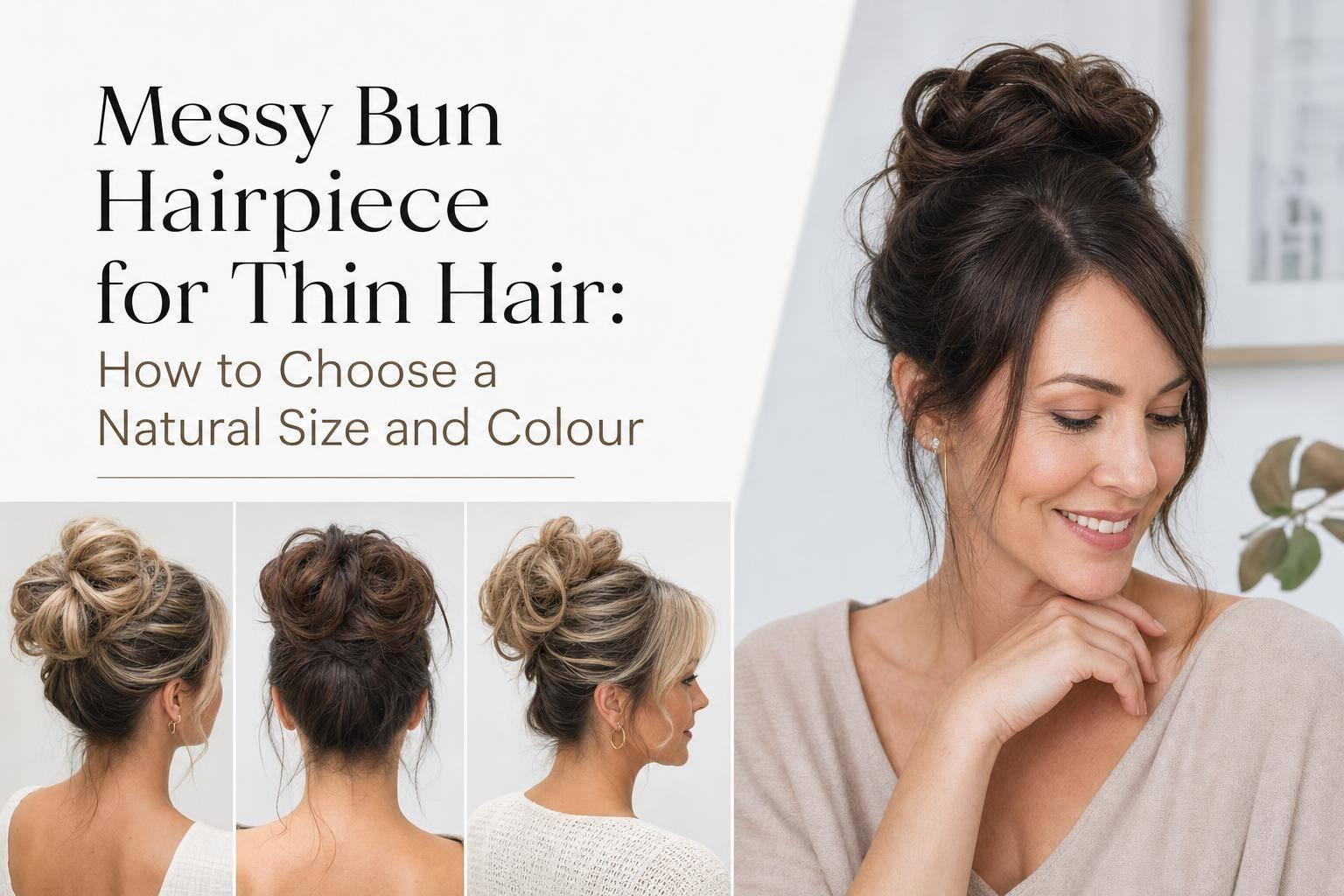
If your bun hairpiece looks too big or the colour is off, it will stand out fast. I’d keep it simple: pick a bun that ends up about 1.5 to 2 times the width of your own bun, match the shade to your mid-lengths and ends, and shape it with your fingers so it doesn’t look too round or stiff.
Here’s the short version:
- Start with your own bun size. Measure your bun across the middle in cm before you buy anything.
- Go smaller if you’re unsure. Thin hair usually looks better with a softer bun than a dense one.
- Use placement well. Put the piece over a small ponytail or bun and pin into the elastic, not into fine strands.
- Match colour in daylight. Check the shade in indirect natural light, not under warm indoor bulbs.
- If your hair has highlights or regrowth, choose a blended shade. A flat single colour can look too even in a textured bun.
- Shape it after you put it on. Lift small sections a few millimetres at a time for a softer finish.
One detail matters more than most people think: a bun hairpiece works on thin hair because the base is small, so your hairline and part still show. That helps the style look like your hair, not a separate piece.
MESSY BUN HACK FOR FINE & THIN HAIR! You Have To Try This!
sbb-itb-08feb2f
Quick comparison
| What to check | What I’d look for | What to avoid |
|---|---|---|
| Size | Finished bun about 1.5 to 2 times your own bun width | A bun that looks far too large for the ponytail under it |
| Shape | Soft, slightly uneven texture | A very round, dense, uniform bun |
| Colour match | Match to mid-lengths and ends | Matching to roots only |
| Shade type | Blended tones for highlighted or multi-tone hair | Flat solid shades when your hair has tone changes |
| Attachment | Stretch over a small bun and pin at the base | Pulling it tight over sparse areas |
If I wanted the most natural look on thin hair, I’d focus on just three things: size, placement, and colour.
Check your natural bun size before choosing a hairpiece
Before you start browsing hairpieces, pause for a minute and look at what your own hair does on its own. That’s the baseline. You’re not trying to build a giant bun out of nowhere. You want something that still looks like your bun, just with a bit more body.
How to measure your natural bun size
Brush your hair back and tie it into a mid or high ponytail with a standard elastic. Then twist the ponytail and wrap it into the smallest secure bun you can make. Pin it in place with a hair tie or a few bobby pins.
Next, measure the bun across its widest point in centimetres. Also pay attention to how it sits. Is it flat? Is it bulky? Can you see scalp through it? That little check tells you a lot.
Use that width as your starting point when choosing a hairpiece.
Why an oversized bun can look unnatural on thin hair
A bun tends to look off when the hairpiece is far bigger than the ponytail underneath. That mismatch is usually what gives it away.
A very dense bun can also look too round and too even. Real buns usually have a softer shape, with a few irregular bits and a little texture. That’s what makes them believable.
A good rule is to aim for a finished bun that’s about 1.5 to 2 times wider than your natural bun.
Bun size guide for Silkara messy buns
Use the table below to match your natural bun width to a Silkara size.
| Natural hair starting point | Natural bun width (approx.) | Recommended Silkara bun | Typical result |
|---|---|---|---|
| Short fine hair (jawline to collarbone) | 3–4 cm | Small messy bun - e.g. Silkara™ Secret Hair Instant Curly Messy Bun | Softly textured bun around 7–8 cm wide; gentle everyday fullness |
| Shoulder-length fine hair | 4–6 cm | Small to medium - e.g. Silkara™ Hair Messy Curly Hair Bun Top (thin variation) | Natural-looking bun around 8–9 cm; believable width without bulk |
| Medium-length, low-density hair | 5–7 cm with visible gaps | Medium-small - e.g. Silkara™ Hair Messy Curly Bun Star | Even coverage around 9–10 cm; fills sparse areas, suits daily wear |
Silkara’s smaller buns are made for subtle everyday fullness. The Bun Star, for example, weighs just 55 g, which makes it a lighter option for fine hair [2].
If you’re between sizes, go smaller. It’s much easier to add shape than deal with a bun that looks too big from the start.
Once the size is right, colour is the next step.
How to attach and shape the hairpiece on thin hair
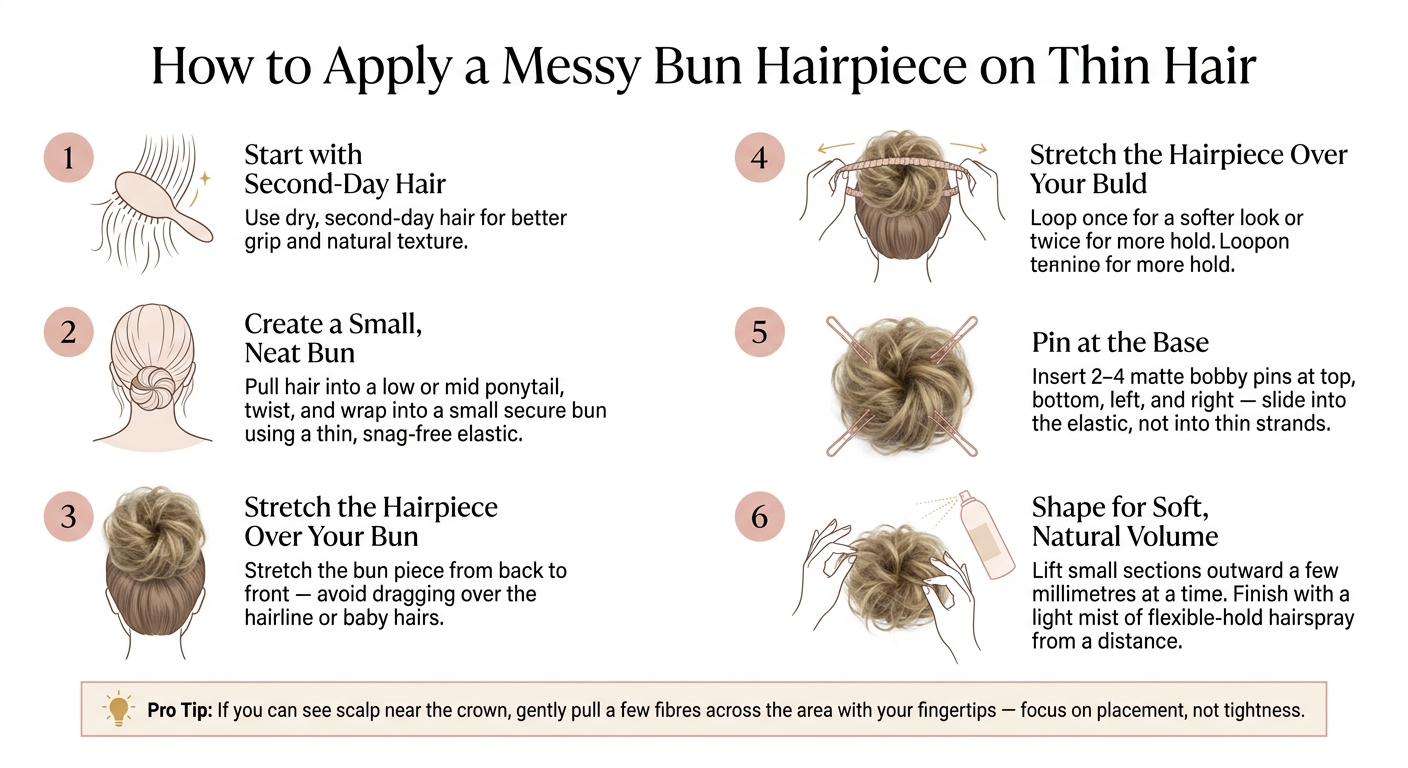
How to Apply a Messy Bun Hairpiece on Thin Hair: Step-by-Step Guide
Step-by-step application on a small bun
Once you’ve picked the right size, placement and shaping make the biggest difference to how natural the bun looks.
Start with dry, second-day hair and a thin, snag-free elastic. Pull your hair into a low or mid ponytail where it grips best, then twist it into a small, neat bun. Use a thin, snag-free elastic, as it tends to hold fine hair better. Keep the bun tidy, but don’t press it flat.
To attach the Silkara™ Secret Hair Instant Curly Messy Bun or a similar smaller option, stretch the bun piece over your bun from back to front. Don’t drag it over the hairline. That can mess up baby hairs and make sparse spots stand out more. Loop it once for a softer look or twice if you want more hold. Then add two to four matte bobby pins around the base, at the top, bottom, left, and right. Slide each pin into the elastic underneath, not straight into thin strands.
"Takes seconds to put on. People think its my own hair." - MS SHEILA TRIMBOLI [1]
How to shape the bun for soft, even fullness
After the hairpiece is in place, slide your fingers under the outer fibres and gently lift and spread small sections outward - left, right, top, and bottom - by only a few millimetres at a time. This helps spread the volume more evenly and gives the bun a softer, slightly uneven shape, which tends to look more like natural hair.
If you can see scalp near the crown or around the elastic, lightly pull a few fibres across that area with your fingertips. Think placement, not tightness. Pulling the hairpiece tighter often makes the part line look wider and can make thinning more obvious. Finish with a light mist of flexible-hold hairspray from a distance so the shape stays in place while the fibres still move softly.
Once the shape looks soft and secure, match the colour to your mid-lengths and ends.
How to choose a colour that blends with your hair
Once you’ve got the size right, colour does most of the heavy lifting. The goal isn’t a perfect match. It’s a close visual match that looks right at a glance. In a bun, twists and loops help blur small colour gaps. That’s why a shade can still work even if it’s not identical strand for strand. On fine hair, though, tone variation matters more. If the colour looks too flat, the bun shape can stand out.
Match the bun colour to your mid-lengths and ends
Match the bun to the hair that will sit around it, not to your roots. A simple way to do this is to tie your hair into the small bun you’d usually wear, then check the colour in indirect natural daylight. That gives you a better read on tone. Indoor lighting often makes hair seem warmer or darker than it is, which can throw the whole match off.
If you have highlights, balayage, greys, or hair that shifts tone on its own, focus on the main shade you can see through the outer layers. If your roots are darker than the rest of your hair, go with your lengths and ends. Once the bun is on, the roots are mostly tucked away anyway.
Solid shades versus blended shades: which looks more natural
With a messy bun, a single flat shade can sometimes look a bit too uniform. Real hair usually reflects light in slightly different ways across each section. A blended or dimensional shade mirrors that variation, so it tends to melt into the style more easily.
Here’s a simple guide:
| Colour Type | Best For | Visual Result |
|---|---|---|
| Solid shades | Hair that is one uniform tone from root to ends | Can look flat if the match is off |
| Blended / dual-tone | Highlighted, foiled, balayage, or naturally multi-tonal hair | Hides the join more easily |
| Ombre / dark-root, light-end shades | Hair with darker roots and lighter ends | Mimics a natural growth pattern or salon-style gradient |
If your hair is one steady brunette tone or a fairly even natural colour, a solid shade can work well. But for most women, blended shades tend to look softer in a textured bun. That’s especially true if your hair has highlights, sun-lightening, grey blending, or visible regrowth.
How Silkara Hair's colour matching support works
Picking a shade from a screen isn’t easy. Silkara Hair offers a free colour match service to make that part simpler. Send an unfiltered photo in natural light, and the team can suggest the closest shade. Selected products also come with AI virtual try-on.
Once the size and colour are right, the bun should read as your own hair at a glance.
Conclusion: Start small, blend the colour, and build confidence
If your natural bun is small, that’s your starting point. A messy bun hairpiece adds volume. It doesn’t need to change your hair shape or make it look overdone.
The main thing is keeping it natural. That usually comes down to three simple factors: size, placement, and colour. A smaller Silkara messy bun for finer hair can feel like the easiest place to start, especially if you want to ease into the look instead of going too big straight away.
Still not sure about the shade? Send a natural-light photo, and Silkara can help match your colour.
FAQs
Will a messy bun hairpiece work with very thin hair?
Yes. A messy bun hairpiece can work well for thin hair because it adds instant volume and makes your bun look fuller without much effort.
Silkara Hair’s pieces are lightweight, so they don’t feel heavy or awkward. They’re made to stay in place with elastic bands or clips, even if your natural bun is quite small. You also get extra texture, which helps your updo look thicker and more natural in seconds, without putting stress on your own hair.
How do I choose between two bun sizes?
Match the bun to the base of your natural bun so the extra fullness looks like it’s part of your own hair.
Silkara’s elastic messy bun hairpieces stretch to fit different bun sizes. If you’re between sizes, the smaller option will often look better on thin or small buns and can help you avoid a bulky finish. Set the adjustable band in place before you secure it, then blend and brush the hairpiece for an easy, natural-looking result.
What if my roots and ends are different colours?
A natural look is still easy to get. Silkara Hair offers a free colour match service to help make that part simple. Just send a photo of your hair, and the team can suggest the best shade or a blended option for a smooth match from roots to ends.
In many cases, blended shades look more natural than solid colours. They tend to give a softer finish with more depth, so the result feels less flat and more like your own hair.
Related Blog Posts
- Want Long Hair and Crown Coverage? How to Choose Between a Topper, Halo and Extensions
- Small Messy Bun vs Big Curly Chignon: Which Bun Extension Should You Choose?
- Best Hair Topper for Thinning at the Crown: How Much Coverage Do You Need?
- Hair Topper vs Wig for Thinning Hair: Which One Should You Buy?